
- India,
- 22-Aug-2026 08:52 PM IST



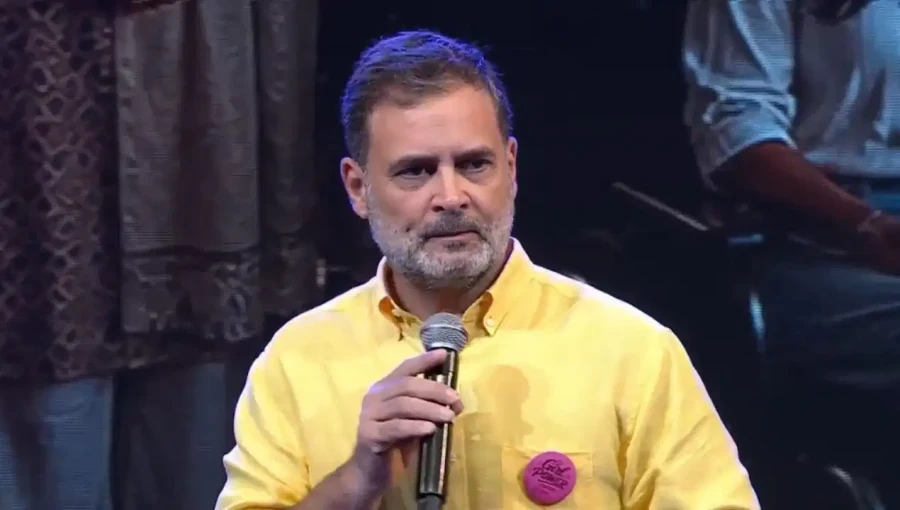
Leader of the Opposition in the Lok Sabha and Member of Parliament, Rahul Gandhi, visited Pune on Saturday to participate in the Chhatron Ki Goonj program, while during this event, he engaged in a deep and meaningful dialogue with female students, highlighting that the 70 crore women of India constitute the nation's greatest strength. He asserted that Nari Shakti (women power) is the true backbone of the country. However, he pointed out a significant societal issue where women are often confined to three specific roles: that of a wife, a daughter, and a mother. While he acknowledged that these roles aren't inherently wrong, he argued that limiting a woman's identity to these roles alone is a major problem in modern society.
Critique of Manusmriti and Women's Identity
Rahul Gandhi took a firm stand against the traditional interpretations found in the Manusmriti. He mentioned that according to the Manusmriti, a girl is considered the property of her father during childhood, belongs to her husband in her youth, and lives for her children in old age. Gandhi described these notions as shameful and outdated. He emphasized that women must be free and aren't dependent on anyone. He told the students that while they've relationships with their fathers, husbands, and sons, their identity isn't defined by these relationships, while he stated, "You've your own identity," urging the young women to recognize their individual worth and independence.
The Need for Freedom and Dialogue
Speaking at the event, Rahul Gandhi reiterated that it's essential for the girls of the country to be free. He clarified that his visit wasn't about politics but about giving the students a platform to speak. "I am not here to talk about politics today. Today, I will give you the opportunity to speak—share what you think and what you want. We will discuss the ideas you present," he said. This approach allowed for a candid discussion on the challenges women face in a patriarchal setup.
Understanding Patriarchy and Control
During the interaction, Rahul Gandhi posed a thought-provoking question to a female student: "Why does a man want to control a woman? " The student responded by saying that she views herself as a human being first. " She shared how she's often told that because she's a girl and beautiful, someone will marry her and she will lead a good life, implying that her success is tied to marriage rather than her own achievements.
The Trap of Control and Violence
Rahul Gandhi outlined what he called a "trap" consisting of four methods used by society to control women: violence, insult or humiliation, time, and control. " He pointed out that boys don't face such constant fear or restrictions. To highlight the gravity of the situation, he cited statistics, stating that daughters are killed even before birth and face exploitation outside their homes, while he mentioned that in India, 6 out of every 100 women are victims of rape.
Personal Struggles and Resilience
The discussion also brought forward personal stories of struggle. A student from Palghar shared her experience of facing harassment, while she revealed that her family members and relatives had pressured her to quit her studies, fearing that something wrong would happen if she went out. However, she credited her father for supporting her, which has allowed her to continue her education in Pune. Another student pointed out that while a son's demand for a share in property is seen as a right, a daughter's demand is often viewed as a favor. She noted that families often expect women to work a 9-to-5 job and then return home to handle all domestic chores and childcare, treating any rights given to them as an act of charity rather than an entitlement.