
- India,
- 11-Jul-2026 12:13 PM IST



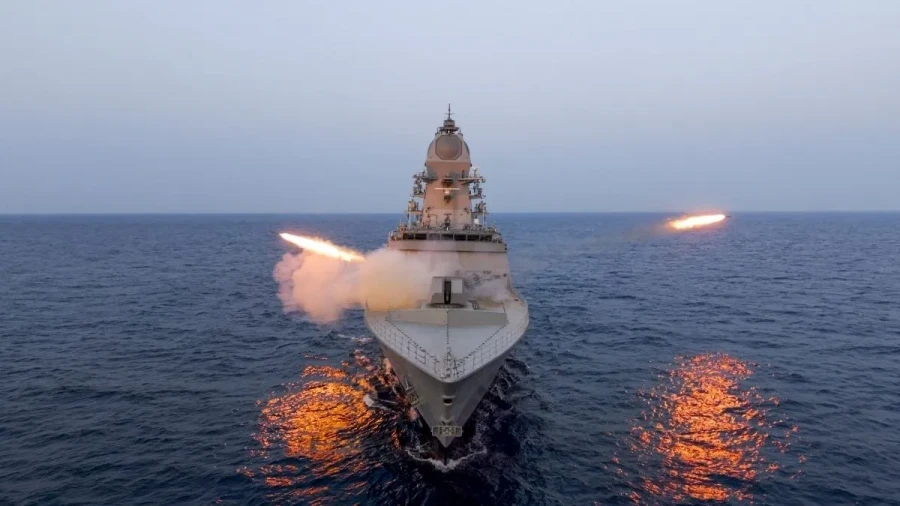
In a significant boost to India's maritime prowess, Defence Minister Rajnath Singh formally commissioned the indigenous stealth frigate INS Mahendragiri into the Indian Navy on Saturday. The commissioning ceremony took place at the Naval Dockyard in Visakhapatnam, where the Minister was accorded a traditional Guard of Honour. This induction marks a pivotal moment in India's journey towards self-reliance in defense manufacturing, showcasing the nation's growing capability to build sophisticated frontline warships. The vessel is designed to meet the evolving security challenges in the Indian Ocean Region and beyond.
A Masterpiece of Indigenous Engineering
INS Mahendragiri is the sixth stealth frigate of the Project 17A Nilgiri-class. It has been designed by the Indian Navy's in-house Warship Design Bureau (WDB) and constructed by the Mumbai-based Mazagon Dock Shipbuilders Limited (MDL). Notably, this is the fourth and final warship built by MDL under the Project 17A program. The vessel stands as a testament to the collaborative efforts of the Indian Navy and the domestic shipbuilding industry. Defence Minister Rajnath Singh emphasized that the commissioning of INS Mahendragiri is a moment of pride for the entire country and the Indian Navy. He stated that this modern warship is an excellent example of completely indigenous design and construction, serving as proof of the resolve for Atmanirbhar Bharat and the growing capacity of India's defense industries, including Micro, Small, and Medium Enterprises (MSMEs).
Symbolism and Strategic Importance
The warship is named after the Mahendragiri mountain range in the Eastern Ghats, symbolizing strength, determination, and unwavering resolve, while this is the first Indian Navy warship to bear the name Mahendragiri, adding a new chapter to India's maritime heritage. " The ship's induction is expected to Importantly enhance the Navy's operational reach and combat effectiveness.
Advanced Technical Specifications
INS Mahendragiri is equipped with over 75 percent indigenous content and technology. Its construction involved contributions from numerous Indian companies and a large number of MSMEs, which has not only strengthened the country's defense industrial framework but also created new employment opportunities. The frigate is a multi-purpose warship with a full load displacement of approximately 6,670 tons. It's powered by a Combined Diesel or Gas (CODOG) propulsion system, allowing it to achieve speeds of up to 28 knots, which is approximately 52 km/h. This propulsion system ensures high speed and long-range operational capabilities, making it suitable for various maritime missions.
Combat Capabilities and Stealth Features
The warship is armed with state-of-the-art indigenous weapons, sensors, and electronic warfare systems, while it's capable of simultaneously tackling threats from the air, enemy warships, and submarines. Beyond combat, INS Mahendragiri is prepared for maritime security, Search and Rescue (SAR) operations, and Humanitarian Assistance and Disaster Relief (HADR) missions. One of its most critical features is the advanced stealth technology, which reduces its radar cross-section, making it difficult for enemy radars to detect. The ship also features high levels of automation and improved safety systems, ensuring it remains a formidable force in the Indian Ocean Region (IOR).
Project 17A Milestones
The commissioning of INS Mahendragiri is a major milestone for the Project 17A program. Other warships in this class have already been integrated into the Navy, and the addition of Mahendragiri further solidifies India's position as a leading indigenous warship manufacturer, while rajnath Singh provided a timeline for other ships in the series, noting that INS Nilgiri was commissioned in January 2025, followed by INS Udaygiri and INS Himgiri in August 2025. Also, INS Taragiri is scheduled for April 2026, and INS Dunagiri is expected to join the fleet in June 2026. This systematic induction reflects the Navy's long-term vision for a modernized and self-reliant fleet.