
- India,
- 11-Jul-2026 08:39 AM IST



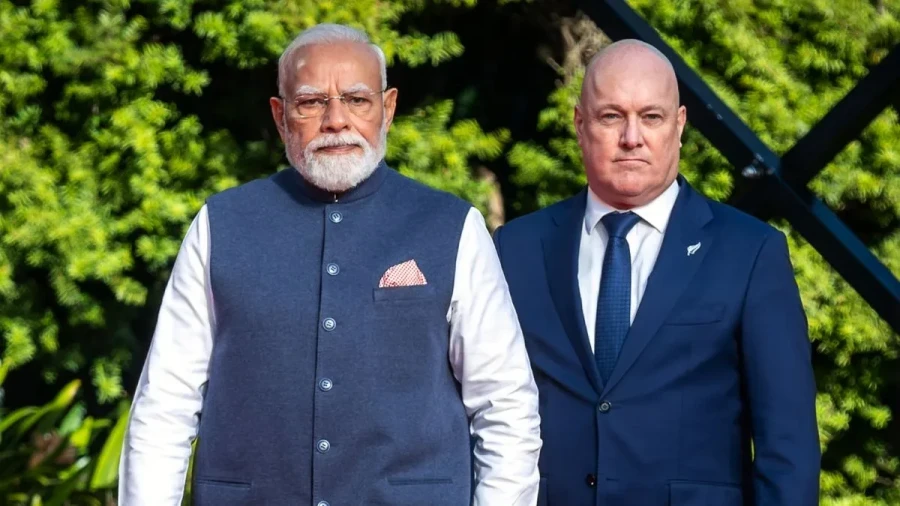
Prime Minister Narendra Modi's landmark visit to New Zealand entered its second day with a high-level bilateral meeting with New Zealand Prime Minister Christopher Luxon in Auckland. This visit is of immense diplomatic significance as it marks the first time in nearly 4 decades that an Indian Prime Minister has traveled to New Zealand. The day commenced with a formal ceremonial welcome for Prime Minister Modi, followed by a Guard of Honor, where he was accompanied by Prime Minister Luxon. The two leaders then engaged in extensive delegation-level talks to discuss various facets of the bilateral relationship and future cooperation.
Strengthening Strategic and Economic Ties
During the discussions, Prime Minister Modi emphasized that this visit has provided a fresh momentum to the relationship between the two nations, while he reiterated the commitment of both countries to further strengthen their strategic partnership. Key agreements were reached across several vital sectors, including defense, maritime security, education, investment, and sports cooperation. Prime Minister Modi expressed his gratitude to Prime Minister Luxon for organizing the event in the economic hub of Auckland, stating that it provided an opportunity to breathe new life into India-New Zealand relations after a long gap of 40 years.
The Historic Free Trade Agreement (FTA)
A major highlight of the meeting was the discussion on the India-New Zealand Free Trade Agreement (FTA), which Prime Minister Modi described as a historic milestone. He noted that the process for the FTA began during Prime Minister Luxon's previous visit to India. Modi praised the speed with which the agreement was finalized, calling it perhaps the first example in the world of such a rapid success. He thanked the New Zealand government and its team for their leadership in making the FTA a reality in such a short timeframe, which reflects the mutual trust between the two nations.
Impact of the FTA on Trade and Agriculture
The FTA, which was signed in April this year, is expected to usher in a new era of economic cooperation, while once fully implemented, tariffs on 95 percent of goods coming from New Zealand will be reduced or eliminated. From the very first day of the agreement, 57 percent of New Zealand's exports will become completely duty-free. On the other hand, tariffs on 100 percent of goods exported from India to New Zealand will be eliminated, providing a significant boost to Indian exporters. To protect the interests of Indian farmers, certain sensitive sectors such as dairy, sugar, apples, and some other agricultural products have been excluded from these tariff concessions.
A Win-Win Partnership for Prosperity
Prime Minister Christopher Luxon welcomed Prime Minister Modi, acknowledging India as one of the world's largest and fastest-growing economies. He stated that this visit is a celebration of a win-win partnership between the two countries, which is destined to bring prosperity and security to their people. The leaders reaffirmed that the friendship between India and New Zealand is built on shared values and mutual respect, setting the stage for deeper engagement in the coming years. This visit is seen as a turning point in the Indo-Pacific region's diplomatic landscape.