

- India,
- 21-Dec-2025 05:36 PM IST


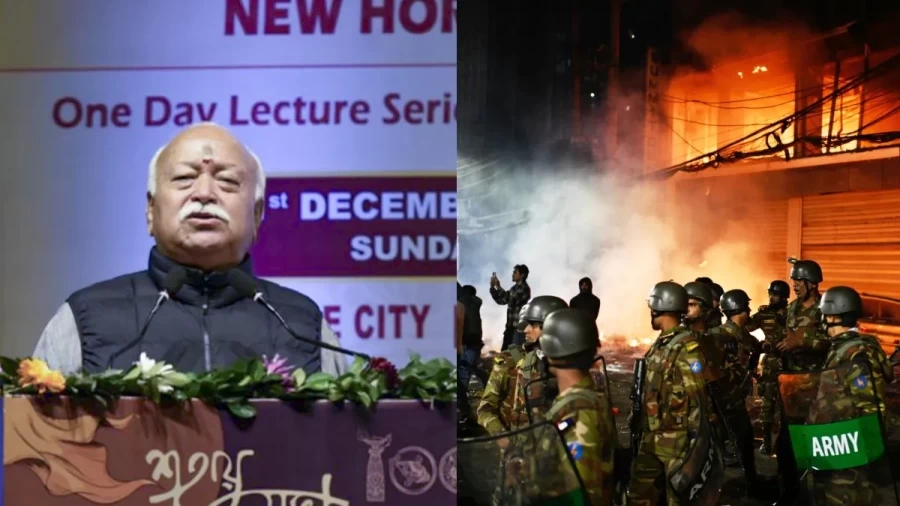
National Sawayamsevak Sangh (RSS) chief Mohan Bhagwat has broken his silence on the escalating violence and persecution targeting the Hindu community in Bangladesh. Speaking from Kolkata, the capital city of West Bengal, during a public event, Bhagwat. Delivered a significant statement addressing the severe challenges faced by Hindus across the border. His remarks come amidst a period of intense unrest in Bangladesh, where the Hindu minority has reportedly been subjected to continuous acts of aggression and injustice, including a recent horrific incident where a Hindu youth was tragically burned alive in public.
Acknowledging a Difficult Reality
During his address, Mohan Bhagwat openly acknowledged the grim reality confronting Hindus in Bangladesh. He stated unequivocally that the situation for the Hindu minority in the neighboring country is "quite difficult. " This candid admission underscores the severity of the crisis and the vulnerability of the community, which has been at the receiving end of widespread violence for several days. The RSS chief's statement highlights the urgent need for attention and action regarding the safety and well-being of these individuals who are struggling amidst a climate of fear and persecution.
A Call for Internal Unity Among Bangladeshi Hindus
In response to the challenging circumstances, Bhagwat offered counsel to the Hindu community within Bangladesh. He emphasized the critical importance of unity, stating that despite the. Inherent difficulties, "for maximum security, Hindus there will have to remain united. " This call for internal cohesion suggests that collective strength and solidarity are viewed as essential protective measures against the ongoing atrocities. The message is clear: a united front can potentially offer a degree of resilience and self-preservation in the face of adversity.
Global Hindu Support and India's Role
Extending his appeal beyond Bangladesh's borders, the RSS chief urged Hindus worldwide to come forward and assist their brethren. He articulated a clear directive: "And Hindus all over the world should help them. " On top of that, he specified India's particular responsibility, stating, "We, within our borders, should help them as much as possible. We've to do everything we can, and we're doing it. " This statement not only seeks to mobilize international Hindu solidarity but also reaffirms India's commitment and ongoing efforts to support the beleaguered community, even if some actions remain undisclosed.
Expectations from the Indian Government
Mohan Bhagwat also directly addressed the role of the Indian government in this crisis. He asserted that "India is the only country for Hindus," thereby placing a significant moral and protective responsibility on the nation, while he urged the Indian government to "take cognizance of this" and "do something. " While acknowledging that the government "may already be doing something," and that "some things have been revealed, some have not," he reiterated the imperative that "something has to be done. " This highlights the expectation for proactive and effective measures from the Indian state to safeguard the interests and lives of Hindus in Bangladesh.
The Power of Hindu Unity in Bengal
Shifting his focus to the broader region, Bhagwat remarked on the potential impact of Hindu unity. He stated, "If Hindu society unites, it won't take long for the situation to change in Bengal. " This observation, made while he was in Kolkata, suggests a belief in the transformative power of collective action and solidarity within the Hindu. Community, potentially hinting at a broader regional influence or a call for unity that could resonate across geographical boundaries to impact the situation positively.
Distinction Between Social and Political Change
Finally, the RSS chief clarified the nature of his organization's work. When questioned about his views on political change, he explicitly stated, "As far as my opinion on political change is concerned, I want to tell you that thinking about political change isn't my job. We're working for social change through the Sangh. " This distinction underscores the RSS's stated primary objective of fostering social transformation and unity, rather than directly engaging in political maneuvering, even while commenting on politically sensitive issues. His focus remains on strengthening the social fabric and empowering the community through unity and self-reliance.
