

- India,
- 22-Nov-2025 07:00 AM IST


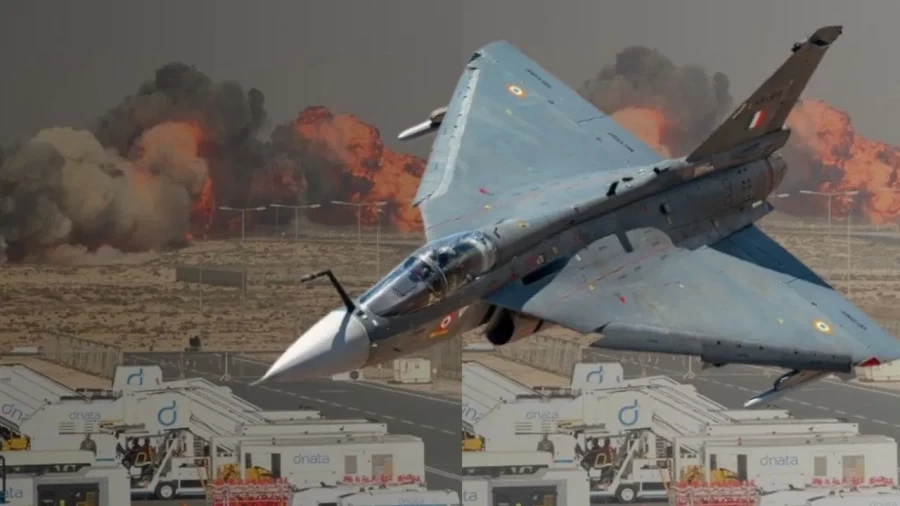
The tragic crash of India's indigenous Tejas fighter jet at the Dubai Air Show has sent shockwaves across the nation. The aircraft, which moments before was captivating audiences with its powerful roar and impressive aerial maneuvers, plummeted to the ground in an instant, transforming into a devastating fireball. This unfortunate incident has not only surprised defense experts but has also raised several critical questions in the minds of ordinary Indians. The most pressing query revolves around the extent of the economic loss incurred by the country and whether such expensive military aircraft are covered by insurance, similar to civilian vehicles. This event marks a setback for India's defense capabilities and the showcasing of its indigenous. Technology, while also highlighting the inherent risks and financial implications associated with operating military aircraft.
The Tragic Incident
According to media reports, the unfortunate incident occurred while the Tejas fighter jet was demonstrating its exceptional maneuverability and aerial acrobatics at the Dubai Air Show. Everything appeared to be proceeding according to plan during the flight, with the aircraft showcasing its speed and agility with remarkable precision. However, suddenly and unexpectedly, the aircraft lost its balance. Losing control, the jet began to descend rapidly towards the ground. Before spectators or air show officials could fully comprehend what was happening, the aircraft violently impacted the earth. The collision was so severe that a powerful explosion immediately followed, and the site was engulfed in thick plumes of smoke and towering flames, while tragically, the pilot operating the aircraft lost their life in this horrific accident, making the event even more heartbreaking.
Assessing the Cost of a Tejas Jet
From an economic perspective, the crash of the Tejas fighter jet at the Dubai Air Show represents a significant blow to the nation's treasury. Naturally, the question arises: what was the actual value of the wreckage now scattered across the Dubai ground, while to accurately estimate the cost of a Tejas, one must look at recent defense procurement deals. Just a few months prior, the Indian government finalized a substantial agreement with Hindustan Aeronautics. Limited (HAL) for the acquisition of 97 Tejas Mk-1A jets, valued at approximately ₹62,370 crore. If this total sum is divided by the number of aircraft, the average cost of a single Tejas jet comes out to roughly ₹680 crore, while this figure provides a clear indication of the overall expense associated with one such advanced aircraft.
However, according to older data from HAL, the cost of the airframe alone is approximately ₹309 crore. But a fighter jet is far more than just a structure of metal and fiber. It incorporates numerous state-of-the-art and complex systems. The total cost includes advanced radar systems, various weapon systems, sophisticated software, the essential ground support systems required for its successful operation, and spare parts. When the costs of all these components are added to the airframe price, the total value of the aircraft escalates from ₹309 crore to around ₹680 crore. This demonstrates that the price of a fighter jet encompasses not only its physical structure but also. The high technology and auxiliary equipment integrated within it, making it a highly valuable and complex asset.
Insurance for Military Aircraft: The 'Sovereign Risk' and 'Self-Insurance' Model
When we're involved in an accident with our personal car or bike, the insurance company typically covers the damages, while it's So natural to wonder if any insurance company will compensate for this massive loss of ₹680 crore. The straightforward answer is no. The world of military aircraft is fundamentally different from that of commercial flights or private vehicles. According to reports and defense experts, no external or private insurance policy is taken out for indigenous fighter jets like the Tejas. The primary reasons behind this are the concepts of 'Sovereign Risk' and the 'Self-Insurance' model, which are applicable to military assets. The rule dictates that as long as the aircraft is within the Hindustan Aeronautics Limited (HAL) factory or undergoing test flights, its responsibility and insurance lie with HAL. If an accident occurs during this period, HAL is accountable. However, once the aircraft is officially handed over to the Indian Air Force (IAF), it becomes a sovereign asset of the nation. The risks associated with equipment used for national security and combat operations are so high and unpredictable that no ordinary private insurance company is willing to cover them.
The risks of accidents during war, training exercises, or demonstration flights are exceptionally high, which commercial insurance companies can't bear. Because of this, once an aircraft is inducted into the Indian Air Force and subsequently crashes, the entire financial burden must be borne by the Government of India itself. This is referred to as 'Self-Insurance,' meaning the government acts as its own insurer for its military assets. This model ensures that the nation's defense capabilities aren't constrained by the terms or limitations. Of an external insurance company, and the government directly manages the risks associated with its strategic assets. It's a matter of national security where the financial risk is directly assumed by the nation.
