

- India,
- 20-Feb-2026 09:59 AM IST


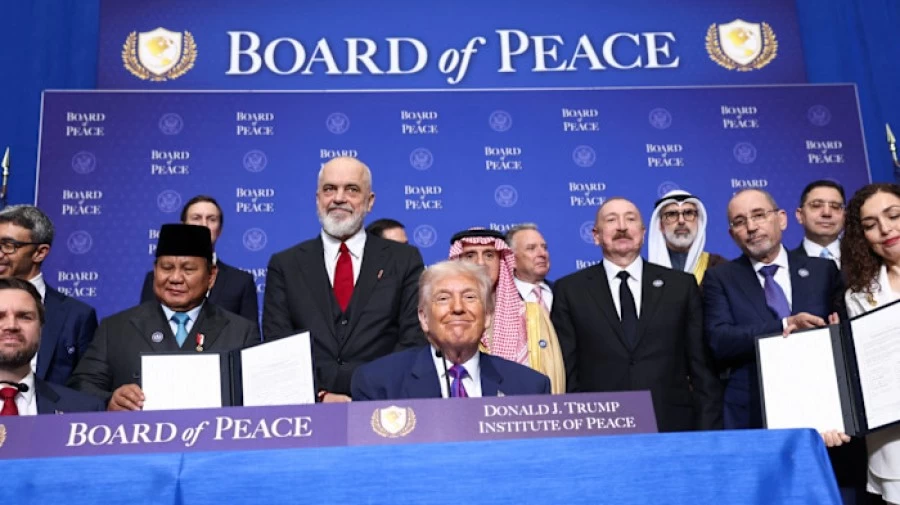
US President Donald Trump has made a significant claim regarding international diplomacy during the 'Board of Peace' event in Washington. Trump stated that he averted a major military escalation between India and Pakistan by threatening to impose a 200% tariff on both nations. According to the President, this economic benefit from was the primary factor that compelled both countries to cease hostilities and return to the negotiating table. He emphasized that the situation at the time was critical, with aerial combat already underway.
Economic Leverage and the 200% Tariff Warning
Addressing the gathering, Donald Trump detailed his intervention during the height of the bilateral tension. He claimed to have contacted Prime Minister Narendra Modi and the Pakistani leadership, delivering a clear ultimatum. Trump stated that he informed both leaders that if the fighting didn't stop immediately, the United States would terminate all trade agreements and implement a 200% import duty on their goods. According to Trump, while both nations appeared prepared for a prolonged conflict, the prospect of severe economic damage led them to agree to a ceasefire.
Claims Regarding Downed Fighter Jets and Casualties
During his speech, Trump cited specific figures related to the military engagement. He claimed that 11 expensive fighter jets were shot down during the period of active conflict. However, the President didn't specify the nationality of these aircraft or the exact dates of these incidents. Trump further asserted that the Pakistani Prime Minister had acknowledged to his Chief of Staff that Trump's intervention saved approximately 25 million lives. He noted his close personal rapport with PM Modi as a key element in managing the crisis through direct communication.
Background of the Pahalgam Attack and Military Response
The context of this escalation traces back to an incident on April 22 last year, when 26 Indian tourists were killed in an attack in Pahalgam, Kashmir. In response, the Indian military conducted operations on the night of May 6 and 7 against terror camps located in Pakistan and Pakistan-occupied Kashmir (PoK). Targets included facilities in Bahawalpur and Muridke in Pakistan's Punjab province. Following this, on May 8, Pakistan attempted to target India's air defense systems using drones sourced from Turkey and China, though these attempts were reportedly neutralized by the Indian Air Force.
The Board of Peace Initiative and Global Diplomacy
Trump also elaborated on the 'Board of Peace' initiative, which he first proposed in September 2025 to address the conflict in Gaza. The US has reportedly invited around 60 nations to join this board. According to the charter, countries seeking membership for more than three years are required to contribute $1 billion. Trump serves as the chairman of this board. He clarified that the body aims to resolve global conflicts in coordination with the United Nations, asserting that while the UN has great potential, it has not been fully utilized in recent years.
Upcoming China Visit and Relations with Xi Jinping
Regarding China, Trump announced his intention to visit the country in April, highlighting his relationship with President Xi Jinping. He recalled his previous visit to China, praising the discipline of the Chinese military and the scale of the reception he received. Trump expressed a desire to maintain a constructive relationship with the Chinese leadership. The President's remarks suggest that the Board of Peace will play a central role in his administration's approach to global stability, even as some international observers raise questions about its impact on traditional UN-led diplomacy.
