
- India,
- 12-Nov-2026 07:02 PM IST



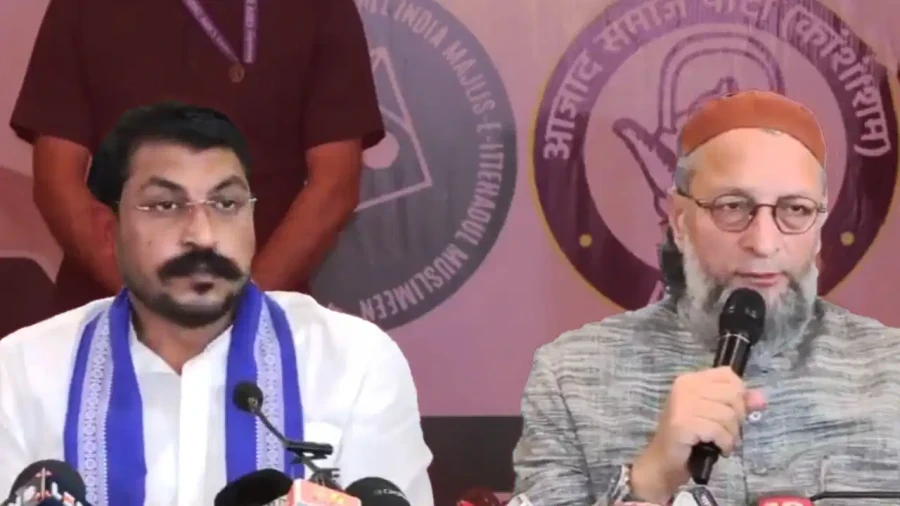
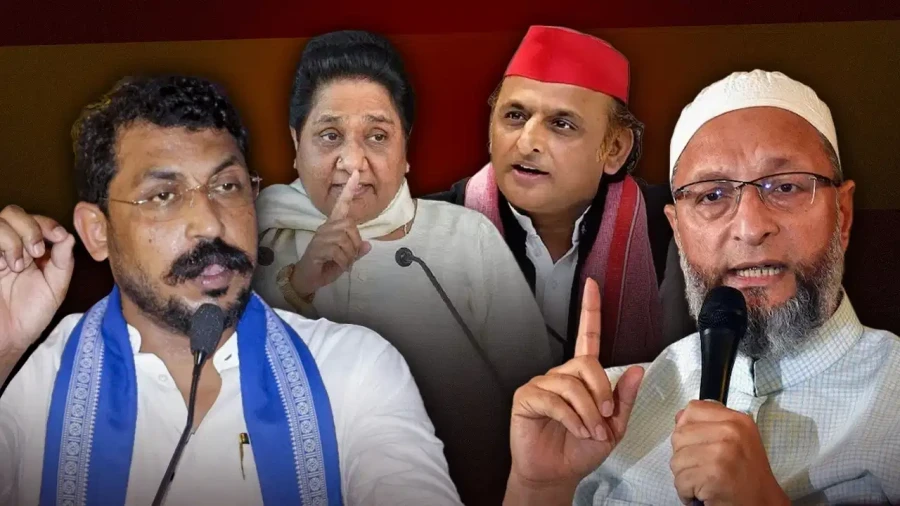
In the political corridors of Uttar Pradesh, discussions regarding the upcoming 2027 assembly elections have already intensified, and a new political front has emerged prominently on the electoral chessboard. Asaduddin Owaisi, the chief of All India Majlis-e-Ittehadul Muslimeen, and Chandrashekhar Azad, the president of Azad Samaj Party, have officially joined hands, Notably elevating the political temperature in the state, while this newly formed political alliance has been named the 'Samajik Parivartan Morcha'. While the stated objective behind the formation of this front by both leaders is to oust the Bharatiya Janata Party from power, political analysts believe that Samajwadi Party chief Akhilesh Yadav is primarily and most heavily in their crosshairs. The core reason behind this entire political development is quite transparent, as the Samajwadi Party has historically held a strong claim over the Muslim votes in Uttar Pradesh, while Chandrashekhar Azad aims to carve out an independent space for himself in Dalit politics, directly challenging Mayawati's dominance. Consequently, a major question has arisen as to whose political ground this new alliance will disrupt more within the opposition rather than threatening the ruling BJP.
A Direct Challenge to Akhilesh Yadav and PDA Politics
Asaduddin Owaisi's political ambitions in Uttar Pradesh are certainly not new, as he has remained active in the state for quite some time. He has consistently cornered the Samajwadi Party on critical issues concerning Muslim leadership and appropriate political representation. Owaisi's primary accusation has been that the Samajwadi Party extensively utilizes Muslim votes during electoral cycles but fails to grant them their due and rightful share when it comes to sharing power. On the other hand, Chandrashekhar Azad has also been posing a stiff challenge to Akhilesh Yadav's much-touted PDA politics, representing backwards, dalits, and minorities. Azad's sharp and direct question is how merely paying lip service to dalits and minorities will ever lead to their genuine political empowerment. In reality, both Asaduddin Owaisi and Chandrashekhar Azad have fixed their keen gaze firmly upon the exact same social base that Akhilesh Yadav considers the bedrock and ultimate strength of his PDA formula. The very first and most intense political conflict of this newly forged alliance is visibly manifesting right here in the electoral arena.
Electoral Statistics and Past Performance of Parties
If we examine past electoral data, during the 2022 Uttar Pradesh assembly elections, Asaduddin Owaisi's party AIMIM fielded its candidates across 95 constituencies. 49 percent and failed to secure a single legislative seat in the assembly. 13 percent. Chandrashekhar himself contested the assembly election from the Gorakhpur Urban constituency against Chief Minister Yogi आदित्यनाथ and suffered a crushing defeat, managing to secure a paltry 7,640 votes. This previous electoral performance of both parties clearly highlights their underlying political limitations and ground realities. However, a completely new dimension and transformation emerged during the 2024 Lok Sabha elections, capturing widespread attention.
Nagina Lok Sabha Victory and Rising Stature of Azad
During the general Lok Sabha elections in 2024, Chandrashekhar Azad registered a resounding victory from the Nagina reserved parliamentary constituency in Uttar Pradesh, thus securing his entry into Parliament. In this high-stakes election, he garnered a total of 5,12,552 votes, whereas the rival BJP candidate secured 3,61,079 votes. Consequently, Chandrashekhar's winning margin exceeded a massive one lakh and fifty thousand votes. In this crucial election, the Bahujan Samaj Party managed to secure a mere 13,272 votes in this constituency. This resounding victory in Nagina Notably elevated Chandrashekhar Azad's political stature overnight, earning him an independent and formidable identity within Dalit politics. His active and aggressive outreach, particularly amongst the youth demographic of the state, became a major talking point. Nevertheless, political experts argue that the overall mood and inclination of dalit voters across all 75 districts of Uttar Pradesh can't be comprehensively gauged through the election results of just a single parliamentary seat.
A Fresh Political Challenge Evolving for Mayawati
Chandrashekhar Azad's sharp sights are firmly set on Mayawati's traditional dalit vote bank in Uttar Pradesh. 88 percent of the total votes, although the party had to content itself with winning just a single assembly seat. The strongest and most foundational support base for the BSP has historically come from Jatav voters, and notably, Chandrashekhar Azad himself belongs to this very Jatav community. Through the organizational network of the Bhim Army and the Azad Samaj Party, he has successfully cultivated a deep space among the youth across the state. However, on the flip side, Mayawati's extensive organizational apparatus and her decades-old political foundation remain firmly intact on the ground. Also, the dalit electorate isn't entirely unified and remains fragmented across various sub-groups, while the political inclinations and preferences of Jatav and non-Jatav communities generally tend to vary Importantly. It remains to be seen in the future how successfully Chandrashekhar can translate his Nagina electoral success into state-wide dalit support.
The Ultimate Test of Muslim Votes for Owaisi
The Muslim community constitutes approximately 19 percent of the total population in Uttar Pradesh. In several crucial districts and assembly segments across Western Uttar Pradesh, Rohilkhand, and the Terai regions, these Muslim voters hold a highly influential and decisive position. Asaduddin Owaisi aims to expand his party and politics precisely among this demographic. However, a very large and decisive segment of Muslim voters in Uttar Pradesh traditionally prioritizes a party possessing the direct capability to defeat the Bharatiya Janata Party over the personal appeal of any individual Muslim leader. Ever since the historic era of the Babri Masjid demolition, the unwavering trust of Muslim voters has predominantly rested with the Samajwadi Party. The strong amalgamation of Muslim voters alongside other backward caste communities during the 2024 Lok Sabha elections delivered historic success to the SP-Congress alliance in the state. Consequently, the biggest and most formidable challenge before Asaduddin Owaisi is to convince Muslim voters credibly that his new coalition with Chandrashekhar Azad can genuinely dislodge the BJP from power, while 49 percent vote share secured by his party in the 2022 elections clearly indicates that he still has to undertake extensive efforts and cover a long political journey to establish firm footing in Uttar Pradesh.
Akhilesh Yadav's Loss and Potential Gains for the BJP
While the question of what this new alliance between Owaisi and Chandrashekhar can independently achieve is significant, an even larger and more critical question is how deeply they can impact the electoral performance of the state's two primary political forces, namely the BJP and the SP. 88 percent of the vote share. Under such circumstances, any fragmentation of opposition votes is bound to severely influence electoral outcomes across numerous constituencies. If Asaduddin Owaisi manages to siphon off a fraction of Muslim votes and Chandrashekhar Azad diverts a portion of dalit votes away from the Samajwadi Party, Akhilesh Yadav's electoral difficulties will multiply. It can't be denied that this internal political friction could deliver direct and substantial political dividends to the Bharatiya Janata Party. Although this new front possesses the capacity to attract a segment of BSP votes as well, its primary challenge lies in convincing the electorate that its true objective is winning elections rather than merely splitting anti-BJP votes.
A New Electoral Formula of Social Transformation
Asaduddin Owaisi and Chandrashekhar Azad harbor high hopes of orchestrating a major political transformation in the state through a unique formula of dalit-Muslim unity, while when the total population of both these communities is combined, they constitute roughly 40 percent of the state's population. However, the foremost and most critical question is whether both communities genuinely place complete trust in these leaders. Political analysts maintain that mere demographic arithmetic alone never automatically translates into a definitive tally of electoral votes. Achieving this requires an effective shared leadership, a solid organizational structure, grassroots local acceptability, and deep-seated trust among the public. The strategic decision to declare Chandrashekhar Azad as the chief ministerial face of this front is primarily driven by the calculated hope of attracting dalits on a large scale. Even though the Samajik Parivartan Morcha persistently rhetoricizes halting the BJP, its immediate and greatest challenge on the ground is carving out its own space within the opposition ranks. The front must establish its political turf right between Akhilesh Yadav's PDA politics and Mayawati's Bahujan support base. It remains to be seen how seriously the anti-BJP voter in Uttar Pradesh will treat this new political experiment and front in the 2027 assembly elections. It's virtually certain that, even more than the BJP, the Samajwadi Party and the Bahujan Samaj Party will remain fiercely aggressive against this new front, leaving no stone unturned in branding it as the B-team of the BJP.