

- India,
- 15-Mar-2026 05:15 PM IST


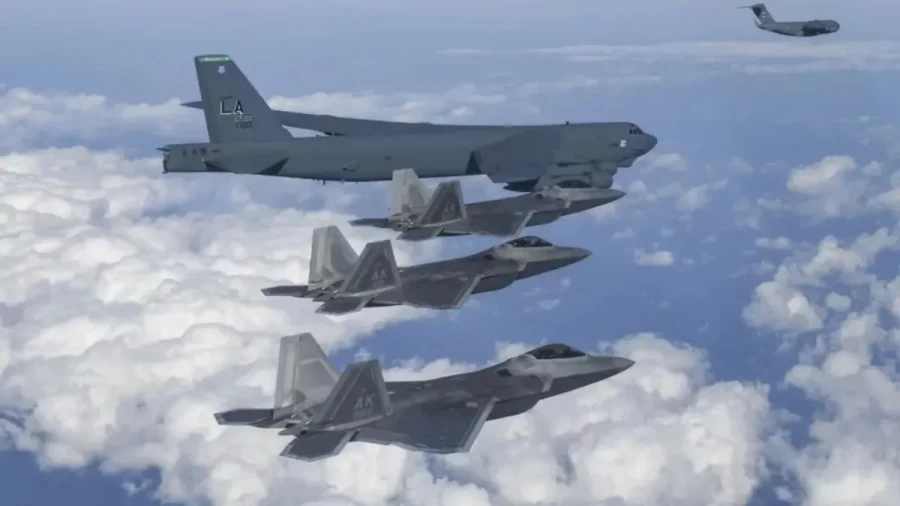
' According to defense officials, these aircraft represent a critical component of the US military strategy to degrade Iran's strategic capabilities, while the deployment follows a series of escalations in the Middle East, involving direct confrontations between Israel and Iran. The B-52, a long-standing symbol of American air power, has been integrated into the mission to provide heavy-lift strike capabilities and long-range endurance.
Strategic Deterrence and Nuclear Triad
The B-52 Stratofortress is a cornerstone of the United States' Nuclear Triad, alongside land-based ICBMs and submarine-launched ballistic missiles. It's specifically designed to carry a wide array of nuclear gravity bombs and cruise missiles, such as the AGM-86 ALCM. While current operations against Iran have utilized conventional munitions, the bomber's nuclear readiness serves as a strategic deterrent against further escalation. Its ability to operate globally ensures that the US maintains a credible air-based nuclear option, reinforcing its commitment to regional security and deterrence.
Technical Specifications and Payload Capacity
Renowned for its massive payload capacity, the B-52 can carry approximately 70,000 pounds (32 tons) of diverse weaponry. This includes precision-guided munitions (PGMs), Joint Direct Attack Munitions (JDAMs), cruise missiles, and conventional gravity bombs. The aircraft features an operational ceiling of 50,000 feet and a combat range exceeding 14,000 km without refueling. Its 'stand-off' capability is particularly significant, allowing it to launch precision strikes from distances well outside the reach of enemy air defense systems, thereby minimizing risk to the crew and the airframe.
Execution of Operation Epic Fury
Since the commencement of 'Operation Epic Fury' on February 28, B-52 bombers have been instrumental in striking high-value targets within Iran. Reports from US Central Command (CENTCOM) indicate that the bombers have targeted ballistic missile launch sites, command and control facilities, and strategic storage depots. In the first 100 hours of the campaign, over 2,000 targets were engaged by a combined force of B-52, B-1, and B-2 bombers. These missions are designed to systematically dismantle the infrastructure required for Iranian regional military operations.
Logistics and Basing at RAF Fairford
Currently, three B-52 bombers are operating out of RAF Fairford in the United Kingdom, serving as a forward-deployed hub for missions into the Middle East. These long-duration flights are supported by a strong network of aerial refueling tankers, enabling the bombers to reach targets deep inside Iranian territory. Officials state that the initial phases of the air campaign focused on suppressing Iranian Integrated Air Defense Systems (IADS), which has subsequently allowed the large, non-stealthy B-52s to operate with a higher degree of freedom in contested airspace.
Impact on Iranian Military Infrastructure
The deployment of B-52s has resulted in substantial damage to Iran's military architecture. The use of heavy conventional munitions has been particularly effective against hardened targets and underground facilities, while military analysts note that the primary objective is to neutralize Iran's ability to launch large-scale missile barrages. Despite Iranian claims of intercepting incoming threats, the persistent presence of B-52s over the region underscores the significant shift in the military balance. The aircraft, despite its 1950s origins, remains a formidable asset due to continuous technological upgrades to its avionics and weapons systems.
