
- India,
- 03-Nov-2026 08:49 AM IST



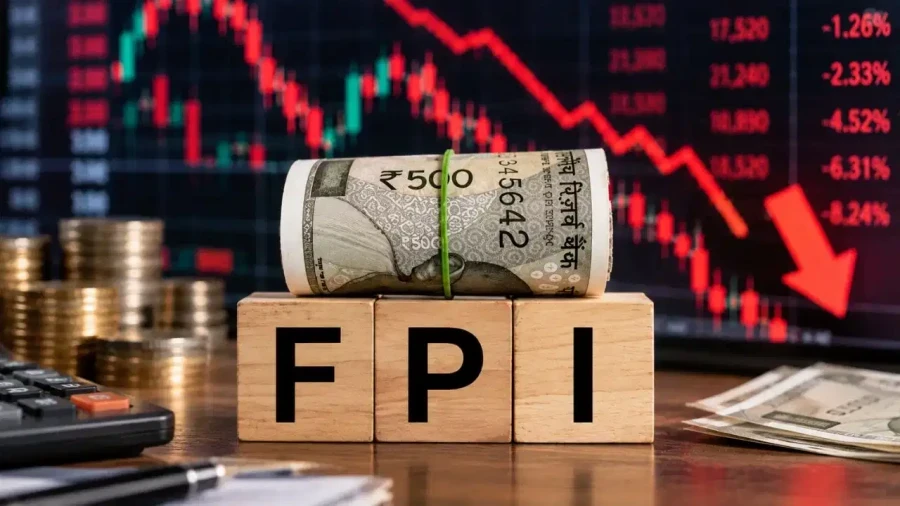
According to a recently released comprehensive report by JM Financial, foreign institutional investors, commonly known as FIIs, have continued to maintain a significant distance from the Indian equity market despite attractive valuations and a notable drop in share prices. Over the past two years, foreign investors have pulled out a staggering sum of approximately 64 billion dollars from Indian equities. This unprecedented trend has sparked widespread debate and raised critical questions among market participants and financial analysts regarding why foreign funds are failing to stage a meaningful comeback despite highly appealing valuations and enhanced corporate earnings prospects. This detailed report dives deep into the core macroeconomic and international factors responsible for this prolonged exit.
Record Outflow of Sixty Four Billion Dollars in Two Years
2 billion dollars. Following this massive sell-off, an additional outflow of roughly 5 billion dollars was recorded during the month of October alone, pushing the total capital withdrawal to approximately 64 billion dollars. A comprehensive review of financial data spanning the past two decades clearly indicates that this represents the longest and largest continuous selling streak by foreign entities in the history of the Indian capital market. 7 billion dollars in fiscal year 2027 including the October sell-off. The departure of such colossal capital underscores that cheap share prices and depressed valuations alone are proving insufficient to attract foreign investors back into the domestic fold.
Crude Oil Prices and Disillusionment of Foreign Funds
The JM Financial report strongly emphasizes that the price of Brent crude oil serves as a vital and decisive benchmark governing foreign investment flows into the country, while historical data reveals that whenever Brent crude prices have sustained above 105 dollars per barrel, FIIs have consistently resorted to aggressive selling. Conversely, when crude prices retreat below 90 dollars per barrel, the selling pressure begins to subside Importantly. By the end of October, the price of Brent crude hovered around 115 dollars per barrel, remaining remarkably higher than the threshold required to trigger any substantial return of foreign capital. Over the past two decades, this inverse correlation between crude prices and FII capital movement has grown increasingly pronounced and critical for market stability.
Cheaper Nifty and the Lagged Impact of Valuations
8 percent. 8 times multiple recorded back in September 2024, at which point the earnings yield was restricted to a mere 4 percent. Detailed analysis conducted by JM Financial establishes that while market valuations undoubtedly matter, their direct impact materializes with a noticeable time lag. The earnings yield recorded in any specific month demonstrates a very weak concurrent relationship with the FII flow observed in that exact same month; however, it exhibits a strong positive correlation with capital flows occurring four to five months later. This structural relationship has strengthened considerably since the year 2021.1 billion dollars.
Economic Growth and the Resilience of Corporate Earnings
Intriguingly, India strong economic growth trajectory has completely failed to halt this massive wave of FII outflows. 4 billion dollars during this exact timeframe. Historical precedents cited within the report highlight this disconnect even more vividly. 2 billion dollars. 8 billion dollars, marking the single largest quarterly outflow recorded within this entire dataset.
Earnings Improvement Does Not Guarantee Immediate Trend Reversals
Corporate earnings and profitability within the Indian listed universe have also shown steady improvement. 6 percent for the second quarter. 9 percent in fiscal year 2028. Despite these positive fundamentals, corporate earnings growth shares only a mild positive relationship with FII flows, while while superior profit-generating capability can certainly make domestic market valuations appear attractive and reasonable, this single factor alone is inadequate to trigger an immediate shift in investment trends.
Why Oil Remains the Primary Catalyst of Macroeconomic Stress
An examination of data spanning the last twenty years reveals that since 2016, there have been seven distinct months where the average price of Brent crude breached the threshold of 105 dollars per barrel. 1 billion dollars from the domestic market. In stark contrast, whenever Brent crude traded below 75 dollars per barrel, India witnessed a consistent monthly net inflow averaging between 700 million and 900 million dollars. 5 billion dollars in the corresponding month. Consequently, the report identifies two critical price thresholds for crude oil. To steer clear of the danger zone, Brent crude must retreat below 105 dollars per barrel, while a drop below 90 dollars per barrel would represent a massive step toward establishing a neutral and stable macroeconomic environment.
The Role of the Rupee and Domestic Institutional Support
Conventional wisdom often assumes that currency movement plays a dominant role in steering foreign investment flows, while however, JM Financial detailed analysis uncovers a surprising reality, demonstrating that the actual mechanism works largely in reverse. While the trajectory of the rupee in the upcoming month can be reasonably anticipated based on prior FII investment patterns, historical currency fluctuations can't accurately predict future FII fund movements. Analysts note that the rupee acts Basically like a thermometer rather than a controlling lever capable of steering capital flows. Meanwhile, despite such monumental FII sell-offs, the Indian stock market has managed to evade any catastrophic collapse, while this resilience is primarily attributed to domestic institutional investors, or DIIs, who have aggressively absorbed the massive brunt of foreign selling. 4 billion dollars channeled through mutual funds, while FIIs offloaded 39 billion dollars in the secondary market during the exact same period. 3 billion dollars against a secondary market FII sell-off of 32 billion dollars. 2 percent by June 2026.9 percent, eventually surpassing foreign investors in December 2024. Nevertheless, while strong domestic buying has provided vital structural support to the market, it has failed to stimulate any broad-based recovery in foreign participation.
Outlook and Probable Scenarios for Foreign Investor Return
According to JM Financial baseline scenario, there is a 45 percent probability that Brent crude oil prices will continue fluctuating within the range of 100 dollars to 115 dollars per barrel moving forward. Under this specific scenario, while domestic equity valuations will offer fundamental support, elevated oil prices will cap the overall market upside. Consequently, the period spanning January to March 2027 could witness the first sustained three-month streak of net capital inflows into the country. Under these prevailing conditions, the brokerage estimates that India could attract foreign inflows ranging between 15 billion dollars and 20 billion dollars in fiscal year 2027, followed by 10 billion dollars to 15 billion dollars in fiscal year 2028. Should geopolitical tensions in West Asia de-escalate Notably, this recovery timeline could accelerate, potentially unlocking inflows between 20 billion dollars and 25 billion dollars through fiscal year 2028. Conversely, if regional conflicts escalate further, this projected market recovery could face prolonged delays, resulting in an estimated capital outflow of roughly 10 billion dollars across fiscal year 2028.