

- India,
- 27-Jan-2026 08:48 AM IST


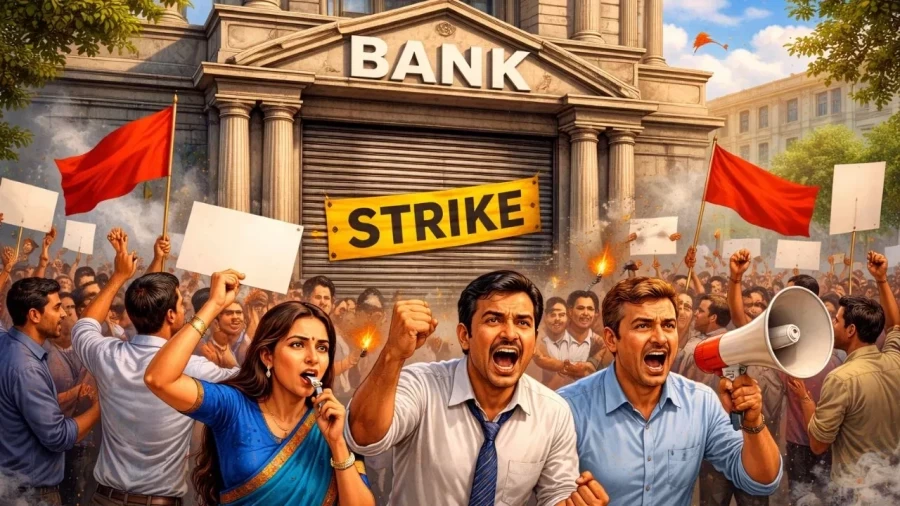
The banking sector in India is facing a massive operational halt today, January 27, as public sector bank employees have launched a nationwide strike. Orchestrated by the United Forum of Bank Unions (UFBU), an umbrella body of nine major unions, the protest is centered around the long-standing demand for a five-day work week. This move comes as a significant blow to financial activities, especially since it. Follows a long weekend where banks were already closed for Sunday and Republic Day.
The Deadlock in Negotiations
The decision to go on strike was finalized after a crucial reconciliation meeting on January 23 failed to yield results, while the meeting, held in the presence of the Chief Labour Commissioner, involved representatives from the Indian Banks' Association (IBA) and the UFBU. Despite hours of deliberation, the government and IBA representatives didn't provide a concrete timeline or assurance for implementing. The 5-day work week, leaving the unions with no choice but to demonstrate their collective strength through a strike.
Why the 5-Day Work Week Matters
Union leaders, including C H Venkatachalam of AIBEA and Rupam Roy of AIBOC, have argued. That a five-day banking structure isn't a luxury but a necessity in the modern era. They pointed out that during the 12th bipartite wage settlement discussions in March 2024, there was a preliminary understanding that all Saturdays would be declared holidays, while to compensate for the loss of working hours, employees have even agreed to extend their daily working hours by 40 minutes from Monday to Friday. This compromise ensures that the total banking hours remain unchanged while providing employees with much-needed rest and work-life balance.
Impact on Public and Private Banking
The strike is predominantly affecting public sector banks like State Bank of India (SBI), Punjab National Bank (PNB), and Bank of Baroda. Services such as cash withdrawals, cheque clearances, and administrative tasks at these branches are likely to remain suspended, while on the other hand, major private sector lenders like HDFC Bank, ICICI Bank, and Axis Bank are expected to function normally. However, customers might still face issues with inter-bank transactions and cheque processing that involve public sector entities. Localized ATM outages are also a concern due to the three-day gap in cash replenishment services.
The Road Ahead for the Banking Sector
This strike is a clear signal to the government that bank employees are united in their quest for better working conditions. The UFBU has hinted that if their demands aren't met, they might escalate the protest to an indefinite strike. For the common man, this highlights the growing friction between the workforce and the management in one of the country's most vital sectors. As the day progresses, the focus remains on how the Ministry of Finance responds to this nationwide outcry and whether a middle ground can be reached to prevent further disruptions in the future.
