

- India,
- 10-Jul-2025 07:20 AM IST


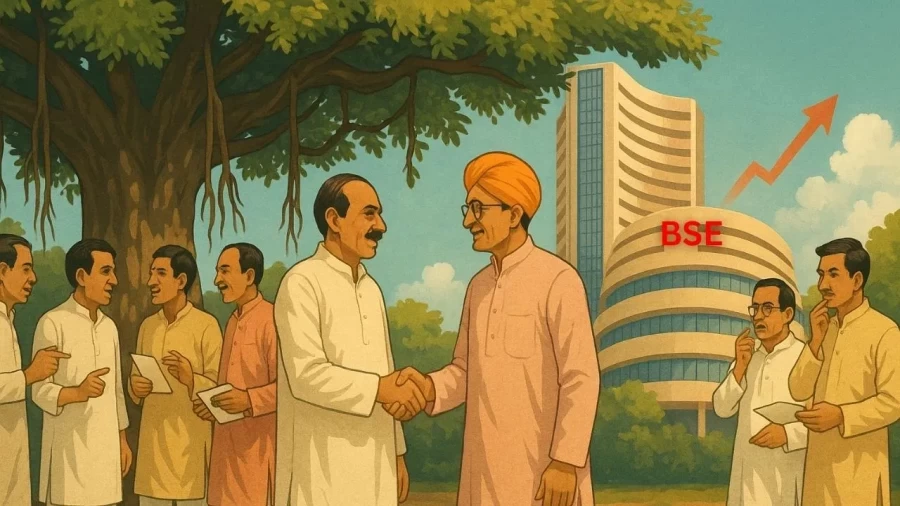
Bombay Stock Exchange: India's stock market, which has become Asia's financial tiger today, started under a small banyan tree. The story of Bombay Stock Exchange (BSE) is no less than a film script. This journey that started 150 years ago on Dalal Street in Mumbai is today counted among the largest stock exchanges in the world. BSE is not only the backbone of India's economy, but it is also a platform to turn the dreams of millions of investors into reality. Come, today on the 150th birthday of BSE, let us know how a small beginning made India a powerhouse of global finance!
The dream started from the banyan tree
Dreams are not those which are seen while sleeping, dreams are those which do not let you sleep. This was the dream seen by some traders in the 19th century, when the foundation of Bombay Stock Exchange was laid on 9 July 1875. At that time it was called "The Native Share & Stock Brokers' Association". Traders and brokers used to gather under a banyan tree near the famous Dalal Street of Mumbai. There they used to buy and sell shares and securities. No one could have imagined that this informal gathering would one day become Asia's first and a major stock exchange of the world.
The method of trading in those days was completely indigenous. Brokers used to close deals by shouting (Open Outcry System). Most of the traders were from Parsi, Gujarati and Marwari communities. The biggest name among them was Premchand Raichand, who is called the "Father of Mumbai's Stock Market". He played an important role in giving rules and structure to this market. Initially, shares of cotton mills, railway companies and government bonds were traded. Gradually this informal system started getting organized, and in 1957 the Government of India recognized it under the Securities Contracts (Regulation) Act, 1956.
BSE's journey is amazing
BSE's story is not limited to just the establishment of a stock exchange. It has achieved many milestones in 150 years. In 1995, BSE bid goodbye to the old shouting trading system and launched the BOLT (BSE On-Line Trading) system. It was an electronic trading system that made trading fast, transparent and easy. In 2005, BSE was corporatized and demutualized, that is, it was given the form of a company. In 2011, derivatives trading was further strengthened, which made BSE shine more in the global market.
BSE's Sensex (Sensitive Index) is on the lips of every investor today. Started in 1986, this index shows the performance of India's top 30 companies. Sensex is today a mirror of the Indian economy, which investors from all over the world watch closely. It is calculated on the basis of free-float market capitalization. Today more than 5,000 companies are listed on BSE, making it one of the largest stock exchanges in the world. Equity, derivatives, mutual funds, bonds—every kind of trading takes place here.
Today's BSE: Global Financial Powerhouse
BSE today is not just a stock exchange, but a strong pillar of India's economy. It gives companies a chance to raise capital and investors a chance to earn money. BSE is the biggest gateway for investment in India for investors from India and abroad. The special thing is that BSE itself has become a listed company. Its shares are traded on the National Stock Exchange (NSE), and currently the share price of BSE Ltd is Rs 2,518. Its market cap is more than Rs 1 lakh crore.
BSE is regulated by SEBI (Securities and Exchange Board of India), which protects the interests of investors. By adopting digital and technology, BSE has made its mark in the global finance market. Today it is making its presence felt not only in India but all over the world.
