
- India,
- 26-Feb-2026 02:30 PM IST


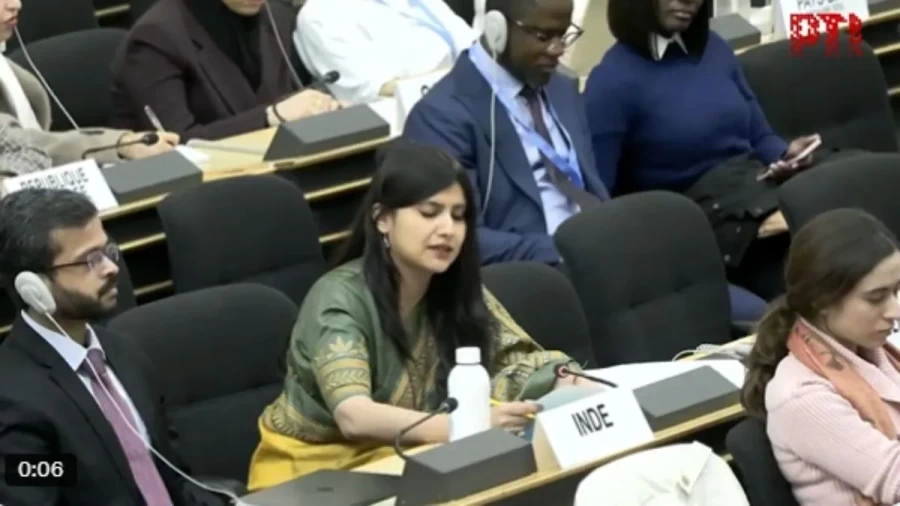
During the 55th regular session of the United Nations Human Rights Council (UNHRC), India exercised its 'Right of Reply' to counter allegations made by Pakistan regarding the Union Territory of Jammu and Kashmir. India's First Secretary, Anupama Singh, described Pakistan's statements as "malicious propaganda" and reaffirmed that Jammu and Kashmir remains an integral and inalienable part of India, while the Indian delegation criticized Pakistan for using the multilateral forum to divert attention from its internal economic and political crises while attempting to interfere in India's domestic affairs.
Economic Disparity and the IMF Bailout Comparison
In a pointed critique of Pakistan's economic situation, Anupama Singh highlighted the vast difference between the developmental focus of Jammu and Kashmir and Pakistan's financial struggles. According to Indian officials, the annual development budget of Jammu and Kashmir is more than twice the size of the bailout package Pakistan recently sought from the International Monetary Fund (IMF). India emphasized that while it's focused on infrastructure and prosperity in the region, Pakistan remains entangled in a cycle of debt and economic instability, yet continues to prioritize anti-India rhetoric over its own citizens' welfare.
Infrastructure Development and the Chenab Rail Bridge
India addressed Pakistan's denial of progress in the region by citing major infrastructure milestones. " The Indian representative stated that the scale of development in Jammu and Kashmir is visible to the world, and Pakistan's refusal to acknowledge it stems from deep-seated envy. The bridge was presented as a symbol of India's commitment to connecting the region with the rest of the country through advanced engineering and sustained investment.
Criticism of OIC as a Political Echo Chamber
India also took a firm stand against the Organization of Islamic Cooperation (OIC) for its references to Jammu and Kashmir. Anupama Singh stated that the OIC has allowed itself to be used as an "echo chamber" for Pakistan's political compulsions. India argued that by repeating Pakistan's narrative, the OIC is compromising its own credibility as an international organization, while the Indian delegation made it clear that the OIC has no locus standi in matters relating to India's internal affairs and urged the body to refrain from being influenced by a single member's motivated agenda.
Legal Sovereignty and the Status of PoK
Reiterating the legal framework of the region's status, India reminded the council that the accession of Jammu and Kashmir to India in 1947 was entirely legal and irrevocable, conducted under the Indian Independence Act of 1947. Singh asserted that the only remaining issue concerning the region is the illegal occupation of Indian territories, specifically Pakistan-Occupied Kashmir (PoK), by Pakistan. India called upon Pakistan to vacate these illegally occupied areas and stop its attempts to alter the facts through misinformation on international platforms.
Democratic Resilience and Rejection of Terrorism
The Indian representative highlighted the significant democratic progress in Jammu and Kashmir, noting record voter turnouts in recent electoral processes. According to India, the people of the region have decisively rejected the ideology of terrorism and violence promoted by Pakistan. Instead, they've chosen the path of peace, development, and democratic participation. India concluded that Pakistan's continued support for cross-border terrorism remains the primary obstacle to regional stability and called on the international community to hold Pakistan accountable for its human rights record and its role as a state sponsor of terror.
VIDEO | Switzerland: At the High-Level Segment of the 55th Regular Session of the UN Human Rights Council, First Secretary, Anupama Singh in Geneva, says, “India is compelled to exercise its right of reply in response to the references made during the high-level segment by… pic.twitter.com/uHOrmIEf4g
— Press Trust of India (@PTI_News) February 26, 2026
