

- India,
- 21-Feb-2026 05:27 PM IST


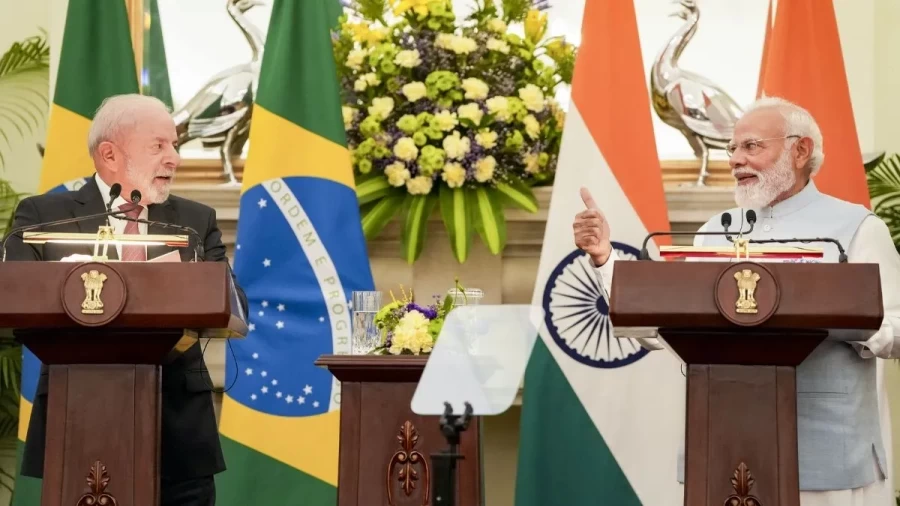
Prime Minister Narendra Modi and Brazilian President Luiz Inácio Lula da Silva held comprehensive bilateral discussions at Hyderabad House in New Delhi. According to the Ministry of External Affairs, the dialogue was aimed at further consolidating the strategic partnership between the two nations across a wide spectrum of sectors. The discussions covered business, energy, defense, agriculture, climate change, and advanced technology, while both leaders emphasized the importance of a multipolar world order and the necessity of enhanced cooperation among Global South nations to address contemporary global challenges effectively.
Economic Targets and Bilateral Trade Expansion
A primary focus of the high-level meeting was the significant expansion of economic ties. Prime Minister Modi noted that Brazil remains India's largest trading partner in the South American region. To sustain this momentum, both nations have established a target to surpass $20 billion in bilateral trade over the next five years. This objective is supported by 10 newly finalized agreements covering critical areas such as MSMEs, health, and mass communication. Officials stated that these initiatives are designed to create new investment corridors and strengthen the economic resilience of both emerging economies through mutual trust and cooperation.
Digital Public Infrastructure and AI Cooperation
In the realm of advanced technology, India and Brazil have agreed to collaborate extensively on Artificial Intelligence and digital transformation. A significant outcome of the talks is the decision to establish a Centre of Excellence for Digital Public Infrastructure (DPI) in Brazil. This center will benefit from India's proven expertise in digital governance and payment systems to support Brazil's digital initiatives. On top of that, the partnership extends to the semiconductor industry and mass communication, aiming to build a strong technological ecosystem that fosters innovation and shared knowledge for the benefit of both populations.
Critical Minerals and Supply Chain Resilience
The agreement on critical minerals is viewed as a strategic move to secure future supply chains for high-tech industries. Prime Minister Modi stated that this deal would be instrumental in strengthening the availability of essential resources required for renewable energy and electronic manufacturing. By collaborating on the exploration, mining, and processing of critical minerals like lithium and cobalt, India and Brazil aim to reduce external dependencies and enhance their respective energy security frameworks. This cooperation is also intrinsically linked to broader efforts in addressing climate change through sustainable technological solutions.
Defense Partnership and Strategic Synergy
The defense sector has emerged as a cornerstone of the India-Brazil strategic relationship. Both leaders highlighted the growing synergy in defense manufacturing and technology exchange. According to government officials, the focus is now on developing joint ventures and enhancing maritime security cooperation. Prime Minister Modi described the defense partnership as an excellent example of strategic alignment, noting that such collaboration contributes Notably to regional and global stability while empowering the domestic defense industries of both nations through co-production and technical sharing.
Counter-Terrorism and Multilateral Governance Reforms
Addressing global security and governance, India and Brazil reaffirmed their unwavering commitment to the fight against terrorism. Both leaders called for a unified international response to combat terror networks and their financing mechanisms. Also, they advocated for urgent and comprehensive reforms in the United Nations, particularly the Security Council, to reflect the geopolitical realities of the 21st century. By championing the cause of the Global South, PM Modi and President Lula emphasized the necessity of an inclusive global governance structure that ensures equitable representation for developing nations in global decision-making.
