

- India,
- 20-Jan-2026 06:13 PM IST


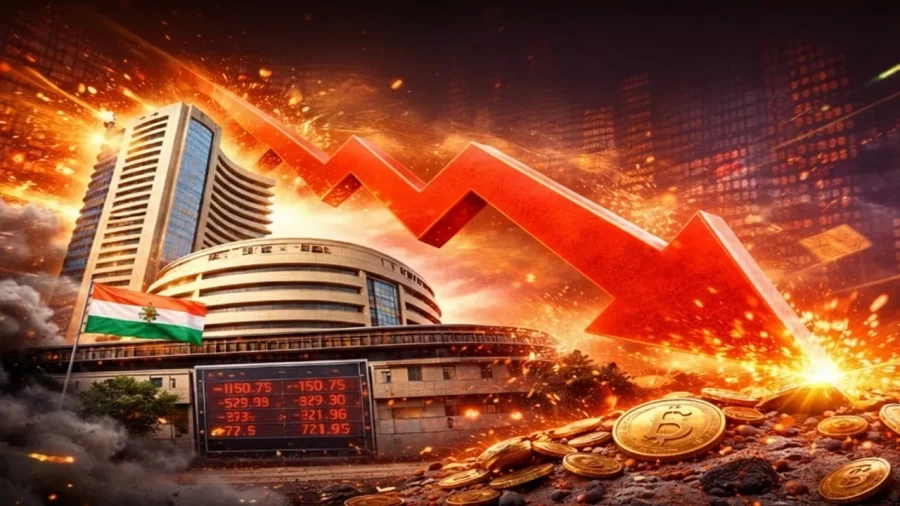
The Indian stock market witnessed a massive sell-off on Tuesday as global geopolitical tensions and heavy selling by foreign institutional investors (FIIs) rattled market sentiment. The primary triggers for this bloodbath were US President-elect Donald Trump's renewed tariff threats and France's rigid stance on international trade boards, while these factors created a ripple effect across global markets, leading to a sharp decline in Indian indices. The Sensex crashed by more than 1,000 points during the trading session, leaving investors in a state of panic as trillions of rupees in market wealth evaporated within hours.
The Scale of the Market Crash
On Tuesday, the Bombay Stock Exchange (BSE) benchmark Sensex was trading down by 960. 77 points at 82,280, while 61 by mid-afternoon. At its intraday low, the index touched 82,147. 52, marking a decline of nearly 1,098, while 66 points. Over the last two trading sessions, the Sensex has lost more than 1,300 points, while similarly, the National Stock Exchange (NSE) Nifty fell by 351. 10 points to trade at 25,235. 95, while market analysts suggest that the volatility is far from over, and the Nifty could see further downward pressure if global cues don't stabilize soon.
10 Key Reasons Behind the Slump
Sixthly, the Indian Rupee hit a low of 90. 98 against the US Dollar due to strong demand for the greenback. Seventhly, investors are cautiously awaiting the US Supreme Court's decision on Trump-era tariffs. Eighthly, a slight rise in Brent crude oil prices to $64, while 01 per barrel has raised concerns about inflation. Ninthly, the weekly expiry of Nifty derivatives led to increased intraday volatility, while lastly, a significant slump in the PSU Bank index, with major banks losing up to 3%, further dragged down the broader market indices.
Several factors converged to trigger this massive downturn. Firstly, concerns over a renewed trade war have resurfaced following uncertainty over US tariff policies. Secondly, the relentless selling by FIIs has drained liquidity from the market; FIIs sold shares worth over ₹3,262 crore on Monday alone. Thirdly, the mixed Q3 earnings reports, particularly weak guidance from IT major Wipro, have dampened investor confidence. Fourthly, weak global cues from Asian markets like Nikkei and Hang Seng added to the bearish sentiment. Fifthly, the India VIX, a measure of market volatility, jumped over 4% to 12. 34, indicating rising fear among traders.
Trillions Wiped Out in Two Days
The financial impact of this crash has been devastating for retail and institutional investors alike. The total market capitalization of BSE-listed companies dropped from ₹465. 68 lakh crore on Monday to ₹457. 15 lakh crore on Tuesday. This represents a one-day loss of approximately ₹9. 02 lakh crore. When combined with the losses from the previous session, investors have lost more than ₹11, while 50 lakh crore in just 48 hours. This massive erosion of wealth highlights the current fragility of the market amidst escalating global trade tensions and domestic economic challenges.
