

- India,
- 09-Apr-2026 04:26 PM IST


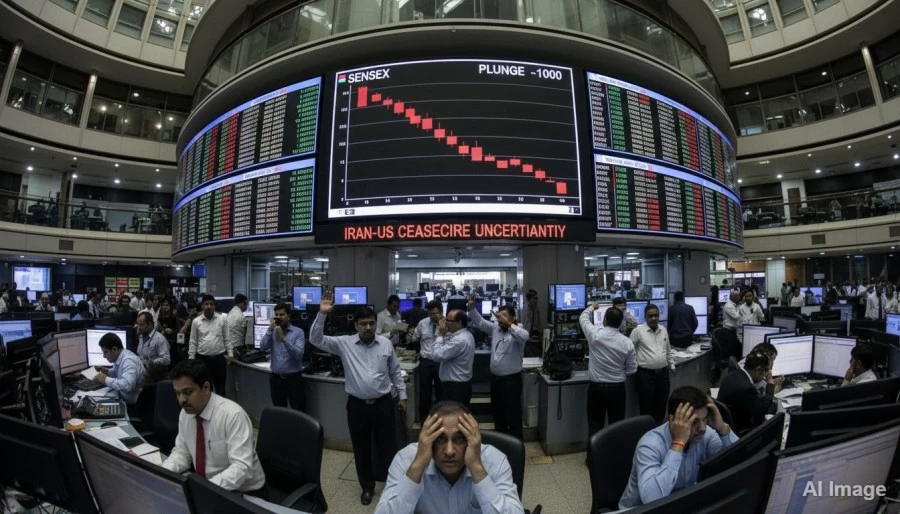
The Indian equity markets faced a massive sell-off during Thursday's trading session, snapping a five-day winning streak. Both benchmark indices closed deep in the red as global and domestic factors weighed heavily on investor sentiment. The BSE Sensex dropped approximately 1000 points to hit a low of 76,558, while the NSE Nifty 50 plunged by 255 points to slip below the 23,740 mark. Large-cap stocks including Infosys, HCL Tech, L&T, and UltraTech Cement saw declines of up to 2%, leading to a significant erosion of investor wealth within a single day.
Geopolitical Tensions and Ceasefire Uncertainty
The primary driver behind the market's sudden downturn is the growing uncertainty surrounding the proposed ceasefire between Iran and the United States. While initial reports of a peace agreement had provided a boost to global markets, the situation has become increasingly volatile. Iran has officially accused the US and Israel of violating the terms of the agreement. Plus, Israel's ongoing military operations against Hezbollah in Lebanon have added to the instability. The Strait of Hormuz, a critical maritime route for global trade, remains restricted for shipping. Warnings from US President Donald Trump regarding military readiness in case of agreement failure have further spooked global investors.
Resurgence in Global Crude Oil Prices
Crude oil prices have witnessed a sharp rebound as tensions in the Middle East refuse to subside. 70 per barrel. Similarly, WTI crude rose by 3% to hit $97 per barrel. For an oil-importing nation like India, rising crude prices are a major concern as they impact the current account deficit and fuel domestic inflation, while the energy market's volatility has directly translated into selling pressure across various sectors in the Indian stock market.
Persistent Selling by Foreign Institutional Investors (FIIs)
The continuous exit of Foreign Institutional Investors (FIIs) from the Indian markets has Importantly dampened market morale. According to exchange data, FIIs have been net sellers for 26 consecutive sessions. On Wednesday alone, they offloaded shares worth approximately ₹2,812 crore. While Domestic Institutional Investors (DIIs) have been attempting to provide a cushion through consistent buying, the sheer volume of foreign capital outflow has kept the indices under pressure, while global risk aversion and higher yields in developed markets are prompting investors to pull funds from emerging markets like India.
Weak Global Cues and Rupee Depreciation
Indian markets mirrored the weakness seen in global peers. Major Asian indices, including Japan's Nikkei, Hong Kong's Hang Seng, South Korea's Kospi, and China's Shanghai Composite, all ended in negative territory. 70 in early trade. The depreciation of the currency adds to the cost of imports and affects the profit margins of companies reliant on foreign raw materials, while the combination of a weak currency and negative global sentiment has led to a cautious approach among institutional traders.
Profit Booking After Recent Market Rally
A significant portion of the decline can also be attributed to profit booking at higher levels. In the first five trading sessions of April, the Sensex had gained over 5,600 points, representing a rally of nearly 8%. After such a rapid ascent, it's common for investors to lock in gains, especially when faced with negative news flow, while the Nifty IT index, which had seen substantial gains recently, fell by nearly 1% as investors offloaded tech stocks. Market experts note that while the underlying domestic economy remains stable, the technical correction was triggered by the convergence of geopolitical risks and high valuations.
