

- India,
- 06-Apr-2026 12:38 PM IST


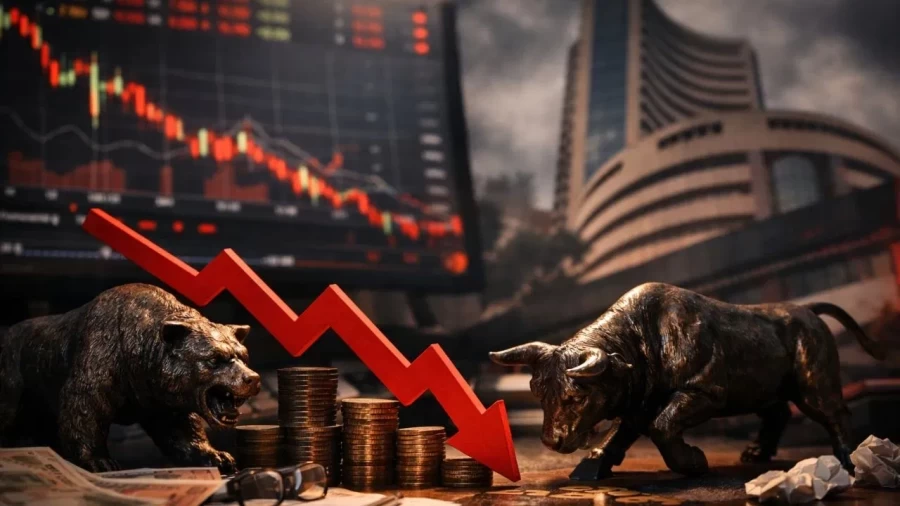
The Indian equity markets experienced significant volatility on Monday as US President Donald Trump escalated his rhetoric against Iran, leading to a sharp decline in investor sentiment. The benchmark BSE Sensex and NSE Nifty 50 indices reversed early gains to trade deep in the red. The primary catalyst for this downturn was the surge in global crude oil prices, which crossed the $110 per barrel mark following threats related to the Strait of Hormuz. 72 lakh crore in investor wealth during the morning session.
Current State of Market Indices
75.66. 95. By mid-morning, the markets were struggling to recover as selling pressure dominated major sectors, particularly oil and gas, banking, and consumer goods. The India VIX, a measure of market volatility, jumped by nearly 4% during the period.
Movement in Major Stocks and Sectors
Among the major laggards on the Sensex were IndiGo, Kotak Mahindra Bank, Reliance Industries (RIL), Sun Pharma, Adani Ports, and ICICI Bank, with shares falling between 1% and 4%. The decline in IndiGo was particularly sharp as rising fuel prices directly impact the operational costs of the aviation sector. Conversely, some IT stocks showed resilience; Tech Mahindra, Infosys, and Titan recorded gains of 1% to 4%. On the National Stock Exchange, approximately 1,702 stocks declined while 1,036 advanced. 3%.
Geopolitical Tensions and Trump's Warning
The market reaction followed a series of statements by US President Donald Trump on his Truth Social platform, while trump warned that the United States would Notably intensify its actions against Iran if the Strait of Hormuz—a critical waterway for global oil and trade—remained restricted. He referred to the upcoming Tuesday as a significant day for Iranian infrastructure. The Strait of Hormuz is a vital chokepoint through which approximately one-fifth of the world's total oil consumption passes. Any disruption in this region leads to immediate concerns regarding global supply chains and energy security.
Surge in Global Crude Oil Prices
Oil prices reacted sharply to the renewed threats, with Brent crude futures rising by approximately 1% to trade at $110 per barrel. 5 per barrel. This marks a significant escalation in energy costs, which had already been elevated due to ongoing regional conflicts. For an import-dependent economy like India, crude oil prices exceeding $100 per barrel pose a risk to the fiscal deficit and inflation. The current price levels are the highest seen since the initial disruptions following the 2022 geopolitical events in Eastern Europe.
Rupee Performance and FII Activity
10. This slight recovery is attributed to recent measures by the Reserve Bank of India (RBI) to curb currency speculation. The RBI has reportedly restricted banks from selling rupee non-deliverable forwards (NDF) to certain clients to support the domestic currency. Despite these measures, Foreign Institutional Investors (FIIs) continued their selling streak. NSE data indicated that FIIs remained net sellers for the 23rd consecutive session, offloading shares worth approximately ₹9,931 crore in the previous trading day.
