
- India,
- 23-Jul-2026 12:16 PM IST



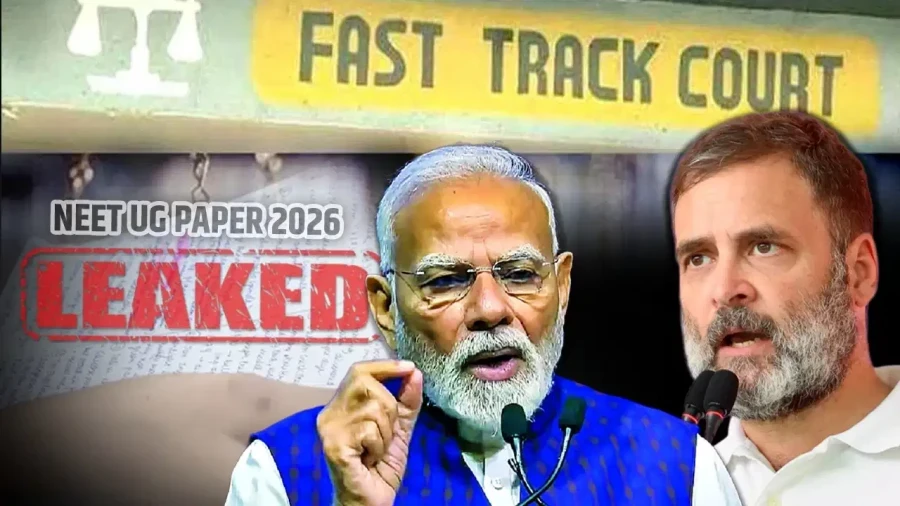
Prime Minister Narendra Modi has made a significant announcement regarding the integrity of examinations in India. In a move to protect the future of the youth, the Prime Minister stated that Fast Track Courts will be established to hear cases related to paper leaks, while taking to his X account, PM Modi emphasized that those involved in paper leaks would face the strictest possible punishment. The decision to take advantage of Fast Track Courts (FTCs) is aimed at ensuring that legal proceedings are completed in record time, providing a strong deterrent against such crimes.
What are Fast Track Courts and How Do They Function?
A Fast Track Court is a specialized judicial setup designed to hear and decide cases in the shortest possible time. The primary objective is to expedite the delivery of justice, especially in cases that are heinous or have a significant social impact. The concept of Fast Track Courts in India was first introduced in the year 2000. This initiative was launched based on the recommendations of the 11th Finance Commission. At that time, the goal was to quickly dispose of long-pending cases in district and subordinate courts. These courts operated under this scheme until 2011, after which they were temporarily discontinued before being revived for specific categories of crimes.
The Revival Post-Nirbhaya Case
The discussion around Fast Track Courts gained renewed momentum following the horrific Nirbhaya case in Delhi. In response to the public outcry for swift justice in cases of sexual assault, the Delhi High Court initially approved 5 Fast Track Courts for the speedy trial of rape and sexual harassment cases. This number was later increased to 6. The first of these special Fast Track Courts was inaugurated on January 2, 2013, at the Saket Court complex in South Delhi. It was in this very court that the proceedings for the Nirbhaya case began, while following this model, several states began using their own resources to maintain Fast Track Courts for heinous crimes.
The 2019 Fast Track Special Court (FTSC) Scheme
In 2018, the Central Government's Nirbhaya Fund Committee approved a proposal to establish 1,023 Fast Track Special Courts across the country. This was formally implemented in October 2019 under the Fast Track Special Court (FTSC) scheme, following the Criminal Law (Amendment) Act, 2018, and directions from the Supreme Court. The scheme specifically targets the pending cases of rape and those registered under the POCSO (Protection of Children from Sexual Offences) Act. The aim is to ensure that victims of such heinous crimes don't have to wait for years to see justice served.
Why was the Need for Fast Track Courts Felt?
The necessity for Fast Track Courts arose from several critical factors in the Indian judicial landscape, while firstly, serious cases such as murder, rape, and crimes against women and children often took many years to reach a verdict in regular courts. Secondly, there was an urgent need to reduce the massive burden of pending cases in the judiciary. Thirdly, the government wanted to ensure the immediate settlement of matters involving vulnerable groups like women and children. Ultimately, the goal is to strengthen public confidence in the justice system by showing that the law can act swiftly and decisively.
Budgetary Allocation and Financial Support
The Central Government has allocated a substantial budget for the FTSC scheme. A total of 1,952 crore 23 lakh rupees was earmarked for this purpose. Out of this, the Central Government is providing 1,207 crore 24 lakh rupees through the Nirbhaya Fund. The remaining expenditure is to be borne by the respective state governments. As of the latest reports, the Central Government has already released 1,034 crore 55 lakh rupees to various states and Union Territories. Currently, states like Madhya Pradesh have 67 Fast Track Courts, while Kerala has 55 such courts operational.
Current Status of Fast Track Courts in India
During the Monsoon Session of 2025, the Central Government provided an update on the status of these courts. As of June 30, 2025, a total of 725 Fast Track Special Courts have been established across 29 states and Union Territories. This includes 392 exclusive POCSO courts. Exclusive POCSO courts are dedicated solely to hearing cases related to sexual offences against children, ensuring a sensitive and rapid trial process. To date, these Fast Track Courts have successfully disposed of 3,34,213 cases.
Efficiency Comparison: Fast Track vs. Regular Courts
The data provided by the government highlights the efficiency of these specialized courts. In regular courts, the average disposal rate for rape and POCSO cases is 3 point 26 cases per court per month. In contrast, the Fast Track Special Courts boast an average disposal rate of 9 point 51 cases per court per month. This indicates that Fast Track Courts are resolving cases nearly three times faster than regular judicial setups. Uttar Pradesh leads the country with the highest number of Fast Track Courts, totaling 218.
Types of Cases Handled by Fast Track Courts
Fast Track Courts aren't limited to just one type of crime, though they prioritize certain categories, while these include rape, sexual offences against children, serious crimes against women, and heinous crimes like murder. They also handle specific cases involving senior citizens and serious criminal matters that have been pending for a long time. Also, special cases identified by the State Government or the High Court can be referred to these courts for speedy resolution.
Classification of Fast Track Courts
There are generally two types of Fast Track Courts. The first is the General Fast Track Special Court, which hears cases related to both rape and the POCSO Act simultaneously. These courts aim to settle cases within 6 months to a year, although delays can occur due to investigation issues or lack of evidence. The second type is the Exclusive POCSO Fast Track Court, while these are dedicated entirely to POCSO Act cases. They offer special provisions for child victims, such as exemption from appearing in open court and special care during statement recording, while the target for completion in these cases is also 6 months to one year.
Record-Breaking Decisions by Fast Track Courts
There have been several instances where Fast Track Courts have delivered justice in record time. In Gorakhpur, a Fast Track Special Court sentenced an accused to life imprisonment in April 2026 within just 24 days for the rape of a 6 month old infant. In Itarsi, Madhya Pradesh, an accused was sentenced to death in just 21 days in 2023 for raping his minor niece. In Delhi, in April 2025, a 45 year old man was sentenced to life imprisonment for raping a 16 year old minor. Plus, in June 2026, in Narsapur, Maharashtra, an accused was given life imprisonment within only 55 days for the rape of a 3 year old child.
Legal Standing and the Right to Appeal
It's important to note that Fast Track Special Courts don't represent a separate judicial system, while they're presided over by judges appointed by the respective High Court or State Government. These courts follow the same legal provisions and sections of the Bharatiya Nagarik Suraksha Sanhita (BNSS) as regular courts. Consequently, the decisions made by Fast Track Courts can be challenged in higher courts. A verdict from a district-level Fast Track Court can be appealed in the High Court, and a decision from a High Court-level Fast Track Court can be challenged in the Supreme Court.