
- India,
- 17-Jul-2026 08:26 PM IST



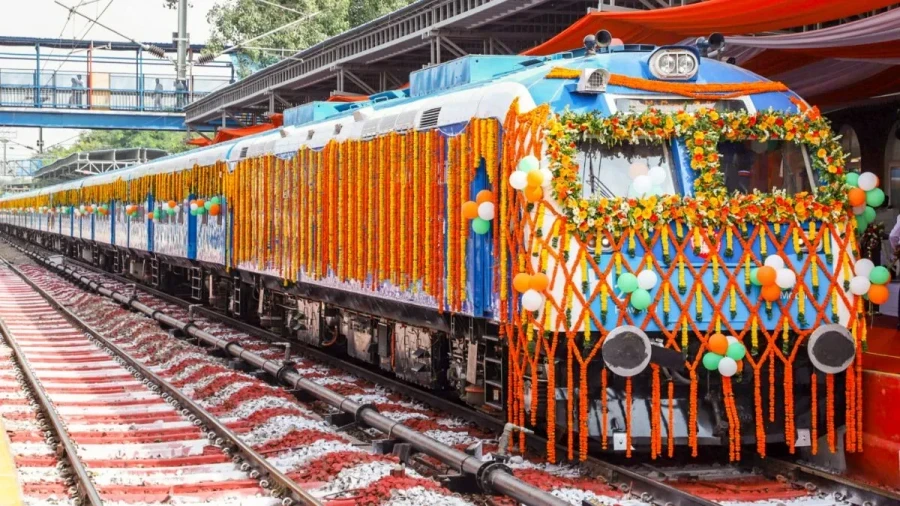
In a significant milestone for the Indian Railways and the nation's green energy goals, Prime Minister Narendra Modi flagged off India's first hydrogen-powered train on Friday. The inauguration ceremony took place in Jind, Haryana, marking the commencement of a new era in sustainable transportation, while this pioneering train is set to operate on the Jind-Sonipat rail section, showcasing India's commitment to adopting advanced and clean energy solutions for public transport. The launch of this hydrogen train is particularly noteworthy as it utilizes indigenously developed hydrogen fuel cell technology, eliminating the need for traditional overhead electric wires or diesel consumption.
Affordable Fare Structure for Passengers
One of the most striking features of the newly launched hydrogen train is its highly economical fare structure, designed to make green travel accessible to the common man. According to official statements from railway authorities, the ticket prices are remarkably low, starting at just 5 rupees. Depending on the distance traveled along the route, the maximum fare is capped at 25 rupees. This pricing strategy makes the hydrogen train a very competitive option compared to other modes of transport. Interestingly, the starting fare of 5 rupees is even lower than the cost of a standard platform ticket at many railway stations, highlighting the government's intent to provide low-cost, eco-friendly commuting options to the public.
Route Details and Station Halts
The hydrogen train is scheduled to cover the crucial rail link between Jind and Sonipat in Haryana. The total distance of this route is approximately 90 kilometers, which the train is expected to complete in a duration of about two hours. The train consists of 10 coaches and has the capacity to accommodate and transport around 2,600 passengers on a daily basis. To ensure maximum connectivity for local commuters, the train will make stops at 11 intermediate locations and proposed halts. The specific stations included in the route are Jind City, Pandu Pindara, Lalit Khera Halt, Bhambhewa, Isapur Kheri Halt, Butana Halt, Khandrai Halt, Rabra Halt, Lath Halt, Mohana Halt, and Barwasni Halt, before reaching Sonipat New. The train will also cater to other intermediate stations and proposed stops along the Jind-Sonipat section.
Operational Schedule and Timings
The railway department has released a detailed schedule for the hydrogen train to facilitate passenger planning. The train operating from Jind to Sonipat is designated as Train Number 74010. It's scheduled to depart from Jind daily at 7:40 AM and is expected to reach Sonipat at 9:40 AM after a two-hour journey. For the return journey, the train is designated as Train Number 74009. It will depart from Sonipat at 10:40 AM and will take approximately 2 hours and 20 minutes to complete the trip, arriving back in Jind at 1:00 PM. This schedule is designed to cater to morning commuters and those traveling between these two important Haryana towns during the day.
Advanced Hydrogen Fuel Cell Technology
The technical foundation of this train lies in its sophisticated hydrogen fuel cell technology. Unlike traditional diesel locomotives that rely on internal combustion to generate mechanical energy, the hydrogen train functions as a mobile power plant. It utilizes Proton Exchange Membrane (PEM) fuel cell technology. The process involves a chemical reaction between hydrogen, stored in cylinders mounted on the train, and oxygen extracted from the surrounding air. This electrochemical reaction generates electricity, which then powers the traction motors responsible for turning the wheels. The most significant environmental advantage of this technology is that it produces only water vapor and heat as by-products, while this completely eliminates carbon emissions, smoke, and other pollutants associated with fossil fuels, making it a clean alternative to conventional rail traction systems.
Train Configuration and Components
The hydrogen trainset is specifically configured to optimize performance and safety. It comprises a total of 10 coaches, which includes two hydrogen driving power cars and eight trailer coaches. Each driving power car is equipped with the essential components of the propulsion system, including the hydrogen fuel cells, lithium iron phosphate batteries, and specialized hydrogen storage cylinders, while these components work in tandem to provide the necessary traction power for the train. The integration of lithium iron phosphate batteries allows for efficient energy management and storage, ensuring a smooth and reliable operation across the 90 kilometer stretch. This indigenous development represents a major step forward in India's self-reliance in high-tech railway engineering.