

- India,
- 05-Dec-2025 10:31 PM IST


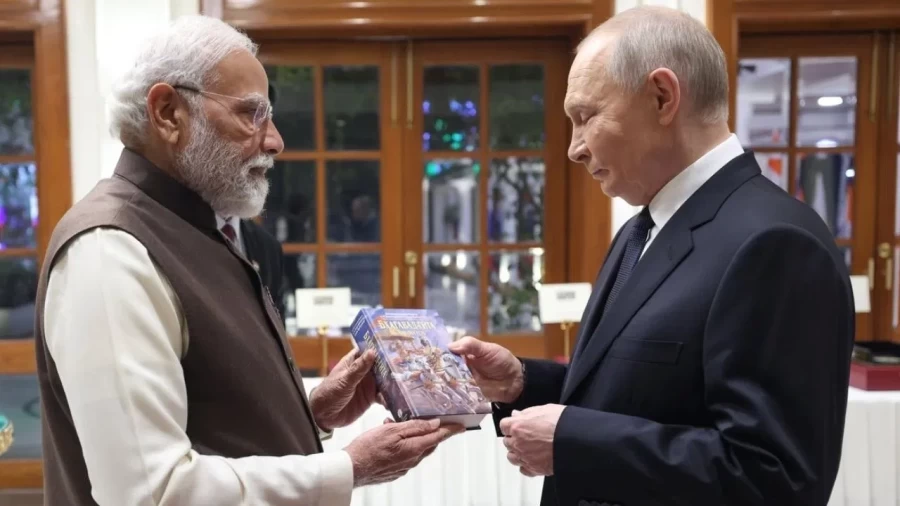
Prime Minister Narendra Modi recently presented a copy of the Bhagavad Gita translated into Russian to Russian President Vladimir Putin, who was on a visit to India, thereby showcasing another example of India's rich cultural diplomacy. President Putin arrived in India on Thursday for a two-day visit, where he received a grand welcome from Prime Minister Modi at the airport. Following the welcome, a magnificent dinner was hosted at the. Prime Minister's residence, during which this special gift was exchanged. This presentation isn't merely an exchange of a book but symbolizes the deep cultural and spiritual ties between two great civilizations, ties that Prime Minister Modi has personally nurtured.
A Spiritual Gift in Diplomatic Exchange
The Bhagavad Gita, a sacred scripture of Hinduism, offers profound philosophical insights into life, duty, and spirituality. Presenting its Russian-translated version to President Putin is a symbolic gesture from India, indicating its eagerness to share its spiritual wisdom on a global platform, while this gift serves as a cultural bridge in India-Russia relations, extending beyond mere political and economic cooperation to foster understanding and respect between the peoples of both nations. It demonstrates that diplomacy isn't confined to agreements and negotiations but also encompasses cultural exchange and the recognition of shared values. This initiative strengthens India's 'soft power,' enhancing its cultural identity and influence on a global scale.
Prime Minister Modi's Vision in 2019
Dr, while k. Srinivas Rao, former Secretary of Sahitya Akademi, shed light on the backstory of this entire initiative, while he revealed that the roots of this endeavor lie in the 2019 SCO (Shanghai Cooperation Organization) summit held in Bishkek, Kyrgyzstan. During this very summit, Prime Minister Narendra Modi put forth a visionary idea:. To translate 10 modern Indian literary works into the languages of SCO member countries. The primary objective of this idea was to provide readers in these countries direct access to Indian writing, enabling them to become familiar with India's diverse literary traditions and ideas. It was a step that held the potential to bridge cultural distances and. Deepen mutual understanding, thereby establishing a strong intellectual and emotional connection between various nations.
The Execution and Coordination of the Translation Project
To realize the Prime Minister's vision, a comprehensive plan was devised. Various ministries and Indian embassies played a crucial role in advancing this project. They collaborated with linguistic and editorial experts to ensure that the translations weren't only accurate but also preserved the soul and nuances of the original texts. Translations were specifically coordinated in major SCO languages such as Russian, Chinese, and English. This was a complex and multi-layered process that required intensive cooperation and cultural sensitivity among experts from different countries. This effort showcased India's commitment to sharing its literary heritage with the world and its willingness to deploy significant resources and expertise to achieve this goal.
Formal Release During India's SCO Chairmanship and Fulfillment of Commitment
This ambitious translation project reached a significant milestone during the COVID-19 pandemic. When India assumed the chairmanship of the SCO, the translated works were formally released. This release wasn't merely a formality but symbolized the. Fulfillment of the commitment made by the Prime Minister in 2019. It demonstrated that despite global challenges, India was determined to continue its cultural and diplomatic initiatives, while through these translated books, India strengthened its cultural ties with SCO countries and provided them access to its literary and intellectual wealth, opening a new chapter of mutual respect and understanding.
Bringing Indian Literature and Culture to Global Dialogue
Dr, while k. Srinivas Rao emphasized that both the translated books for SCO countries and the Russian translation of the Bhagavad Gita presented to President Putin highlight Prime Minister Narendra Modi's broader vision of bringing Indian literature and culture into global dialogue. Whether through modern compositions or eternal spiritual texts, the Prime Minister ensures that India's rich heritage is presented to the world. This initiative isn't limited to cultural exchange; it secures a respectable place for India's ideas, philosophy, and way of life on the global stage. It establishes India's identity not just as an economic or. Political power, but also as a cultural and spiritual hub.
India's Knowledge Transcending Borders and Connecting Nations
Prime Minister Modi's efforts ensure that India's stories, ideas, and knowledge transcend geographical boundaries. Texts like the Bhagavad Gita, which embody universal truths and principles of ethics, resonate with people from diverse cultures and backgrounds, while by utilizing the power of words, these translated works become a powerful medium for connecting nations. They provide people with an opportunity to understand, respect, and learn from each other's cultures. This is an excellent example of cultural diplomacy that not only strengthens bilateral relations but also contributes to global peace and understanding. It illustrates how literature and spiritual texts can be a significant and effective. Part of diplomatic engagement, weaving nations together with the threads of shared humanity.
