

- India,
- 12-Feb-2026 11:10 PM IST


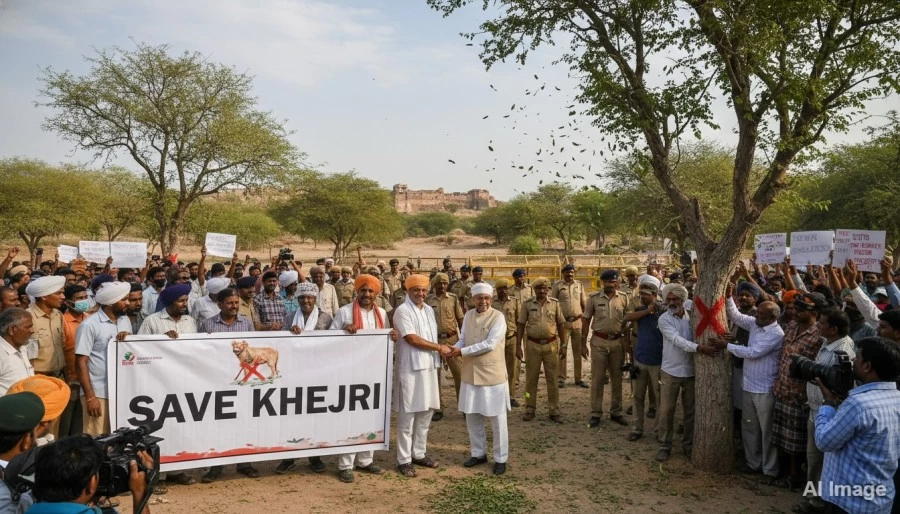
In a significant move towards environmental preservation, the Rajasthan government has officially prohibited the felling of Khejri trees across the state. This prohibition will remain in effect until a dedicated and strong law is passed by the State Legislative Assembly. K. Bishnoi arrived with a government circular and provided necessary assurances to the agitators. The minister personally delivered the official letter, stating that new regulations and legal frameworks for the protection of the state tree would be introduced during the current legislative session.
Government Circular and Official Intervention
K. Bishnoi reached the protest site with the official government document. He was accompanied by Jaswant Singh Bishnoi, Chairman of the State Animal Welfare Board, Pabaram Bishnoi, and former MLA Bihari Lal Bishnoi. Addressing the protesters, the minister emphasized that the government is fully committed to environmental protection and, recognizing the ecological importance of the Khejri tree, has issued an immediate circular to halt its felling. According to officials, following the implementation of this circular, cutting Khejri trees for any project or individual purpose will be considered illegal throughout Rajasthan.
Conclusion of the 11-Day Mahapadav
Ram Gopal Bishnoi, the main convener of the movement, announced from the stage that the 'Mahapadav' (mass sit-in), which had been ongoing for 11 days, is being suspended following the written assurance from the government. He described this as a victory for the struggle of the community and environmental enthusiasts. The protesters welcomed the decision, stating that it's a triumph not just for the Bishnoi community but for all 36 ethnic groups that supported the campaign. During the conclusion of the protest, traditional songs were performed on stage, symbolizing a positive outcome. Saints and local leaders stressed the importance of remaining organized to protect the environment in the future.
Historical Significance of Khejri and Amrita Devi
The Khejri tree holds a unique position in the ecology and culture of Rajasthan, while during the protest, speakers recalled the Khejrali sacrifice of 1730, where 363 people, led by Amrita Devi Bishnoi, sacrificed their lives to save trees. Khejri is often referred to as the 'Kalpavriksha of the Desert' because it survives extreme heat and drought while providing essential fodder for local livestock, while agitators argued that this historical and ecological heritage can't be destroyed in the name of modern development. The government has now acknowledged the need for a separate and stringent law that provides greater protection to Khejri compared to other common trees.
Impact of Solar Projects on Local Ecology
The primary catalyst for this movement was the rapid expansion of solar power plants in Western Rajasthan. According to the protesters, thousands of Khejri trees were being felled during the development of these solar energy projects. Ram Gopal Bishnoi alleged that solar companies have caused environmental destruction under the guise of development. Local residents stated that the indiscriminate cutting of trees is increasing desertification and destroying wildlife habitats. The government has now directed that no Khejri trees should be harmed for any new projects and that alternative routes or technologies must be utilized to avoid ecological damage.
Proposed Legislative Framework for Tree Protection
According to state government officials, the proposed law for Khejri protection will include strict penalties and fines. The existing general rules for tree felling will be made Importantly more stringent specifically for the Khejri species. Officials have indicated that the new law might categorize the illegal felling of Khejri as a non-bailable offense. Plus, the Forest Department has been given special instructions to conduct a census of Khejri trees in their respective areas and increase patrolling for their safety. The bill is expected to be introduced in the upcoming assembly session, marking a new chapter in the history of forest conservation in Rajasthan.
