
- India,
- 03-Oct-2026 03:56 PM IST



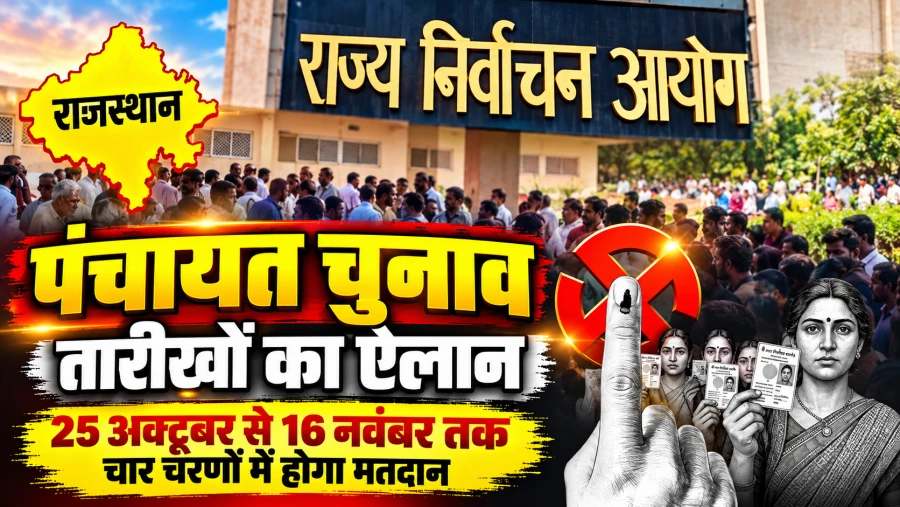
The wait for the 2026 Panchayati Raj elections in Rajasthan has finally come to an end. The State Election Commission (SEC) officially announced the comprehensive schedule for the upcoming local body polls during a high-level press conference held in Jaipur on Saturday. State Election Commissioner Rajeshwar Singh addressed the media, providing a detailed roadmap for the elections that will cover 14,403 Gram Panchayats, 457 Panchayat Samitis, and 41 Zila Parishads across the state. This massive democratic exercise is set to be conducted in four distinct phases, ensuring a smooth and organized voting process for the rural population of Rajasthan.
Implementation of Model Code of Conduct
With the formal announcement of the election dates, the Model Code of Conduct (MCC) has come into immediate effect across all rural areas of the state. This regulatory framework imposes strict restrictions on the state government to ensure a level playing field. Consequently, the government is now prohibited from announcing any new development projects or schemes specifically targeting rural regions. On top of that, no new work orders can be issued until the conclusion of the election process. The Commission has set a firm deadline, stating that the entire electoral process must be completed by 28 November 2026.
Hybrid Voting Model and One State One Election
During the press briefing, Commissioner Rajeshwar Singh emphasized the commission's commitment to the "One State One Election" philosophy. To streamline the process, the elections for the three-tier Panchayati Raj institutions are being held simultaneously. A notable feature of this election is the adoption of a hybrid voting model. While the elections for the positions of Sarpanch and Ward Panch will be conducted using traditional ballot papers, the voting for Zila Parishad and Panchayat Samiti members will take advantage of Electronic Voting Machines (EVMs), while this dual approach aims to balance traditional methods with modern technology.
Detailed Four-Phase Voting Schedule
The election for choosing representatives at the Gram Panchayat level will be spread across four phases to manage the logistical requirements and security arrangements effectively. The Commission has also clarified that the counting of votes will commence at the respective polling stations immediately after the conclusion of voting in each phase.
- Phase 1 (25 October): Voting will take place in 3,672 Gram Panchayats across 10,857 polling stations.
- Phase 2 (31 October): This phase covers 3,626 Gram Panchayats with 11,763 polling stations.
- Phase 3 (6 November): Elections will be held in 3,605 Gram Panchayats at 11,566 polling stations.
- Phase 4 (16 November): The final phase will see voting in 3,500 Gram Panchayats across 11,198 polling stations.
Exceptions and Special Cases
While the majority of the state will go to polls according to the announced schedule, there are certain exceptions. Commissioner Singh pointed out that some local bodies in the districts of Baran, Sri Ganganagar, Karauli, and Kota still have remaining legal tenures. Due to these legal requirements, elections in these specific areas will only be conducted after 22 December 2026. This ensures that every institution completes its full constitutional term before the next representative is elected.