
- India,
- 10-Nov-2026 05:32 PM IST



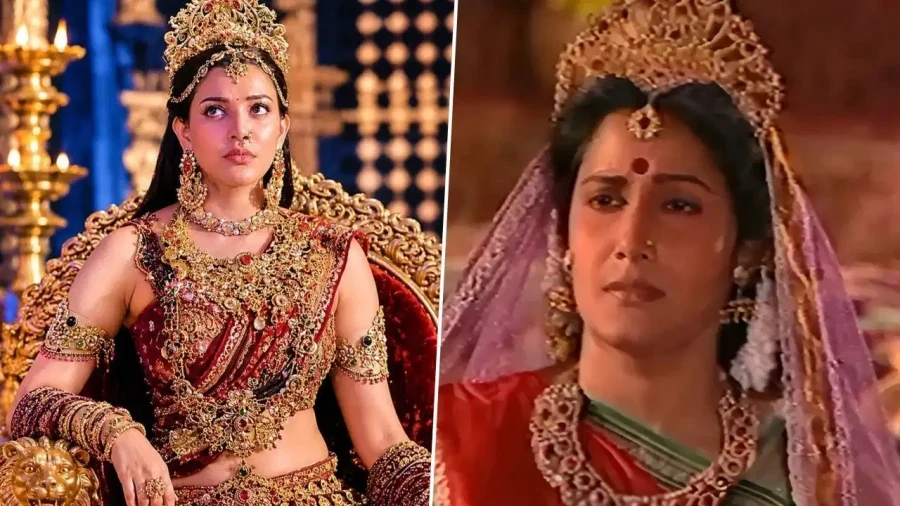
In the narrative of the Indian epic Ramayana, the character of Queen Mandodari, wife of Lanka's king Ravana, has always been considered extremely important and dignified. According to mythological beliefs, Mandodari wasn't only an ideal and devoted wife, but she also represented policy, conscience, truth, and righteousness. Whenever the sequence of Queen Mandodari appeared in Ramanand Sagar's historical Doordarshan Ramayana broadcast in 1987, the audience witnessed her dignified form. Meanwhile, in Nitesh Tiwari's grand film Ramayana made with a budget of two thousand crore rupees in 2026, popular South and Hindi cinema actress Kajal Aggarwal has played the role of Queen Mandodari.
The style and vision of presenting this mythological character in both Ramanand Sagar's television serial and Nitesh Tiwari's modern film are quite different from each other. Let us know what the differences have been in the presentation of Mandodari's character and the main aspects of the story in both mediums. A major difference is visible in the character of Queen Mandodari between Ramanand Sagar's serial and Nitesh Tiwari's film Ramayana. Aparajita Bhushan played the memorable role of Mandodari in the 1987 Ramayana, while Kajal Aggarwal has become Queen Mandodari in the grand 2026 film Ramayana. Whether Mandodari's role is different in the two thousand crore movie just like the serial and whether Queen Mandodari of Ravana got a new identity on the big screen is a big topic.
Aparajita Bhushan's Acting and Kajal Aggarwal's New Avatar
In Ramanand Sagar's Ramayana broadcast in the 1980s, the memorable character of Queen Mandodari was played by Aparajita Bhushan, daughter of senior actor Bharat Bhushan. Aparajita Bhushan established Mandodari's character in every household with her controlled dialogue delivery and soulful acting, while the seriousness of her face and calm demeanor breathed life into this mythological character. On the other hand, pan-India star Kajal Aggarwal was chosen for this role in Nitesh Tiwari's cinematic version, while on the big screen, Kajal Aggarwal has been shown mainly in royal scenes of Lanka and marriage sequences alongside KGF fame star Yash who plays the king of Lanka Ravana, providing a modern and grand cinematic experience.
Nature of Dialogue with Ravana and Remembrance of Policy
In Ramanand Sagar's serial, the dialogues between Mandodari and Ravana were shown with great detail and depth, while when the entire Lanka remained silent out of fear of Ravana, only Mandodari would go alone to the bedroom and remind Ravana of righteousness and policy. She used to tell Ravana that her father Mayasura, grandfather Malyavan, and brother-in-law Vibhishana were all of the opinion that Sita should be respectfully returned to Lord Rama. In contrast, due to cinematic time constraints in Nitesh Tiwari's film Ramayana, instead of long discussions between Mandodari and Ravana, more focus has been placed on the visual scale of the story and main war sequences, which changes the nature of the dialogues between the two.
Moral Consciousness of Lanka and Perspective of Sita Abduction
In the television serial, Mandodari was portrayed not just as a queen, but as the moral heritage of Lanka. She was seen continuously striving to divert both her husband Ravana and son Meghanada from the path of unwarranted war and destruction. Through her, the audience received the message that the consequence of the path of unrighteousness is always destructive. In the film version, this aspect of Mandodari has been kept in a more concise form and her character has been presented mainly as the queen of Ravana's empire, where grandeur and visual effects have been given priority.
Post-War Scene and Difference in Mourning Sequences
In Ramanand Sagar's Ramayana, the scene of Mandodari's lamentation and mourning on the battlefield after the slaying of Ravana was filmed in an extremely pathetic and impactful manner. It had both the grief of Ravana's end and the acceptance of the victory of truth. Although this scene isn't in the first part of Ramayana, both mediums have presented different dimensions of this great character to the audience according to their respective styles and the demands of time, which will always live on in Indian cultural consciousness.