
- India,
- 06-Nov-2026 05:35 PM IST



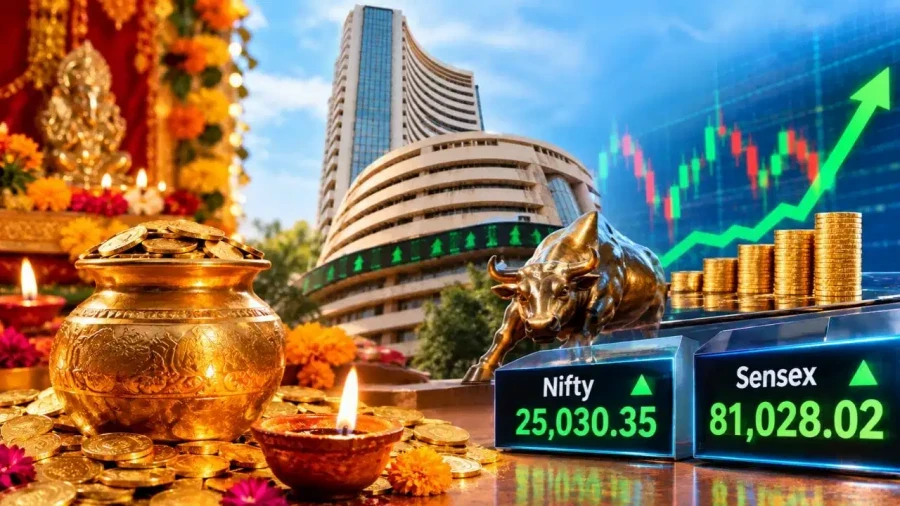
Indian stock markets recorded a phenomenal and strong rally on the auspicious occasion of Dhanteras, filling investors' portfolios with joy and optimism. Powered by massive and aggressive buying from foreign institutional investors, key benchmark indices took a massive leap. 02.35 mark. Right before the festival of Diwali, when major global equity markets from the United States to Asia were grappling with heavy selling pressure, Dalal Street provided a massive sigh of relief to domestic investors. Breaking the sluggishness of the past several months, major indices gained immense momentum, painting the entire market green, while however, this stellar rally remained strictly confined to large-cap companies and frontline stocks, while severe selling pressure was clearly visible in smaller stocks and broader indices.
How the Global Artificial Intelligence Crisis Became a Blessing in Disguise for India
The primary trigger behind the sudden and sharp slump across global markets is the massive panic and sell-off in artificial intelligence related shares. In the United States midterm elections, the Democratic Party managed to capture Congress by defeating President Donald Trump's Republican Party. This significant political shift has triggered widespread fears that stringent rules and regulations will now be imposed on the AI sector under the new political dispensation, potentially halting the massive capital expenditures being poured into data centers. Rattled by this uncertainty and panic, the US tech-heavy index Nasdaq plunged by nearly 6 percent, marking its single-largest daily decline since the March 2020 coronavirus crash. This severe jolt dragged the Nasdaq down by 10 percent from its record high of October 6, pushing it officially into correction territory, while roughly 3 trillion dollars in market value were wiped out from S&P 500 companies. 3 percent, while in Asian markets, South Korea's Kospi index tumbled more than 9 percent to slip below the crucial 5,000 mark. Also, Japan's Nikkei index also closed with a steep loss of nearly 7 percent.
While the rest of the global financial world trembles under this unprecedented rout, India is reaping direct and unexpected benefits from being labeled an anti-AI market. According to veteran banker Uday Kotak, global corporations took on massive debts in their frantic pursuit of artificial intelligence, inflating their stock valuations far beyond reasonable fundamentals. Now that the air is steadily leaking out of those overheated markets, foreign capital is rapidly shifting its course back toward India in search of safer and more stable returns.
Foreign Institutional Investors Shatter 6-Year Record
Foreign institutional investors, who had been aggressively pulling out capital from the Indian stock market continuously from September through the first half of October, have now completely returned to an aggressive buying mode, while according to provisional data released by the National Stock Exchange, foreign investors purchased shares worth a staggering 14,975 crore rupees in a single trading session on Thursday. This marks the largest single-day purchase by foreign investors in the Indian markets in nearly 6 years. Within a brief span of just 5 trading sessions, foreign investors have pumped approximately 5 billion dollars into the Indian equities, while their net inflows over the past 10 sessions have touched the monumental milestone of 4 billion dollars. Plus, during the second half of October as well, they engaged in heavy buying across 6 out of 10 trading sessions, reflecting strong underlying confidence in the Indian economy.
Frontline Stocks Shine While Midcap and Smallcap Investors Face Disappointment
The steering wheel of this phenomenal market rally was primarily driven by Mahindra and Mahindra, whose share price soared by over 5 percent following stellar second-quarter financial results that surpassed street expectations. Prominent brokerage firm Nomura has maintained its top-pick rating on the stock, citing a strong new product launch cycle slated for 2027. Also, frontline heavyweights such as Titan, Infosys, HCL Technologies, TCS, and Bharti Airtel also registered solid gains of around 2 percent each. 5 percent, whereas the Nifty Metal index bucked the trend by tumbling 2 percent. Meanwhile, shares of Asian Paints, Bajaj Finance, and Power Grid faced selling pressure, closing up to 2 percent lower in the red.
While large-cap companies and market heavyweights witnessed strong buying interest, retail and institutional investors dealing in midcap and smallcap segments had to endure severe disappointment. 5 percent, while the Nifty Midcap 100 index also dropped by over 1 percent. On the National Stock Exchange platform, a total of 2,236 shares closed in negative territory, whereas only 937 shares managed to advance, and 99 stocks remained unchanged without any price movement.
Strong Corporate Earnings Provide Cushion, But Investors Must Remain Cautious of Risks
According to a recent research report published by Kotak Institutional Equities, the consolidated net profit of Nifty 50 companies that have declared their financial results so far has grown by 19 percent year-on-year, outperforming initial street estimates by roughly 4 percent. TCG AMC Managing Director Shahzad Madan noted in this context that after two consecutive years of sluggish performance, valuations of Indian equities have now reached fair and attractive levels, and the worst phase on the macroeconomic front is firmly behind the country. On the other hand, brokerage firm Nomura also believes that following the US elections, Iran's diplomatic stance toward negotiations could soften, potentially leading to a decline in international crude oil prices and halting any further aggressive interest rate hikes by the US Federal Reserve.
However, amidst this widespread euphoria and festive cheer in the market, several critical headwinds and risks still loom large over investors. Following aggressive statements from US President Donald Trump regarding potential military action against Tehran, international crude oil prices have once again surged past the crucial threshold of 100 dollars per barrel. Concurrently, rising US bond yields, depreciation in the value of the Indian rupee against the US dollar, and a sharp spike of nearly 8 percent in the India VIX—the benchmark volatility index—pushing it closer to the 17 mark, clearly indicate that investors must tread with utmost caution and vigilance despite the ongoing market rally.