

- India,
- 29-Dec-2025 06:01 PM IST


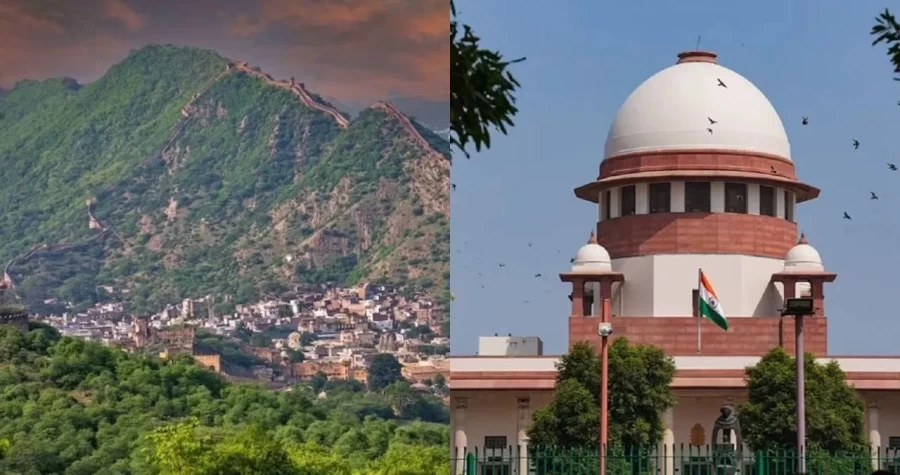
In a significant development on Monday, the Supreme Court of India has decided to stay its own previous order concerning the definition of the Aravalli Range. This crucial decision comes in the wake of widespread concerns raised by environmentalists and opposition. Parties regarding the implications of the central government's proposed definition of the ancient mountain range. The apex court, taking suo motu cognizance of the matter, has issued notices to the Central government, Haryana, Rajasthan, Delhi, and other relevant parties. The next hearing for this pivotal case has been scheduled for January 21, signaling a renewed and deeper examination into the future of the Aravalli hills.
Reversal of Previous Ruling
On November 20, the Supreme Court had initially accepted the central government's definition, which stipulated that hills with an elevation of less than 100 meters wouldn't be considered part of the Aravalli mountain range. This acceptance triggered a nationwide outcry and a fervent demand to protect the Aravalli. Environmentalists and conservation groups argued vehemently that such a definition would effectively strip significant portions of the Aravalli of their protective status, thereby opening them up to unchecked development and rampant mining activities, while faced with these extensive concerns and public apprehension, the Supreme Court took suo motu cognizance, effectively staying its previously issued directives. This stay is intended to allow for a comprehensive re-evaluation of all aspects. Of the case, aiming to arrive at a more inclusive and ecologically sound resolution.
Suo Motu Action by the Apex Court
The three-judge bench, presided over by Chief Justice of India (CJI) Suryakant, is currently hearing this sensitive matter. During the proceedings, the bench explicitly stated that there are certain issues concerning the redefinition of the Aravalli hills and mountain ranges that require further clarification. The court recognized that the previously accepted definition might have several implications that weren't fully understood or adequately addressed. So, in pursuit of a comprehensive and balanced approach, the court has decided to dive into deeper into the matter. This bench, under the leadership of the CJI, will now consider the arguments from all concerned parties. And expert opinions to formulate a strong and effective framework for the conservation of the Aravalli range.
Proposal for a High-Level Committee
In its ongoing deliberation on the redefinition of the Aravalli hills, the Supreme Court has put forth a proposal to constitute a high-level committee. This committee is envisioned to comprise experts from relevant fields, who will undertake an in-depth analysis of the matter from scientific and environmental perspectives. Solicitor General (SG) Tushar Mehta, addressing the bench, suggested that before the committee is formed, the honorable courts should determine the specific areas the committee will investigate, while this suggestion is crucial as it will ensure that the committee's scope of work is clearly defined, enabling it to effectively achieve its objectives. The primary task of this committee will be to propose a definition for the Aravalli Range that fully recognizes its ecological significance and provides a strong legal basis for its conservation. The recommendations of this committee are expected to play a pivotal role in the Supreme Court's final decision.
Interim Halt on Mining Activities
Recognizing the sensitivity of the matter, the court has taken an interim measure by issuing notices to the states, directing them to refrain from undertaking any further mining activities in the Aravalli region. CJI Suryakant clarified that the committee's recommendations and the court's directives are to be kept in abeyance for now, and this stay will remain effective until the committee is constituted. This proactive step has been taken to prevent any potential environmental damage in the Aravalli area while the final decision on the matter is pending. This immediate halt on mining activities will ensure that the fragile ecosystem of the Aravalli isn't further harmed until a new and more sustainable definition is established. It also underscores the court's commitment to environmental protection.
Next Hearing and Legal Assistance
The Supreme Court's order recorded that the apex court has proposed the formation of a high-level committee of experts from the relevant field to re-examine the previous report. In this intricate process, the Amicus Curiae (friend of the court), Solicitor General Tushar Mehta, and the Attorney General will assist the Supreme Court. Notices have been issued to the Centre and all concerned states, requesting them to clarify their positions on this matter and present them before the court, while the next hearing is scheduled for January 21, during which arguments from all parties will be heard, and further discussions on the committee's formation and its scope will take place. This hearing could prove to be a significant turning point for the future of. The Aravalli, as it seeks to strike a balance between its conservation and developmental needs.
Environmentalist and Opposition Concerns
Environmentalists and opposition parties had expressed profound concerns regarding the central government's definition of the Aravalli Range. Their apprehension stemmed from the belief that excluding hills below 100 meters. From the Aravalli chain would effectively strip these areas of legal protection. This could potentially pave the way for illegal mining, encroachment, and unplanned urbanization in these lower hilly regions, causing irreparable damage to the overall ecosystem of the Aravalli. The Aravalli Range serves as a vital green lung and water recharge zone for Delhi-NCR and surrounding areas. These deep-seated concerns were instrumental in prompting the Supreme Court. To take suo motu cognizance and reconsider its earlier order. This highlights the critical importance of public participation and judicial activism in matters of environmental preservation.
Challenges to the Centre's Definition
The definition of Aravalli proposed by the central government, which only considered hills. Above 100 meters in height as part of the range, was widely questioned. Critics argued that this definition overlooked the geological and ecological integrity of the Aravalli, while the Aravalli is an ancient mountain range comprising hills of various elevations, all of which possess their own ecological significance. Even smaller hills play a crucial role in maintaining biodiversity, water conservation, and local climate. Accepting this definition would have opened up a large portion of the Aravalli to development projects, thereby threatening its natural character. The Supreme Court's decision to reverse its ruling indicates that the court has understood the. Gravity of these arguments and is now seeking a more comprehensive and scientifically valid definition.
