

- India,
- 15-Jan-2026 01:37 PM IST


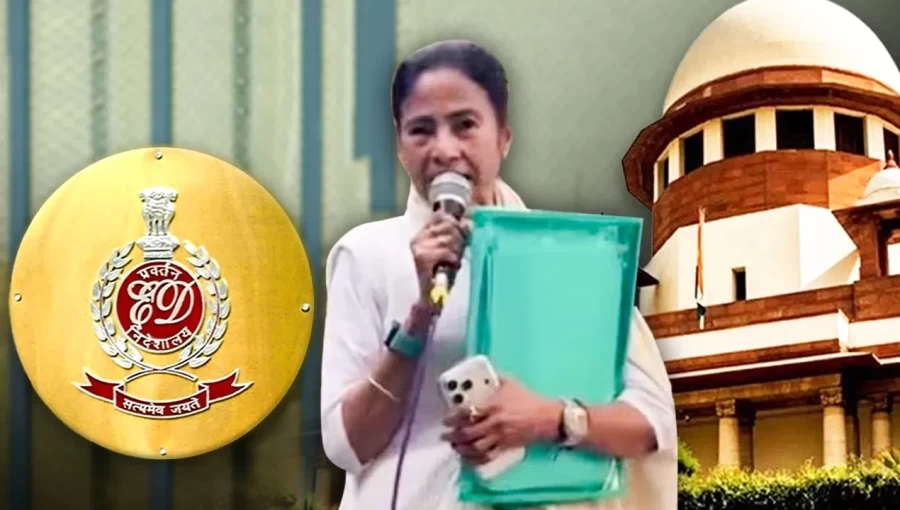
A significant hearing took place in the Supreme Court on Thursday concerning the Enforcement Directorate's (ED) raid on the I-PAC office and the residence of its Chief, Prateek Jain, in Kolkata, coupled with allegations of obstruction by West Bengal Chief Minister Mamata Banerjee. The proceedings witnessed a fierce exchange between Solicitor General (SG) Tushar Mehta, representing the ED, and senior advocate Kapil Sibal, appearing for the West Bengal government, intensifying the courtroom atmosphere.
ED's Grave Allegations: Obstruction and File Theft
During the hearing before a bench of Justices Prashant Kumar Mishra and Vipul Pancholi, the Enforcement Directorate informed the Supreme Court that the “interference and obstruction” by the West Bengal government, including Chief Minister Mamata Banerjee, during the investigation and search operation at the I-PAC office and its Chief's home, exhibited a “very shocking pattern. ” SG Tushar Mehta alleged that Chief Minister Mamata Banerjee herself arrived at the raided premises and disrupted the investigation. He stated that the state police acted in a manner akin to political members, deliberately influencing the ED's action under Section 17 of the PMLA. SG Mehta described the incident as 'shocking,' highlighting that the Chief Minister's intervention,. Accompanied by the Police Commissioner, followed by a dharna, indicated a serious pattern. He also mentioned instances where the Joint Director's house was gheraoed, prompting officers to make frantic calls.
Demand for CBI Probe and Historical Precedents
Solicitor General Mehta further alleged that Chief Minister Mamata Banerjee seized all the files, which he termed as 'theft. ' He also claimed that the Chief Minister took an ED officer's phone. The SG argued that such acts would demoralize central forces and lead. State governments to believe they could intrude, steal, and then stage protests. He called for a precedent to be set, demanding the suspension of the officers who were clearly present there. When Justice Mishra inquired if the court should suspend them, the. SG urged the court to direct the competent authority to take action. He also sought to implead the Chief Secretary and departmental officers in the case, while the SG cited past incidents, such as the arrest of CBI officers and their detention at a police station during a judicial inquiry into the chit fund scam, where the Chief Minister had also staged a dharna.
'Jantar Mantar' Like Situation in High Court
SG Tushar Mehta further informed the Supreme Court about significant commotion during a related hearing in the Calcutta High Court. He stated that the High Court environment wasn't conducive for a hearing due to a large number of lawyers gathering and creating a ruckus. The SG alleged that messages were explicitly circulated, instructing to 'turn the court into Jantar Mantar,' implying bringing a massive crowd. He claimed that WhatsApp chats from the law department were on record, indicating that these actions were orchestrated under the direction of the party's legal cell, suggesting deliberate intent rather than innocence, while he also mentioned that the High Court subsequently ordered that only lawyers would be allowed entry into the courtroom, and the proceedings would be live-streamed.
Sibal's Counter-Attack: Why ED Before Elections?
Senior advocate Kapil Sibal, representing the West Bengal government, vehemently refuted the Solicitor General's allegations and questioned the timing of the ED's actions. Sibal stated that I-PAC is responsible for election management in West Bengal, and the party had a formal contract with I-PAC in 2021. He argued that the ED was aware that I-PAC would possess significant party-related data. Sibal questioned why the ED chose to raid the I-PAC office in the middle of elections, especially when the last statement in the coal scam was recorded on February 24, 2024. He contended that if such information were seized, it would severely hamper the party's ability to contest elections. Sibal also asserted that the Chief Minister had every right to visit the premises and that video evidence would prove the ED's allegations false.
Refutation of File Theft Allegations by Sibal
Kapil Sibal dismissed the allegation that the Chief Minister seized all equipment as 'false. ' He stated that the ED's own panchnama confirmed that no seizure had occurred until 12:05 PM. Sibal clarified that only Prateek Jain's laptop, containing all election-related information, and his personal iPhone were taken by the ED. He emphasized that there was no obstruction, and the panchnama bore the ED's signatures, while sibal alleged that the claims made in the petition contradicted the panchnama and were merely intended to create prejudice. He argued that the ED went to I-PAC because it contained party material,. And the agency's actions were a malicious attempt to collect more such material.
Courtroom Dynamics and Future Implications
Sibal further argued that if an offense had occurred, the state should have been informed. He questioned how such matters could be brought under an Article 32 petition and why the High Court, which possesses jurisdiction under Article 226, shouldn't hear the case. He accused the ED of pursuing parallel proceedings, while in response, Justice Mishra advised Sibal not to put words into the court's mouth or make assumptions. Senior advocate Singhvi, representing the state and DGP, also raised serious objections to the maintainability of the petition and opposed forum shopping. He contended that the ED is permitted to intervene only in extraordinary circumstances where virtually no other remedy exists.
This heated debate in the Supreme Court underscores the escalating tensions between central and state agencies within India's federal structure, while both sides presented their arguments robustly, with the ED citing the state government's interference as a 'shocking pattern' and demanding a CBI probe, while the state government questioned the timing and intent of the ED's actions. The court heard the arguments from both parties and acknowledged the gravity of the matter. Further hearings and the court's eventual decision in this case will play a crucial role in. Defining the balance of power and the limits of cooperation between central investigative agencies and state governments.
