
- India,
- 16-Aug-2026 12:05 PM IST



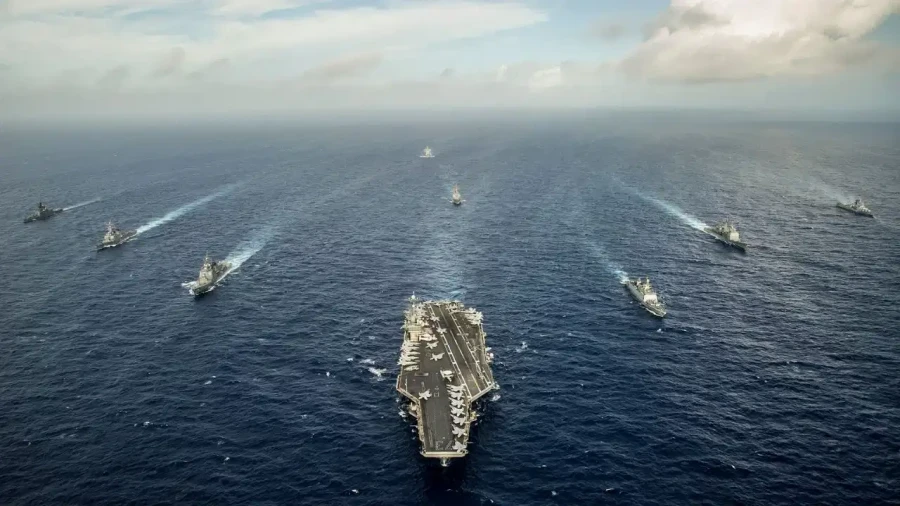
The geopolitical landscape of the Western Pacific is witnessing a significant shift as the United States Navy's last aircraft carrier in the region, the USS George Washington, prepares to depart for the Middle East. This strategic movement comes amidst the ongoing conflict involving Iran, which has necessitated a reshuffling of American naval assets, while the departure of the USS George Washington marks a period where the Western Pacific will be without a permanent US aircraft carrier presence, raising questions about the regional security balance and the potential for China to assert its influence in the South China Sea and beyond.
The Strategic Shift to the Middle East
The USS George Washington is scheduled to replace the USS Abraham Lincoln, which has been stationed in the Middle East for an extended period, while the USS Abraham Lincoln was originally slated to return to its home port in May, but the escalating tensions and the American campaign against Iran led to multiple extensions of its deployment. As of now, the USS Abraham Lincoln has been at sea for more than 240 days. This prolonged deployment has sparked significant concerns regarding the mental health of the sailors on board and the logistical challenges of maintaining supplies over such a long duration. US Democratic lawmakers have already begun demanding investigations and more detailed information regarding the condition of the ship and its crew.
Implications for China and Regional Security
Experts suggest that this move highlights the immense pressure currently facing the US military. Greg Poling from the Center for Strategic and International Studies (CSIS) noted that while the Trump administration has frequently stated that the Pacific region is its top priority after the Western Hemisphere, the conflict with Iran is forcing the US to redirect its strength back to the Middle East, while this shift has caused concern among key American allies, including Japan and the Philippines. For China, this situation presents a strategic advantage. Beijing views the American military presence as a major obstacle to its regional ambitions, particularly regarding its claims over Taiwan. While experts don't necessarily expect an immediate attack on Taiwan solely due to the carrier's departure, China is likely to use this opportunity to showcase its military prowess.
Recent Chinese Military Activities
China has already been active in demonstrating its naval capabilities. Recently, China conducted naval exercises with Indonesia and held military drills near the Scarborough Shoal in the South China Sea, a territory contested by both China and the Philippines. On top of that, last month, a Chinese missile destroyer carried out live-fire exercises near Okinotori, a southern Japanese island. These actions underscore China's readiness to fill any perceived power vacuum in the region.
The Strain on the US Carrier Fleet
The United States possesses a total of 11 aircraft carriers, with typically 2 or 3 deployed at any given time. If the USS Theodore Roosevelt is sent from San Diego to the Middle East, the number of deployed carriers could rise to 4. However, such heavy usage necessitates extensive maintenance. The US currently has only two shipyards capable of repairing these massive vessels, which could lead to significant pressure on the fleet's long-term readiness. The case of the USS Gerald R. Ford serves as a stark reminder of these challenges; it returned in May after an 11 month deployment, the longest since the Vietnam War. During its mission, which included operations against Iran and efforts to capture former Venezuelan leader Nicolas Maduro, the ship even experienced a fire in its laundry area that affected the sleeping quarters of hundreds of sailors.
Future of Naval Warfare
Experts point out that continuous sea duty leads to mental fatigue and a lack of adequate rest for sailors. On top of that, the increasing use of drones and missiles means that large aircraft carriers could become easier targets for adversaries like China, while uS Navy Admiral Daryl Caudle has emphasized the need to reduce reliance on large carriers and instead focus on utilizing smaller, newer ships and submarines, which may prove more effective in modern combat scenarios.