

- India,
- 22-Aug-2025 04:55 PM IST


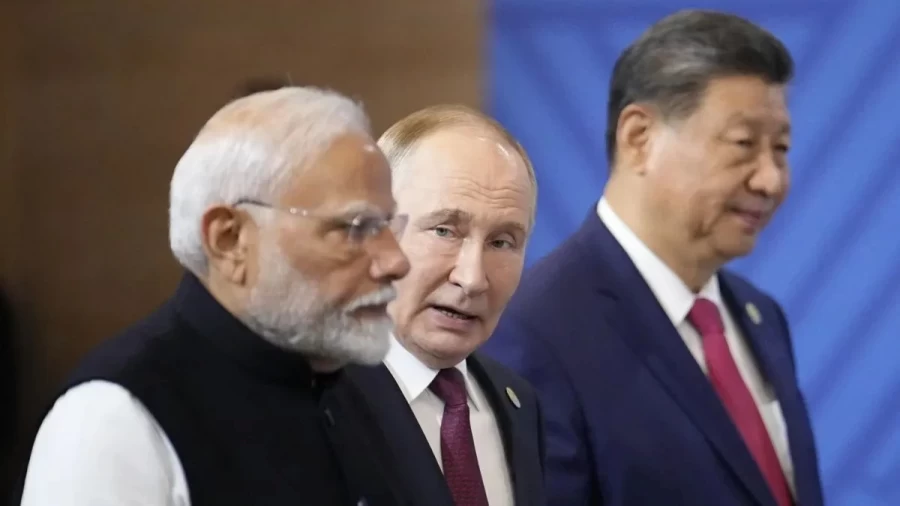
A new history is being created on the global stage for the last few days. BRICS i.e. Brazil, Russia, India, China and South Africa have surprised the world by uniting against the pressure of Western countries. These countries, which earlier looked isolated due to their mutual differences, have now come together to emerge as a strong force in front of the Western world. This is not a simple diplomatic move, but a major change that changes the equation of global economy and power. Let us try to understand the whole story of this historical turn.
The story started with Russia in 2022
In the last few years, Western countries, especially the US and the European Union, have put various kinds of pressure on the BRICS countries. In 2022, Russia's foreign exchange reserves of about $ 300 billion were seized by Western countries, causing a stir in the whole world. This was a big blow to the Global South i.e. developing countries and they realized that their assets are not safe in Western countries. This incident gave a new direction to the BRICS countries and they accelerated the campaign to reduce dependence on the US dollar, i.e. 'de-dollarization'.
Heavy tariffs imposed on China and India
The US meanwhile intensified its trade war against China, imposing heavy tariffs on Chinese goods. In response, China also took similar steps against the US. Apart from this, the US first imposed a 25 percent and then a 50 percent tariff on India for buying Russian oil, while earlier it had encouraged India to buy oil from Russia to stabilize the global market. A 50 percent tariff was also imposed on Brazil, in response to which Brazilian President Lula da Silva clearly said that his country would not tolerate this 'punishment' silently.
South Africa and Brazil were also threatened
The US State Department issued a report against South Africa, accusing it of violating the rights of racial minorities there. South Africa strongly criticized it and termed it 'contradictory'. In addition, the NATO chief threatened India, China and Brazil to talk to Russian President Vladimir Putin on the Ukraine issue or face sanctions. The European Union also put pressure on India not to buy Russian oil, while it itself is importing energy resources from Russia.
BRICS responded to everything with full force
In response to all these pressures from Western countries and especially the US, the BRICS countries further strengthened their unity. Recently, within a few days, several major diplomatic steps were taken, which are proof that BRICS is now more organized and powerful than ever before.
India's activism: India's National Security Advisor Ajit Doval made a surprise visit to Russia and met President Putin. Prime Minister Narendra Modi spoke to Brazilian President Lula da Silva over the phone and set a target of taking trade between the two countries to $20 billion by 2030. Apart from this, Modi will soon visit China for the Shanghai Cooperation Organization (SCO) meeting, which will be his first visit to China in 7 years. External Affairs Minister S. Jaishankar also met his Russian counterpart Sergei Lavrov in Moscow and discussed increasing bilateral trade.
Russia's initiative: Russian President Putin spoke to Indian Prime Minister Narendra Modi, Chinese President Xi Jinping and South African President Cyril Ramaphosa over the phone within 24 hours. This conversation was a big step towards further strengthening mutual cooperation among the BRICS countries.
China's stance: Chinese Foreign Minister Wang Yi visited India after many years, which is an indication that both countries are standing together against American pressure. China also made it clear on the BRICS platform that this organization is not made for confrontation, but for cooperation.
Brazil and South Africa's response: Brazilian President Lula rejected American pressure and said, "We do not want any emperor." He planned to use the presidency of BRICS to discuss the effects of tariffs with the leaders of India and China. South Africa also emphasized its sovereignty while responding to the allegations of America.
De-dollarization is a new turn in the global economy
The biggest step of the BRICS countries is to reduce dependence on the US dollar. These countries are now promoting trade in their local currencies. For example, oil trade between India and Russia is being done in rupees, while China and Russia have started settling 80 percent of their trade in rubles and yuan. BRICS has started working towards strengthening its systems like New Development Bank and BRICS Pay, so that it can avoid Western financial mechanisms like SWIFT. However, experts believe that the dominance of the dollar will not end soon, as it still handles 80% of global trade. Still, BRICS is moving rapidly towards making the global economy more inclusive.
Why is this rise of BRICS considered historic?
BRICS is no longer just an economic alliance, but has become a force that is challenging the unipolar world of Western countries. These countries are working towards a multipolar world, where no one country dominates the entire world. This unity of India, Russia, China, Brazil and South Africa is not only protecting their sovereignty but is also inspiring other countries of the Global South. This unity of BRICS can bring big changes in global trade, diplomacy and economy. Now it remains to be seen whether the BRICS countries are able to take this story to its conclusion with their unity or not.
