

- India,
- 12-Apr-2026 09:21 PM IST


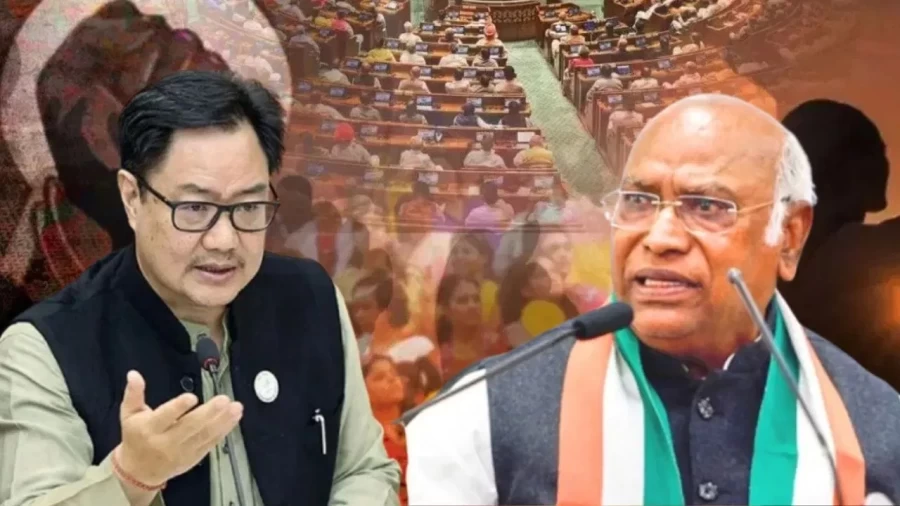
The Central Government has intensified its efforts to implement the Nari Shakti Vandan Adhiniyam (Women's Reservation Act) before the 2029 Lok Sabha elections. In a significant move to build political consensus, Union Minister for Parliamentary Affairs Kiren Rijiju has addressed a formal letter to the Leader of the Opposition in the Rajya Sabha, Mallikarjun Kharge. The government aims to ensure that the 33% reservation for women in the Lok Sabha and State Assemblies becomes a reality in the next general elections, avoiding any further legislative delays.
Rijiju's Outreach to Opposition Leader Mallikarjun Kharge
In his communication, Union Minister Kiren Rijiju emphasized that the Nari Shakti Vandan Adhiniyam, passed by Parliament in 2023, reflects a long-standing national desire and collective political commitment toward women's empowerment. He urged the opposition to extend their valuable support to facilitate the smooth passage of necessary amendments. Rijiju stated that the government is fully prepared for constructive dialogue with all political stakeholders to ensure the historic legislation is implemented without further hindrance. The letter underscores the government's intent to treat this as a national priority rather than a partisan issue.
Urgency of Implementation Before 2029 General Elections
The government has highlighted the critical timeline required to make the reservation effective by 2029. Under the original 2023 Act, the implementation was linked to the completion of the census and subsequent delimitation exercise, which could have pushed the actual reservation to 2034. However, the government now seeks to fast-track this process through specific amendments, while minister Rijiju noted that 2026 is the logical and most appropriate time to act. He warned that any delay at this stage could jeopardize the possibility of having women's reservation in place for the 2029 polls, making immediate legislative action essential.
Consultation with Political Stakeholders and NDA Allies
Addressing concerns regarding the lack of consultation, Kiren Rijiju clarified that the government has been in continuous contact with various political groups. He mentioned that since March 19, 2026, several meetings have been held with representatives from the Samajwadi Party, DMK, and other regional parties. Also, extensive discussions have taken place with NDA allies to align on the roadmap for implementation, while the Minister reiterated that the government remains open to further deliberations with the opposition to ensure that the final framework for the reservation is solid and inclusive.
Structural Changes: Expansion of Lok Sabha to 816 Seats
The implementation of the Women's Reservation Act is expected to bring about structural changes in the composition of the Lok Sabha. According to official projections, the total number of seats in the Lok Sabha is expected to increase to 816 following the delimitation process. Out of these, 273 seats will be specifically reserved for women candidates. The special three-day session of Parliament, scheduled to begin on April 16, 2026, will focus on these numerical adjustments and the legal framework required to operationalize the 33% quota across all states and union territories.
Prime Minister Modi's Call for Unified Political Action
Prime Minister Narendra Modi has also made a strong appeal to all political parties to support the early implementation of the bill. In a letter addressed to floor leaders of both Houses, the Prime Minister emphasized that a society can only progress when women are given equal opportunities to lead and participate in decision-making. He stated that conducting the 2029 Lok Sabha and Assembly elections with women's reservation is vital for the health of Indian democracy. The Prime Minister expressed confidence that this move would bring new energy to democratic institutions and ensure broader representation in governance.
