
- India,
- 23-Jun-2026 12:13 PM IST



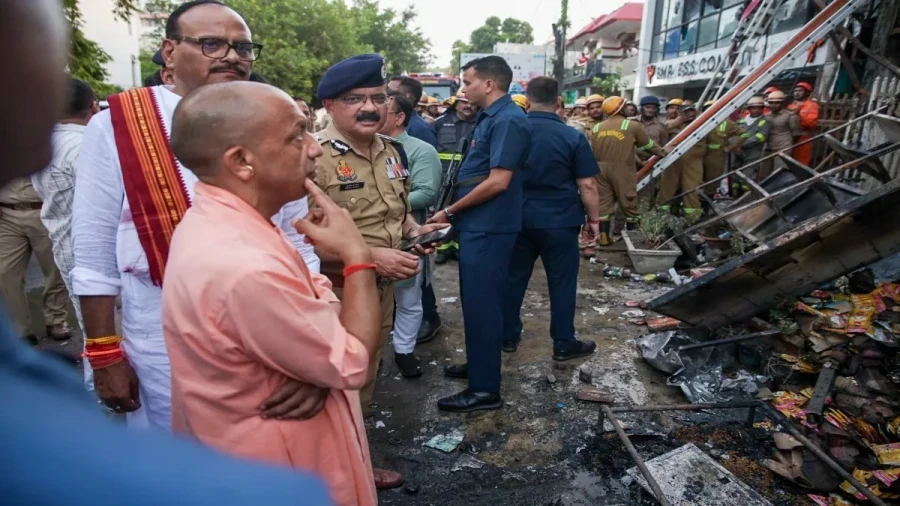
The Lucknow Development Authority (LDA) has taken a major step in the aftermath of the horrific Aliganj fire incident by issuing a formal demolition order for the building where the tragedy occurred. The authority has delivered a clear ultimatum to the owners, stating that they must demolish the building on their own accord, or the LDA will proceed to raze the structure to the ground. This decisive action follows a catastrophic fire that resulted in the loss of 15 lives, an event that shocked the entire city and prompted immediate intervention from the highest levels of the state government.
SIT Investigation and Government Response
In response to the gravity of the Aliganj fire, Chief Minister Yogi Adityanath ordered the formation of a Special Investigation Team (SIT) to conduct a thorough probe into the circumstances leading to the disaster, while the SIT was tasked with identifying the lapses in safety protocols and determining the accountability of those involved. As the investigation progressed, several glaring irregularities regarding the building's construction and usage came to light, leading the Lucknow Development Authority to issue the demolition notice. The LDA's order emphasizes that the building was in direct violation of multiple urban planning and safety regulations.
Land Use Violations and Illegal Construction
The investigation revealed that the site where the building stands is designated as a residential area. According to the land use regulations of the Lucknow Development Authority, only residential houses are permitted to be constructed on this land. However, in a significant breach of these rules, a commercial complex was erected on the site, while the records show that the plot, which measures 1992 square feet, was purchased in 2013 by Virendra Shukla and Surendra Shukla. While they successfully obtained a residential map approval in 2014, they proceeded to build a commercial complex instead of the approved residential structure.
Violation of Setback and Safety Norms
The LDA rules stipulate specific construction guidelines for such plots, including the mandatory provision of setbacks. Specifically, it's required to leave a 3 meter setback at the front and a 3 meter setback at the back of the building. This means that no construction should occur within these 3 meter zones to ensure proper ventilation and safety. Also, the inclusion of a central courtyard or 'aangan' is mandatory under the rules. The Aliganj building failed to adhere to these setback requirements, Notably increasing the risks during an emergency. Plus, commercial buildings are required to have at least two separate entry and exit routes, while in this case, the building had only one path, which was further obstructed by the installation of air conditioning outer units, making escape nearly impossible during the fire.
History of Illegal Status and Technical Failures
The building's history with the authorities is also under scrutiny. In 2016, the structure was officially declared illegal due to its various violations. However, through questionable means, the building was later legalized on paper within a short period. Technical negligence also played a major role in the tragedy. The investigation found that poor quality wiring and electrical components were used throughout the building, which likely contributed to the fire. In the animation center located within the building, the exit door was equipped with a biometric system, but the upper floor exit was found to be locked at the time of the incident. Regarding fire safety, the building didn't have a Fire NOC. According to Fire Department regulations, only buildings taller than 15 meters are required to undergo mandatory inspections for an NOC. Since this building was less than 15 meters in height, it bypassed this requirement. Another critical flaw was that the front of the building was completely closed off, leaving no room for ventilation or rescue operations.