

- India,
- 07-Apr-2026 09:41 AM IST


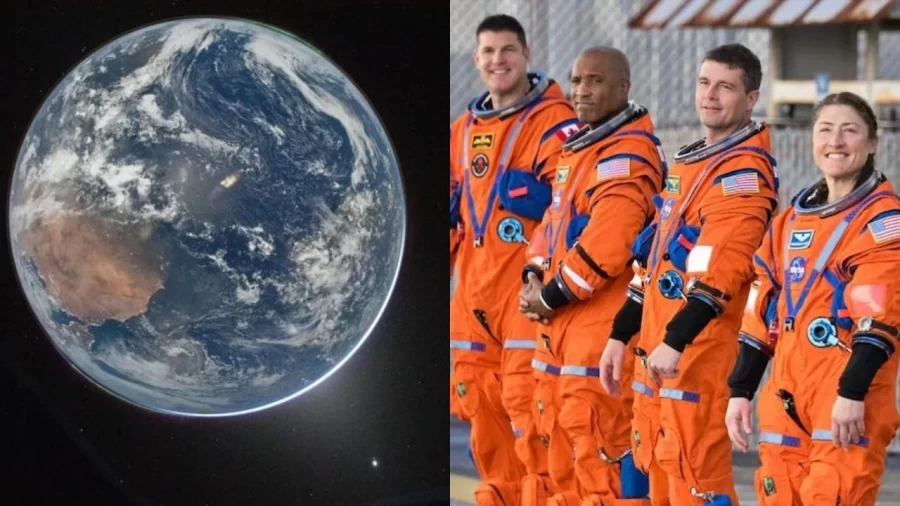
NASA's Artemis II mission has etched a new chapter in the history of human space exploration by setting a record for the furthest distance traveled by humans from Earth, while the crew of four astronauts successfully orbited the Moon, observing the lunar 'far side'—a region rarely seen by human eyes. During this historic journey, the spacecraft reached a peak distance of 252,756 miles from Earth. According to NASA officials, the astronauts turned their capsule back toward Earth on Monday night, marking the conclusion of the deep-space phase of their lunar transit.
Breaking the 54-Year-Old Apollo 13 Record
According to official flight data, the Artemis II mission has officially surpassed the long-standing record set by the Apollo 13 mission in 1970. For over five decades, the record of 248,655 miles (approximately 4,00,171 km) remained the benchmark for human deep-space travel. By reaching 252,756 miles, Artemis II has demonstrated the enhanced capabilities of modern propulsion and life-support systems. This achievement is viewed by the global scientific community as a significant leap forward in humanity's quest to explore the solar system.
Observations of the Lunar Far Side
As the spacecraft passed behind the Moon, the crew conducted detailed observations of the lunar surface. Canadian astronaut Jeremy Hansen described the experience as incredible, noting that seeing the Earth and the Moon from such a perspective was a lifelong dream realized. NASA astronaut Christina Koch reported that the lunar surface appeared distinctly brownish when viewed from close range, while the crew utilized high-resolution cameras and personal devices to capture unprecedented images of the lunar terrain. Pilot Victor Glover noted that certain mountain peaks were so reflective they appeared to be covered in snow.
Solar Eclipse Witnessed from Deep Space
In a rare celestial coincidence, the crew witnessed a total solar eclipse while beginning their return trajectory toward Earth. The three Americans and one Canadian astronaut observed the Moon passing between their spacecraft and the Sun, momentarily obscuring the solar disk. The crew described the sight as a profound experience that's difficult to articulate in words. This event marks the first time a crewed mission has documented a solar eclipse from such a significant distance in deep space, providing unique data for solar researchers.
Technical Specifications and Crew Details
The Artemis II crew consists of Commander Reid Wiseman, Pilot Victor Glover, Mission Specialist Christina Koch, and Jeremy Hansen of the Canadian Space Agency. The primary objective of this mission is to test the Orion capsule's critical systems, including life support, communication, and navigation in a deep-space environment. Throughout the flight, the crew has collected a wealth of scientific data that will be essential for future long-duration missions. The astronauts have also extended a challenge to future generations to surpass this newly established distance record.
Path Toward Future Lunar Landings
According to NASA, the success of Artemis II is a foundational step toward the Artemis III mission, which aims to land humans on the lunar South Pole. This mission serves as a rigorous test of the hardware and software required for sustained lunar exploration. The data gathered during this flight will inform the strategies for establishing a long-term human presence on the Moon, while by successfully navigating the far side and returning toward Earth, the Artemis II mission confirms that the infrastructure for the next generation of lunar exploration is operational and reliable.
