

- India,
- 30-Oct-2025 07:02 PM IST


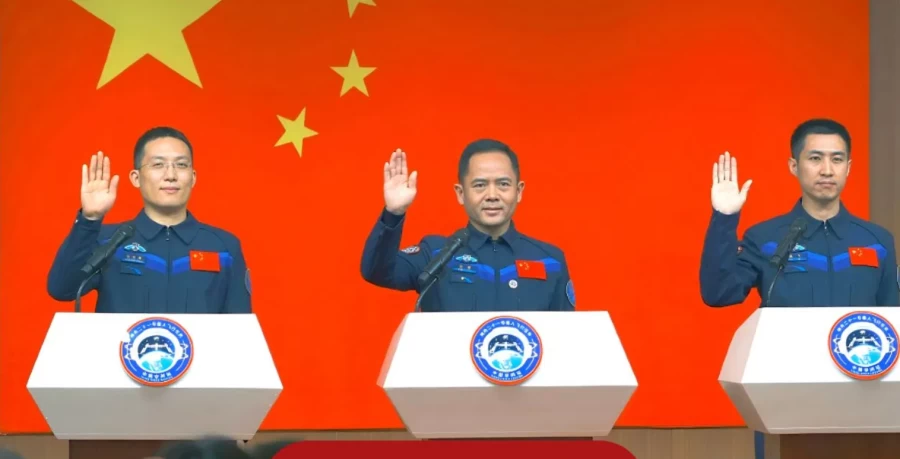
China is pushing forward with its ambitious 'Space Dream' as. It prepares to launch the Shenzhou-21 manned mission on Friday night. This significant mission will carry three astronauts and four lab mice to the Tiangong Space Station. A key highlight of the launch is that 32-year-old Wu Fei is set to become China's youngest astronaut, marking a notable milestone in the nation's burgeoning space endeavors. The launch is scheduled for 11:44 PM local time from the Jiuquan Satellite Launch Center, representing another leap in China's solid space exploration program.
Youth at the Forefront of China's Space Program
The Shenzhou-21 crew includes Commander Zhang Lu, 48, an experienced astronaut who previously participated in the Shenzhou-15 mission. He will be joined by payload specialist Zhang Hongzhang and flight engineer Wu Fei, while at 32 years old, Wu Fei, born in 1992, will establish a new record as China's youngest astronaut. Globally, the youngest person to travel to space remains Oliver. Daemen, who flew with Blue Origin at the age of 18. Wu Fei's inclusion underlines China's commitment to integrating young talent into its sophisticated space exploration initiatives, fostering a new generation of space pioneers.
Pioneering Animal Experiments in Space
In a groundbreaking move for China, the Shenzhou-21 mission will also. Transport four lab mice—two males and two females—to the Tiangong Space Station. These will be the first animals sent by China for scientific experimentation and study in space, while scientists aim to meticulously observe the effects of zero gravity on the physiology and behavior of these organisms. This research is crucial for understanding how living beings adapt to the. Harsh space environment, providing invaluable data for future long-duration human space missions. Historically, the Soviet Union sent Laika the dog into orbit in 1957,. While the US and France utilized monkeys and other animals in the 1940s-60s. Smaller creatures like frogs, fish, insects, and rabbits have also been sent to space for biological and developmental studies.
China's Ambitious 'Space Dream' Unfolds
This mission is an integral part of China's broader 'Space Dream' strategy, a multi-billion dollar investment aimed at matching and potentially surpassing the space capabilities of the United States and Russia. China has already successfully landed robotic rovers on Mars and the Moon, while its next significant objective is to send humans to the Moon by 2030 and establish a lunar base. To achieve this, China is actively developing and testing advanced technologies, including the LanYue lunar lander and the Mengzhou manned spacecraft. Commander Zhang Lu expressed confidence in the mission's success, stating that. The crew is ready to make the nation proud with their accomplishments.
