
- India,
- 14-Nov-2026 09:03 AM IST



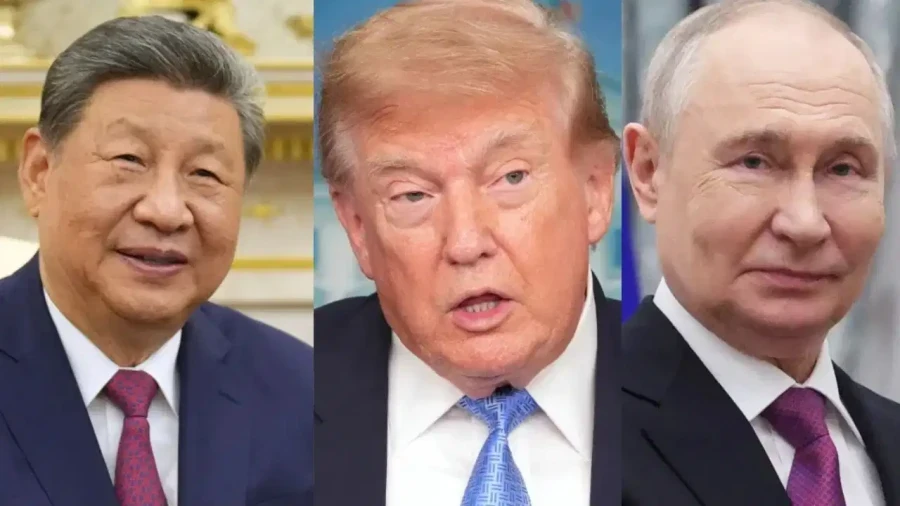
US President Donald Trump, Chinese President Xi Jinping, and Russian President Vladimir Putin are scheduled to meet during the upcoming Asia-Pacific Economic Cooperation (APEC) summit in China's tech hub, Shenzhen. The trilateral meeting, set for Thursday, will mark the first time that the leaders of the world's three largest nuclear powers sit down together, the White House confirmed on Friday. This high-profile gathering of the top leaders from the three major nuclear-armed nations is being considered extremely crucial in terms of international diplomacy, drawing intense global attention.
Symbolism Over Substance and Analyst Perspectives
Although the gathering of these leaders for joint talks will undoubtedly be a momentous occasion, analysts suggest that major concrete breakthroughs from these discussions are unlikely. They note that the engagement will likely emphasize symbolism over substance. The White House confirmed on Friday that this trilateral summit between Donald Trump, Xi Jinping, and Vladimir Putin will indeed take place, while this meeting comes at a time when relations among these three nations are navigating a highly complex and sensitive phase. Following a brief trade war last year, a preliminary agreement was reached between Trump and Xi Jinping, while since then, Trump has displayed considerable warmth toward Xi Jinping, despite ongoing tensions between the US and Iran, alongside persistent disagreements between these major global economic powers on various other fronts. Similarly, Trump has sought to improve his personal relationship with Russian leader Vladimir Putin, even as Moscow remains deeply embroiled in a nearly five-year war with Ukraine and has further deepened its military, intelligence, and diplomatic partnership with Iran.
Expected Focus on Nuclear Weapons and Iran Crisis
US President Donald Trump has stated that this meeting will provide the three leaders an opportunity to discuss US tensions with Iran and the overarching goal of forging a trilateral understanding on nuclear weapon stockpiles. According to a senior US official who spoke to reporters on the condition of anonymity, Trump plans to discuss the Iran conflict with Xi and Putin, but won't place Ukraine on the agenda for this specific discussion. The previous arms control agreement governing strategic nuclear weapons between Russia and the United States expired in February. This marked the first time in over half a century that numerical limits on the arsenals of the two largest nuclear superpowers have been entirely removed. When this pact, known as the New START treaty, lapsed, Trump rejected a Russian proposal to extend the agreement for another year. Instead, Trump called for a new, broader, and more modern agreement that would also incorporate China.
Nuclear Disarmament and China Position
The US official explained that the objective of this trilateral meeting is to initiate a conversation on nuclear disarmament that could yield long-term benefits down the line. The official also clarified that no formal agreement announcements are anticipated to come out of this specific gathering. According to Pentagon estimates, Beijing possesses over 600 nuclear warheads, which is Notably smaller than the massive arsenals held by the United States and Russia. Each of the US and Russia is estimated to maintain stockpiles exceeding 5,000 warheads. Given that its own stockpile is dwarfed by the massive nuclear arsenals of Washington and Moscow, China has historically shown very limited interest in participating in trilateral nuclear arms control negotiations, while officials within the Trump administration recognize that engaging Beijing on the sensitive issue of nuclear stockpiles will be an uphill task, yet the US official framed this meeting as an opportunity for China to step forward as a responsible stakeholder on a matter of critical international importance.
Displaying Superpower Status and Diplomatic Motives
By agreeing to host the meeting, Xi Jinping likely calculates that the event affords him a prestigious platform to showcase China's growing global influence and diplomatic stature. For the Kremlin, this trilateral summit presents a prime opportunity to project itself as a superpower standing on equal footing with Washington and Beijing. Edgar Kagan, a former US ambassador to Malaysia currently associated with the Center for Strategic and International Studies, remarked that he would be profoundly surprised if the meeting produced a joint statement addressing nuclear disarmament in any meaningful way, while for Moscow, Kagan noted, Putin's primary motivation was likely the desire to project an image of conferring directly with the US President and Chairman Xi, thereby signaling that critical decisions regarding Ukraine are being made with his involvement—an optics outcome that's naturally unappealing to Ukrainians and European allies alike.
Overshadowing the Broader APEC Summit
This trilateral meetup threatens to completely overshadow the broader APEC summit proceedings. The gathering in Shenzhen brings together delegations from 21 economies, serving as a major showcase for China to display its rapidly developing, high-tech coastal metropolis—a city that transformed over a few decades from a sleepy fishing village into a global technology and financial powerhouse. More Notably, a meeting of this magnitude could potentially blunt some of China's core diplomatic arguments, including its frequent assertions that Russia's invasion of Ukraine was primarily provoked by Western Cold War mentalities. Plus, it could complicate Beijing's criticisms alleging that the United States has systematically undermined international institutions and foundational treaties. Huong Tiang Boon, a professor of Chinese foreign policy at Nanyang Technological University, observed that this trilateral summit could potentially run counter to China's efforts to portray itself at APEC as a steadfast champion of free trade and multilateralism.
Prior Relations and the Deep Moscow-Beijing Axis
Over the past several years, these leaders have interacted through numerous bilateral engagements. Putin and Xi are well acquainted, sharing a close personal rapport, while since Xi assumed the presidency in 2013, the two leaders have met more than 40 times, frequently referring to each other as close personal friends. Trump and Putin have met face-to-face on seven distinct occasions, with their most recent encounter occurring in Alaska in August 2025. Meanwhile, Xi and Trump have held eight face-to-face dialogues, which included Xi's state visit to Washington in September. Beijing currently stands as Moscow's largest trading partner, a commercial bond that has tightened considerably since Putin ordered troops into Ukraine in 2022. As the European Union and Western nations sought to economically isolate Russia, China ramped up its purchases of Russian energy resources. China has emerged as a vital supplier of crucial technologies to Moscow, encompassing high-tech components essential for the Russian defense industrial base. Beijing has consistently rebuffed Western demands to curtail these supply lines, while even before the onset of the war in Ukraine, Xi and Putin famously declared a friendship with no limits between their nations. While Beijing maintains an official stance of neutrality regarding the conflict, it has frequently echoed assertions that Kiev's Western backers helped instigate Moscow's military actions.
Ukrainian Apprehensions and Kremlin Clarifications
Meanwhile, Ukrainian President Volodymyr Zelenskyy has expressed deep apprehension that this trilateral meeting could function as a forum where arrangements concerning Ukraine might be discussed behind Kiev's back. Comparisons have been drawn between the planning of this summit and the historic Yalta Conference of 1945, where leaders of the United States, Great Britain, and the Soviet Union agreed on the post-war division of Germany and finalized plans for the establishment of the United Nations. However, Kremlin spokesperson Dmitry Peskov dismissed comparisons to Yalta, asserting that any prospective understandings reached in Shenzhen can't and won't be imposed upon others. Peskov stated that while meetings among the leaders of major powers like Russia, China, and the United States are undeniably vital, it must not be forgotten that the ultimate vision for global governance dictates that no nation should attempt to impose its worldview on others, but rather build relations strictly on principles of mutual benefit and mutual respect.