

- India,
- 11-Mar-2026 09:55 AM IST


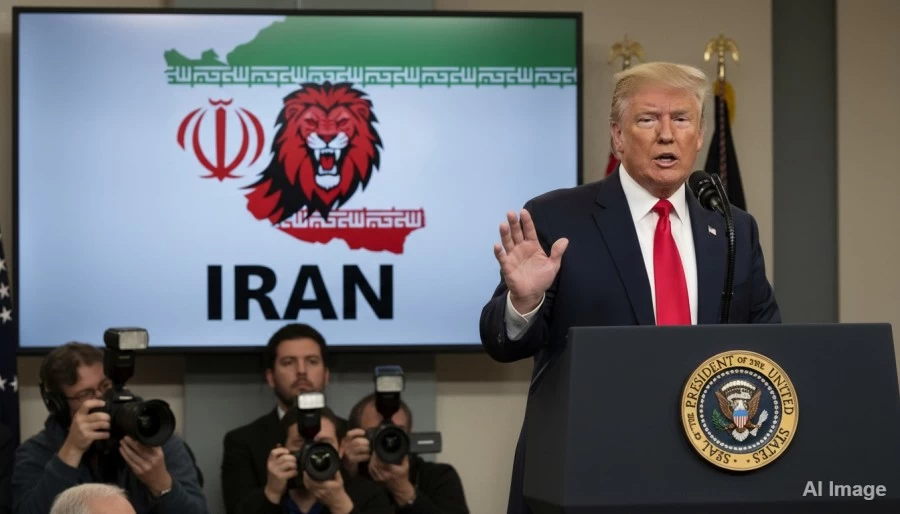
United States President Donald Trump has issued a severe ultimatum to Iran, warning of unprecedented military consequences if the Islamic Republic attempts to plant naval mines in the Strait of Hormuz. Trump explicitly stated that any mines already placed in the strategic waterway must be removed immediately. Following this statement, the President announced that US forces had successfully targeted and destroyed 10 inactive Iranian mine-laying vessels. This escalation occurs amid a broader conflict in West Asia, raising significant concerns regarding the stability of international maritime trade and energy corridors.
Trump Issues Direct Military Ultimatum to Tehran
In a series of posts on his social media platform, Truth Social, President Donald Trump addressed the Iranian leadership directly. " Trump emphasized that the immediate removal of any existing mines would be viewed as a significant step in the right direction. The President's rhetoric underscores a zero-tolerance policy toward any attempts to block or endanger the world's most critical oil transit chokepoint.
Destruction of Iranian Mine Laying Vessels
Shortly after his initial warning, President Trump confirmed that US military assets had identified and neutralized 10 Iranian vessels designed for mine-laying operations. According to the President, these boats were destroyed while in an inactive state, and he indicated that further strikes against similar assets would continue as necessary. Trump revealed that the US is utilizing advanced surveillance and missile capabilities—technologies previously deployed against high-level narcotics traffickers—to detect and eliminate any vessel attempting to disrupt navigation in the Strait. He warned that any future attempts would be dealt with swiftly and severely.
US Central Command and Strategic Objectives
The US Central Command (CENTCOM) corroborated the President's statements by releasing footage of military operations in the region. CENTCOM stated that US forces are actively working to degrade the Iranian regime's ability to project power at sea and harass international shipping. According to military officials, Iranian naval forces have long posed a threat to the freedom of navigation in waters essential for regional and global security. Simultaneously, White House Press Secretary Karoline Leavitt informed reporters that the administration has not ruled out the possibility of deploying ground troops if necessary. She stated that military operations, under the framework of 'Epic Fury,' would continue until all strategic objectives are met.
Escalation of Conflict Across West Asia
The maritime tension is part of a rapidly deteriorating security situation across West Asia. Reports indicate that Iran has launched retaliatory strikes using missiles and drones against various US military installations, embassies, and energy infrastructure in the region, while these incidents have been reported in several neighboring countries, including the United Arab Emirates, Saudi Arabia, Qatar, Kuwait, Bahrain, and Jordan. The intensification of hostilities has placed regional allies on high alert as the risk of a direct and full-scale military confrontation between Washington and Tehran continues to grow, affecting diplomatic and security dynamics across the Persian Gulf.
Implications for Global Energy and Oil Markets
The Strait of Hormuz is widely regarded as the world's most important oil transit hub, with approximately 20% of the global oil supply passing through the waterway daily. Located between Oman and Iran, it connects the Persian Gulf with the Gulf of Oman and the Arabian Sea. Any prolonged disruption or the presence of naval mines in this area could lead to a sharp increase in global energy prices and trigger significant volatility in international markets. US officials have reiterated that maintaining the free flow of commerce through the Strait is a matter of national and global economic security, justifying the use of force to prevent Iranian interference.
