

- India,
- 31-Oct-2025 06:32 PM IST


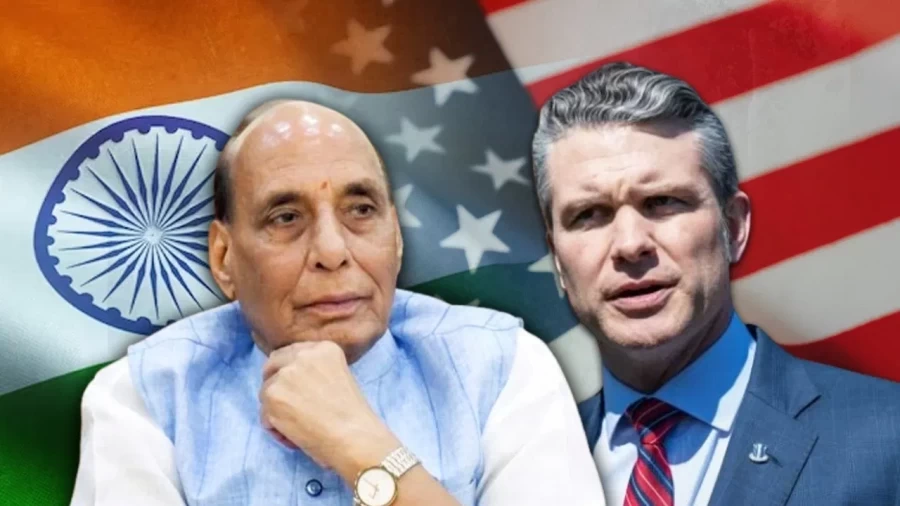
India and the United States have formalized a landmark 10-year defense agreement, an announcement made by US Defense Secretary Pete Hegseth. This pivotal deal is set to elevate defense cooperation between the two nations to unprecedented levels, with information sharing, advanced defense technology, and military interoperability forming its core pillars. The historic agreement was unveiled following a meeting between India's Defense Minister Rajnath Singh and US Defense Secretary Pete Hegseth in Kuala Lumpur, Malaysia.
Core Objectives and Duration of the Agreement
This comprehensive agreement will span a decade, during which India and the United States will collaborate extensively in the defense sector. The primary objectives of this deal are to bolster the defense capabilities of both countries and to foster stability and security within the Indo-Pacific region, while this partnership extends beyond mere arms procurement, encompassing broader dimensions of strategic cooperation and technological advancement, signifying a deeper commitment to mutual security interests.
Defense Technology Sharing and Joint Production Initiatives
Under the terms of the agreement, India and the United States will share critical defense technological information. This provision is crucial for India, as it opens avenues for accessing cutting-edge US defense technologies, thereby boosting its indigenous defense research and development capabilities, while On top of that, both nations are committed to promoting joint production and technical cooperation. This implies that in the future, several defense systems could be manufactured in India, aligning with the 'Make in India' initiative and enhancing India's self-reliance in defense. This collaboration won't be limited to existing systems but will. Also focus on new and emerging technologies, ensuring a forward-looking partnership.
Strengthening Military Interoperability
Another significant aspect of this deal is the strengthening of interoperability between the two armed forces. This means that the Indian and US militaries will be able to coordinate. More effectively in future joint military exercises, training programs, and humanitarian assistance operations. Enhanced interoperability will allow the forces to better understand each other's systems and procedures, improving their response time and effectiveness in addressing shared challenges. This strategic coordination will be particularly vital in tackling regional security concerns and ensuring a cohesive approach to defense.
Key Benefits for India
This defense agreement promises numerous direct and indirect benefits for India. Firstly, India will gain access to advanced US defense technology, accelerating its military modernization process. The United States will provide India with new weapons and systems, including Javelin anti-tank missiles and Stryker armored vehicles. Javelin missiles are renowned for their 'fire and forget' capability, which will Notably enhance the Indian Army's anti-armor capabilities. The Stryker armored vehicles, on the other hand, will offer high mobility. And protection to the Indian Army, especially in challenging terrains, bolstering ground forces.
Marine Patrol Aircraft and Advanced Drones
As part of the agreement, discussions have progressed on the acquisition of 6 new P-8I marine patrol aircraft, while the P-8I aircraft will further strengthen the Indian Navy's capabilities in maritime surveillance, anti-submarine warfare, and intelligence gathering, which are critical for India's maritime security in the Indo-Pacific region. India already operates a range of US-made defense assets, including C-130J Super Hercules, C-17 Globemaster III, P-8I Poseidon, CH-47F Chinook, MH-60R Sea Hawk, and AH-64E Apache. On top of that, M777 Howitzer artillery guns, Harpoon missiles, and MQ-9B Sky Guardians drones are integral to India's defense arsenal. The MQ-9B drones, in particular, are crucial for long-range surveillance and reconnaissance capabilities, aiding India in better monitoring its borders and maritime zones.
Growing Influence in the Indo-Pacific
US Defense Secretary Pete Hegseth emphasized that both nations comprehend regional security concerns and possess the capacity to collectively confront these threats. He stated that the United States is prepared to provide India with the necessary means to enhance security in the Indo-Pacific region. This partnership will Notably bolster India's strategic position amidst China's growing influence in the Indo-Pacific. India's External Affairs Minister S. Jaishankar also underscored the importance of this agreement, remarking that the India-US defense partnership stands as one of the most crucial pillars of their relationship today. He added that this partnership is founded not merely on shared interests, but on a shared understanding of responsibilities and capabilities, which further strengthens its foundation. This agreement is poised to not only foster greater trust and cooperation between the two nations but also play a vital role in building a more stable and secure Indo-Pacific region for all.
