
- India,
- 19-Jul-2026 03:14 PM IST



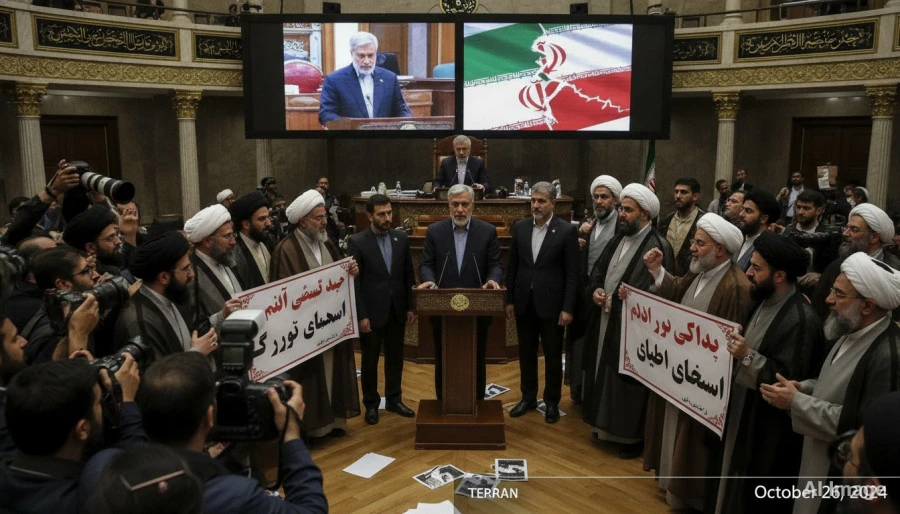
The political landscape in Iran has been plunged into chaos following a controversial agreement with the United States. This diplomatic move has triggered a fierce internal rebellion, with hardline factions accusing President Masoud Pezeshkian and Foreign Minister Abbas Araghchi of conspiring against the Islamic Republic. The tension reached a boiling point during the funeral of the late Supreme Leader Ali Khamenei in Tehran. As President Pezeshkian walked alongside the funeral procession, groups of hardliners dressed in black chanted provocative slogans such as "Death to the compromiser" directly at him. The situation escalated further when Foreign Minister Abbas Araghchi was targeted with stones and labeled a traitor and a sell-out, forcing him to flee the scene for his safety.
Allegations of a Soft Coup
According to reports by CNN, a theory is rapidly gaining traction among Iran's ultra-conservative circles that the leaders who signed the deal with Washington have effectively executed a peaceful or soft coup against the revolutionary ideals of the state. The hardliners, including members of the Paydari Front and conservative lawmakers, claim that these leaders acted against the will of the new Supreme Leader, Mojtaba Khamenei. They argue that instead of avenging the death of Ali Khamenei, the current administration has surrendered to American interests. The mystery is deepened by the total public absence of Mojtaba Khamenei, with rumors suggesting he's either in hiding due to security threats or is unwell, while arash Azizi, an Iran expert and author of "What Iranians Want," notes that Mojtaba's absence has left a power vacuum, allowing Pezeshkian, Araghchi, and Parliament Speaker Mohammad Bagher Ghalibaf to effectively run the country, which the hardliners view as a coordinated takeover.
Threats and Internal Resistance
The opposition to the deal isn't limited to street protests. Hardline lawmaker Mahmoud Nabavian took to the social media platform X to warn the public of an impending coup, stating that they would stand firm against this betrayal and uphold the flag of vengeance for the martyred Imam. Another lawmaker, Kamran Ghazanfari, dismissed the government's claims of victory as a blatant lie, asserting that the US has not actually retreated. Perhaps the most chilling threat came from Mohammad Ali Bakhshi, a religious singer linked to the regime, who publicly warned the President that if the Supreme Leader's conditions weren't met, they would use their swords against him. Despite the severity of this threat, no legal action has been taken against Bakhshi.
The Hormuz Strait Dispute and Ceasefire Breakdown
The core of the dispute lies in the Hormuz Strait agreement. The Guardian reports that hardliners are furious over the decision to open this strategic waterway, which they consider Iran's strongest bargaining chip. Hossein Shariatmadari, editor of the hardline newspaper Kehan, questioned why Tehran would give up such use without clear guarantees of sanctions relief, while this internal friction manifested on the ground when the fragile ceasefire between Iran and the US nearly collapsed this week. The Revolutionary Guards attempted to assert dominance by targeting vessels in the Hormuz Strait, prompting a military response from the United States. In defense of the deal, Mehdi Mohammadi, an advisor to Speaker Ghalibaf, presented 3 key arguments: first, the deal ends the war and provides sanctions relief; second, Iran and Oman will regulate shipping under Iranian systems; and third, Iran has not accepted new nuclear restrictions, merely reiterating its policy of not building nuclear weapons.
The Three Poles of Power
Iranian politics is currently divided into 3 distinct poles. On one side are the reformists led by Pezeshkian and Araghchi, who seek to lift sanctions to save the economy. On the opposite side are the ultra-hardliners of the Paydari Front, who prioritize ideological purity and direct confrontation with the US. The third pole is the silent and absent Supreme Leader Mojtaba Khamenei, whose lack of public direction has fueled the current crisis and left the nation's future hanging in the balance.