

- India,
- 08-Mar-2026 07:10 PM IST


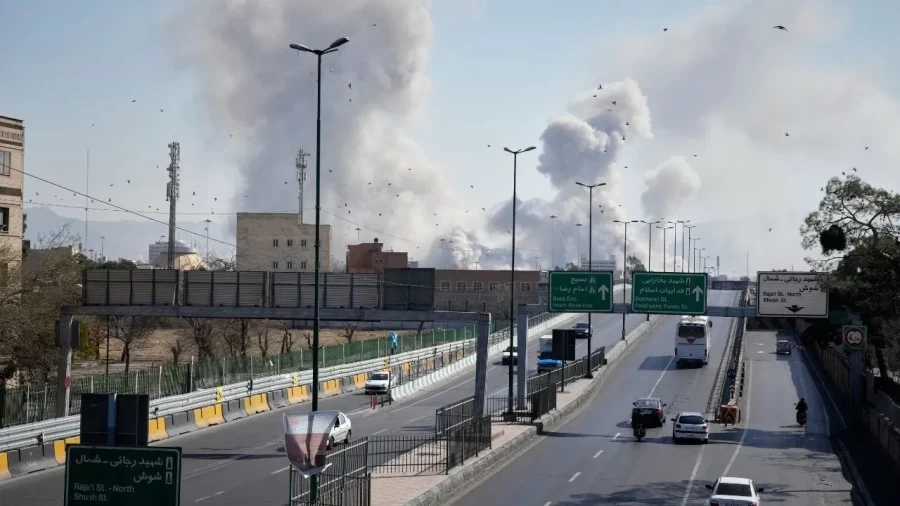
The military confrontation between Iran and the US-Israel alliance has entered its eighth day, marked by an unprecedented scale of aerial and missile warfare. According to official military reports and defense data, more than 8,000 attacks have been exchanged between the opposing sides within this brief period. The conflict is characterized by high-intensity strikes involving advanced fighter jets, ballistic missiles, and unmanned aerial vehicles (UAVs). Data indicates that the combined forces of the United States and Israel have executed approximately 4,500 air strikes. In response, Iran has deployed nearly 3,500 offensive vectors, including a significant barrage of 905 ballistic missiles. Military officials state that the intensity of these exchanges represents one of the most concentrated missile conflicts in modern history.
Scale and Scope of US-Israeli Aerial Offensives
The 4,500 strikes conducted by the US and Israel have utilized a wide array of sophisticated aerial platforms and precision-guided munitions. According to defense sources, F-35 Lightning II stealth fighters, along with F-15 and F-16 squadrons, have been central to these operations. The primary objectives of these strikes have been the systematic degradation of Iran's military infrastructure. Key targets include underground missile silos, early-warning radar installations, command and control centers, and drone manufacturing facilities. Also, the Israeli Air Force has reportedly deployed bunker-buster munitions to penetrate fortified Iranian positions. The US Navy, operating from the Red Sea and the Mediterranean, has complemented these efforts by launching Tomahawk cruise missiles from guided-missile destroyers to neutralize coastal defense batteries.
Iran’s Strategic Response and Ballistic Missile Deployment
Iran has responded to the aerial campaign with a massive counter-offensive involving approximately 3,500 weapon vectors. In military terminology, a 'vector' refers to any delivery system, including ballistic missiles, cruise missiles, and drones. The deployment of 905 ballistic missiles highlights Iran's reliance on its long-range strike capabilities. Reports suggest the use of advanced missile variants such as the 'Kheibar Shekan', 'Fattah' hypersonic missiles, and the 'Shahab' series. Iran's strategy appears focused on targeting Israeli airbases and strategic maritime ports to disrupt military operations. On top of that, the extensive use of 'Shahed' loitering munitions aims to saturate and overwhelm enemy air defense systems, creating windows of opportunity for ballistic strikes to penetrate the defensive umbrella.
Evaluation of Advanced Air Defense Interception Capabilities
The defining feature of this conflict is the technological duel between sophisticated air defense systems. Israel has activated its multi-layered defense architecture, comprising the 'Iron Dome' for short-range threats, 'David’s Sling' for medium-range interceptions, and the 'Arrow' system for exo-atmospheric ballistic missile defense. To bolster these defenses, the United States has deployed 'Patriot' missile batteries and the 'THAAD' (Terminal High Altitude Area Defense) radar system to provide comprehensive coverage. Conversely, Iran has utilized its indigenous 'Bavar-373' and 'Khordad-15' systems, alongside Russian-made air defense units, to protect its airspace. Military experts observe that the strategic advantage in this conflict is currently dictated by the interception success rates of these competing technologies.
Integration of Unmanned Aerial Vehicles and Precision Munitions
The conflict has seen a easy integration of fifth-generation fighter aircraft and unmanned aerial vehicles (UAVs). US and Israeli forces have utilized high-altitude long-endurance (HALE) drones for real-time intelligence and target acquisition, allowing for rapid strikes on mobile Iranian missile launchers. Iran has countered with 'swarm drone' tactics, launching dozens of UAVs simultaneously to confuse radar arrays and deplete interceptor stockpiles. Reports indicate that Iranian drones are being programmed for low-altitude flight paths to evade radar detection. This technological tug-of-war has transformed the battlefield into a high-stakes electronic warfare environment, where signal jamming and cyber-interference play as much a role as physical munitions.
Impact on Regional Military Infrastructure and Command Chains
Eight days of continuous bombardment have placed immense strain on the military logistics and supply chains of all involved parties. US and Israeli strikes have specifically targeted Iranian transport routes used for missile logistics, as well as fuel depots and power infrastructure supporting military installations, while iran has reciprocated by attempting to strike the logistical hubs that facilitate Israeli sorties. According to military analysts, the sheer volume of fire is rapidly depleting munitions stockpiles, forcing both sides to prioritize the protection of production facilities and maintenance hubs. The conflict underscores that in modern warfare, the ability to maintain a functional command chain under constant missile threat is the primary factor in sustaining long-term military operations.
