

- India,
- 27-Dec-2025 08:05 AM IST
- (Updated 27-Dec-2025 08:53 AM IST)


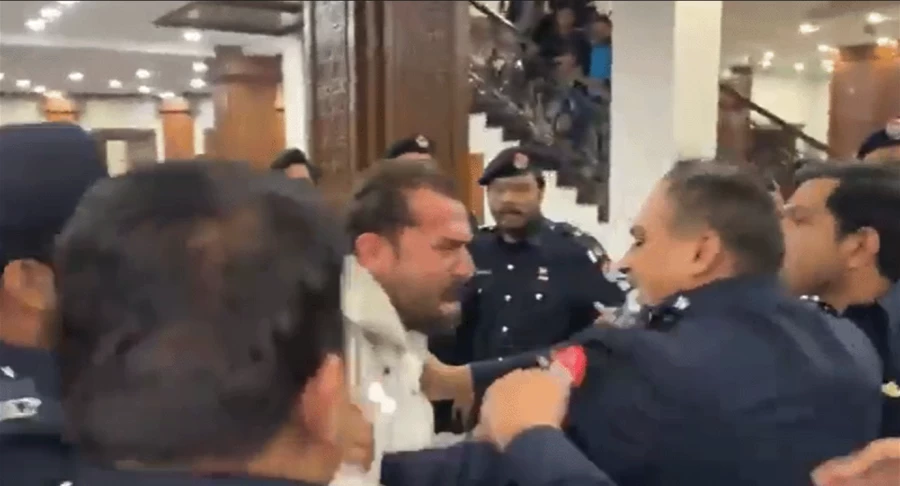
Political tensions in Pakistan have reached a boiling point, with Khyber Pakhtunkhwa (KP) Chief Minister Sohail Afridi reportedly facing physical assault once again. The incident occurred on Friday in the Punjab Assembly, where. Security personnel allegedly manhandled the Chief Minister and his representatives. A video of the event has surfaced, raising serious questions about the escalating political instability and the erosion of democratic values within Pakistan.
Confrontation in Punjab Assembly
The video footage clearly depicts Chief Minister Afridi and his representatives attempting to enter the Punjab Assembly. During this attempt, security personnel reportedly tried to block their entry. In the ensuing scuffle, Fateh Ullah Burki, one of Afridi's companions, intervened. Following this, guards allegedly assaulted Burki, pushing him and attempting to forcibly remove him from the assembly premises. However, other officials intervened, leading to Burki's release. Pakistani authorities have stated that no one sustained serious injuries in this particular. Incident, but the nature of the event has sent ripples through political circles.
Chief Minister Afridi's Strong Condemnation
Following the incident, Chief Minister Afridi issued a statement strongly condemning the actions. He declared, "No democratic government does such a thing, this is directly like martial law behavior. " Afridi expressed deep concern over the state of democracy in Pakistan, stating that it's in danger. He accused the Punjab government of being a "fake government" solely focused on "intimidating and threatening one party, while " Afridi also detailed alleged harassment faced by his workers in Lahore, including "bad behavior and harassment," their paths being blocked in Chakri and Mandi Bahauddin, vehicles stopped, some workers arrested, and Members of Parliament (MPs) also being mistreated.
Political Rivalry and Context
This incident unfolds against a complex political backdrop in Pakistan. The Punjab province is governed by the Muslim League-N (PML-N), with Nawaz Sharif's daughter, Maryam Nawaz, serving as Chief Minister. In contrast, Khyber Pakhtunkhwa Chief Minister Sohail Afridi belongs to Imran Khan's Pakistan Tehreek-e-Insaf (PTI) party, while this political divide and power struggle are at the core of these events, where a Chief Minister from one province faces such mistreatment in the assembly of another. It clearly illustrates the extent to which political rivalries have intensified within the country.
A Precedent of Violence: Adiala Jail Incident
This isn't the first instance where Chief Minister Sohail Afridi has faced physical assault. Approximately one month prior, on November 28, he was reportedly beaten by police while visiting Imran Khan at Adiala Jail in Rawalpindi. During that incident, police allegedly pulled his hair and threw him to the ground. This earlier event had already heightened political tensions, and the new incident in the Punjab Assembly has further exacerbated the situation, while it underscores the harsh stance of the state apparatus against political opponents.
Calls for Afridi's Removal and Administrative Concerns
According to media reports, the attack on Chief Minister Sohail Afridi at. Adiala Jail was allegedly carried out "on the orders of the army. " At the time of Afridi's arrival at the jail, heavy security was deployed, and the crowd of Pakistan Tehreek-e-Insaf (PTI) supporters was continuously growing. His arrival reportedly "worsened the situation," which may have prompted authorities to use force. These allegations, if true, raise serious concerns about civil-military relations in Pakistan and the alleged influence of the military over democratic institutions.
Amidst these events, Pakistan's Minister of State for Justice, Aqeel Malik, made a statement on December 1, asserting that "the security and administrative situation in Pakhtunkhwa has become very bad. " This statement followed Afridi's overnight protest outside Rawalpindi Central Jail. Malik accused Afridi of having "badly failed to improve the situation there" in Khyber Pakhtunkhwa. He further criticized Afridi for "neither coordinating with the central government nor taking necessary action in crucial areas, while " These remarks cast a shadow over Chief Minister Afridi's future and his position in Khyber Pakhtunkhwa, further complicating the ongoing political turmoil.
Implications for Pakistani Democracy
The repeated assaults and confrontations involving a provincial Chief Minister, coupled with accusations of "martial law-like behavior" and a "fake government," paint a concerning picture for Pakistan's democratic future. Chief Minister Afridi's assertion that "democracy in Pakistan is in danger" resonates. Deeply in a climate where political figures face physical violence and administrative threats. The ongoing tensions between provincial and central authorities, and between rival political parties, contribute to an environment of instability and uncertainty, challenging the very foundations of democratic governance in the nation.
