
- India,
- 21-Sep-2026 08:45 AM IST



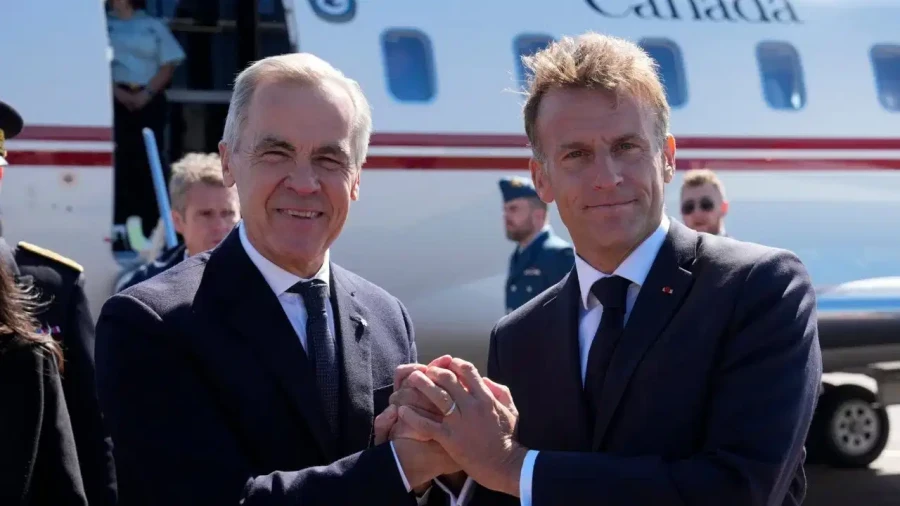
French President Emmanuel Macron has officially backed the proposal to designate Canada as the first associate member of the European Union (EU). This significant diplomatic development occurred during a high-profile meeting between President Macron and Canadian Prime Minister Mark Carney on Sunday. The meeting took place in the French territory of Saint-Pierre-et-Miquelon, an archipelago located near the coast of Newfoundland, Canada. The proximity of this French territory to Canada, being only a few kilometers away, served as a symbolic backdrop for the discussions aimed at strengthening trans-Atlantic ties.
Strengthening Ties Amid US Tensions
The meeting between the two leaders comes at a critical juncture when relations between Canada and the United States have become increasingly strained. US President Donald Trump has recently imposed tariffs on Canada and has made several controversial remarks, including suggesting that Canada could become the 51st state of the United States. Also, Trump recently shared a map on social media depicting the entire North American continent under the American flag, which included both Canada and the French territory of Saint-Pierre-et-Miquelon. In this context, President Macron emphasized that the relationship between France, Canada, and Europe must be further strengthened. Prime Minister Mark Carney echoed these sentiments, stating that while the physical distance between Canada and France is small, the shared values and relationships between the two nations are even closer.
The Associate Membership Proposal
The idea of granting Canada associate membership was recently proposed by the President of the European Commission, Ursula von der Leyen. Prime Minister Carney has expressed his support for this concept, noting that stronger ties with Europe would help Canada reduce its economic dependence on any single nation. Although the status of an associate member doesn't currently exist within the formal structure of the European Union, the proposal marks a significant shift in geopolitical alignment. Both leaders discussed the potential for this new form of partnership to foster deeper integration without the full requirements of EU membership.
Enhanced Cooperation in Defense and Technology
During the summit, France and Canada agreed to increase cooperation across several strategic sectors. Both nations have directed their respective space agencies and defense ministries to develop a shared framework for collaboration. This initiative includes the development of rocket launch systems and ground-based satellite facilities. The scope of cooperation extends to energy, telecommunications, climate action, and general economic development. Specific discussions were held regarding critical minerals, rare earth elements, quantum computing, satellite technology, and supercomputing, while president Macron highlighted that Canada possesses vast resources of oil, gas, and essential minerals. He expressed France's interest in securing more Liquefied Natural Gas (LNG) agreements from Canada for the benefit of Europe.
Regional Security and International Agreements
In addition to his meeting with Macron, Prime Minister Carney also held talks with Norwegian Prime Minister Jonas Gahr Store on Sunday. Their discussions focused on defense, Arctic security, energy, and the implementation of new technologies. Following these meetings, Carney is scheduled to travel to New York on Monday for the United Nations General Assembly. During the discussions in Saint-Pierre-et-Miquelon, President Macron also welcomed the recent agreement between the United States and Denmark regarding Greenland, while he noted that the agreement respects Denmark's sovereignty and adheres to international law, providing a positive example of diplomatic resolution in the region.