

- India,
- 19-Dec-2025 12:28 PM IST


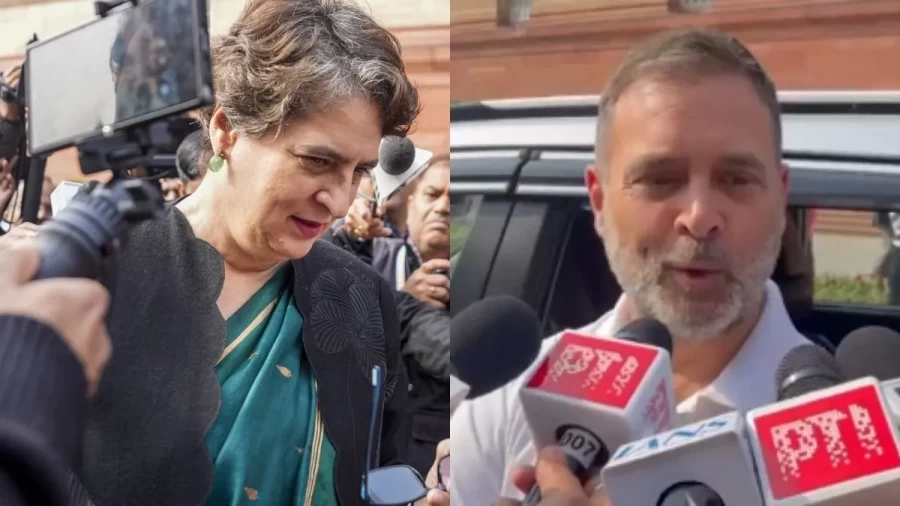
Top Congress leaders Rahul Gandhi and Priyanka Gandhi Vadra have launched a scathing attack on the central government over the newly introduced VB-G RAM G Bill. They've labeled the bill as detrimental to rural India and have raised serious questions about the government's intentions behind its introduction and hurried passage, while rahul Gandhi has explicitly called the bill 'anti-village,' while Priyanka Gandhi has expressed deep concern over the process of its swift approval and the government's apparent reluctance to discuss critical issues like pollution in Parliament.
Accusations of Undermining MGNREGA
Rahul Gandhi has unequivocally stated that the VB-G RAM G Bill isn't a 'revamp' of the Mahatma Gandhi National Rural Employment Guarantee Act (MGNREGA), but rather a bill designed to abolish the guarantee of the right to employment. He alleged that the Modi government has effectively 'ended MGNREGA in one day' through this legislative move. MGNREGA, widely recognized as one of the world's most successful poverty alleviation and empowerment programs, has historically served as the backbone of the rural economy, providing crucial employment to millions of impoverished individuals. According to Rahul Gandhi, this new bill will Notably weaken this vital scheme, thereby diminishing the strength of rural India, particularly impacting Dalits, Other Backward Classes (OBCs), and Adivasis who rely heavily on such support systems.
Impact on Labor Laws and Centralization of Power
Rahul Gandhi, the Leader of Opposition in the Lok Sabha, further accused the central government of weakening labor laws through the VB-G RAM G Bill. He asserted that the government is attempting to strip away the rights of laborers in rural India. Gandhi also claimed that Prime Minister Modi's ultimate objective is to weaken the working class and centralize power. He argued that the bill would erode the autonomy of rural India and local empowerment initiatives, concentrating all authority in the hands of the central government, while this centralization, he believes, would reduce grassroots participation and control, leading to a less responsive and less equitable system for rural communities.
Questioning the Bill's Passage Process
Priyanka Gandhi Vadra has raised serious questions regarding the procedure adopted for passing the VB-G RAM G Bill 2025 in Parliament, while she highlighted that despite the parliamentary session running for an extended period, the government chose to introduce crucial bills in the final days, allowing very little time for discussion and scrutiny. Priyanka Gandhi described this 'rush' as 'suspicious,' emphasizing that such significant legislation, which impacts the lives of millions, shouldn't be passed in haste without adequate deliberation and debate. The opposition's demand to refer the bill to a standing committee was reportedly rejected, leading to its passage without thorough review, a move that undermines democratic legislative processes.
Demand for Discussion on Pollution
Priyanka Gandhi also expressed her disappointment over the lack of parliamentary discussion on pressing and immediate issues such as pollution, while she questioned why, when the nation is grappling with a major challenge like pollution, there couldn't be a debate on it in Parliament. Priyanka Gandhi argued that such critical matters demand comprehensive discussion, where all perspectives should be heard to formulate effective and holistic solutions. She stressed that Parliament should actively engage in debates on issues of public interest rather than solely focusing on the hurried passage of bills, thereby neglecting its broader responsibility to address national concerns.
Flaws in the Bill and Impact on MGNREGA's Structure
Priyanka Gandhi elaborated on the specific shortcomings of the VB-G RAM G Bill. She explained that the original MGNREGA scheme was designed with the central government contributing 90% of the funds, making it the backbone of the rural economy and a primary source of support for the extremely poor who struggled to find employment. For two decades, it has been one of the successful schemes that has genuinely helped impoverished individuals, especially those with no other means. However, Priyanka Gandhi warned that the new bill proposes significant cuts to central funding, which state governments will be unable to bear, while this, she concluded, would effectively lead to the demise of the scheme, causing severe negative repercussions on the livelihoods of millions in rural areas.
Opposition's Stance and Government's Approach
Rahul Gandhi further reiterated in his tweet that the law was forcibly passed in Parliament without any proper scrutiny. The opposition's plea to send the bill to a standing committee was dismissed, a move that he criticized strongly. Rahul Gandhi asserted that this law affects millions of laborers in rural areas and shouldn't have been pushed through without public debate. He viewed this as a direct affront to democratic principles and the. Spirit of public interest legislation, where transparency and thorough review are paramount.
Conclusion of the Parliamentary Session
These strong statements from the Congress leaders come as both the Lok Sabha and Rajya Sabha were adjourned sine die on Friday, marking the conclusion of the Winter Session 2025 of Parliament. The opposition has consistently questioned the process of passing crucial bills during the final days of the session, and the VB-G RAM G Bill stands as a prime example of legislation that has drawn significant objections and criticism from the Congress party.
#WATCH | दिल्ली: कांग्रेस सांसद प्रियंका गांधी वाड्रा ने कहा, "यह बिल गरीब लोगों के लिए बहुत नुकसानदायक होने वाला है, क्योंकि मूल MGNREGA योजना को जिस तरह से बनाया गया था - उसमें केंद्र सरकार 90% कोष देती थी, वह ग्रामीण अर्थव्यवस्था की रीढ़ थी और बहुत गरीब लोगों के लिए सबसे बड़ा… https://t.co/e5xCSatHhY pic.twitter.com/tZ5R3X1fHU
— ANI_HindiNews (@AHindinews) December 19, 2025
