

- India,
- 16-Mar-2026 08:45 AM IST


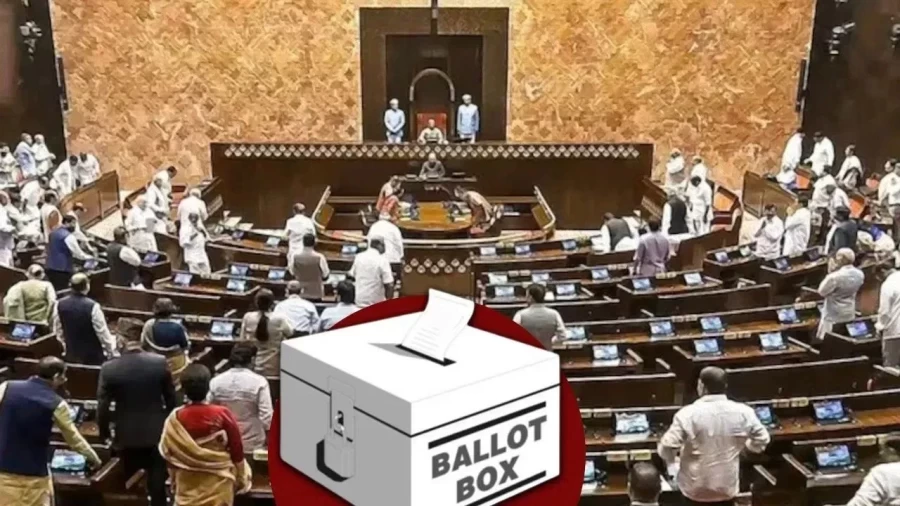
The voting process for 11 vacant seats in the Rajya Sabha, the Upper House of Parliament, has officially commenced today in Bihar, Odisha, and Haryana. According to the Election Commission, polling began at 9 AM and will continue until 4 PM. The counting of votes is scheduled to start at 5 PM, with results expected to be announced later this evening. In this biennial election cycle, a total of 37 seats across 10 states were up for election, of which 26 candidates have already been declared elected unopposed. The remaining 11 seats are being contested due to the presence of additional candidates beyond the available vacancies.
According to election officials, prominent leaders elected unopposed include former Defense Minister Sharad Pawar, Union Minister Ramdas Athawale, Abhishek Manu Singhvi, Vinod Tawde, and Babul Supriyo. However, in Bihar, Odisha, and Haryana, the number of candidates exceeds the seats, leading to high-stakes battles. Political parties in these states have issued whips to their legislators and held multiple rounds of meetings to ensure party discipline and prevent potential cross-voting.
Political Dynamics and Contests in Bihar
In Bihar, polling is underway for 5 Rajya Sabha seats with 6 candidates in the fray. Based on the numerical strength of the 243-member state assembly, a candidate requires 41 first-preference votes to secure a win. The ruling National Democratic Alliance (NDA) currently holds the support of 202 MLAs, while the opposition Mahagathbandhan has 35 MLAs. Chief Minister Nitish Kumar, who is moving to the Rajya Sabha after leading the state for over two decades, is a key candidate. Other NDA candidates include BJP National President Nitin Nabin, Upendra Kushwaha of Rashtriya Lok Morcha, Ramnath Thakur of JDU, and Shivesh Kumar of BJP.
According to political analysts, the NDA is comfortably placed to win 4 seats but faces a challenge for the fifth. After securing 4 seats, the NDA will have 38 surplus votes, falling 3 short of the 41 required for the fifth seat. Conversely, the Rashtriya Janata Dal (RJD) has 25 MLAs, and with allies, the Mahagathbandhan reaches 35. Their candidate, Amarendra Dhari Singh, needs at least 6 additional votes. In this scenario, the 5 MLAs of Asaduddin Owaisi's AIMIM and one independent legislator hold the key to the final outcome.
High-Stakes Battle for Four Seats in Odisha
Odisha is witnessing a contest for 4 Rajya Sabha seats with 5 candidates competing. According to the legislative arithmetic of the 147-member Odisha Assembly, each candidate needs 30 votes to win. The Bharatiya Janata Party (BJP) has 79 seats and the support of 3 independents, bringing their total to 82. The BJP has fielded Sujit Kumar and Manmohan Samal, whose victories are considered certain, while the party has also extended support to Dilip Ray as a third candidate.
The opposition Biju Janata Dal (BJD) has 48 MLAs and has fielded Santrupt Misra and Datteswar Hota. While Santrupt Misra has sufficient votes, the party needs to mobilize additional support for Datteswar Hota. The support of 14 Congress MLAs and 1 CPI MLA is crucial for the opposition camp. Just before the polls, the BJD directed its two suspended MLAs, Sanatan Mahakud and Arvind Mohapatra, to vote in favor of the party, intensifying speculations regarding the final tally.
Triple Contest for Two Rajya Sabha Seats in Haryana
In Haryana, 3 candidates are contesting for 2 Rajya Sabha seats, making it a triangular fight. In the 90-member Haryana Assembly, 31 votes are required for a win. The BJP, with 48 MLAs, is set to secure the victory of its first candidate, Sanjay Bhatia. Following this, the BJP will have 17 surplus votes. The BJP-backed independent candidate, Satish Nandal, will require 14 more votes to reach the winning threshold.
The Congress party has 37 MLAs, which is theoretically sufficient for their candidate, Karmveer Baudh. However, given Haryana's history of cross-voting in previous Rajya Sabha elections, the Congress remains on high alert. The stance of 2 MLAs from the Indian National Local Dal (INLD) and other independents could prove decisive. All parties have issued strict instructions to their legislators to remain present and follow official voting protocols.
Official Schedule for Polling and Vote Counting
The Election Commission has implemented stringent security measures at the legislative assemblies of all three states. The entire voting process is being videographed, and observers have been appointed to oversee the proceedings. As per the rules, legislators must show their marked ballots to their party's authorized agents before casting them to ensure transparency, while after polling concludes at 4 PM, the ballot boxes will be sealed, and counting will commence at 5 PM. The official declaration of results is expected by late tonight.
