

- India,
- 07-Jan-2026 05:30 PM IST


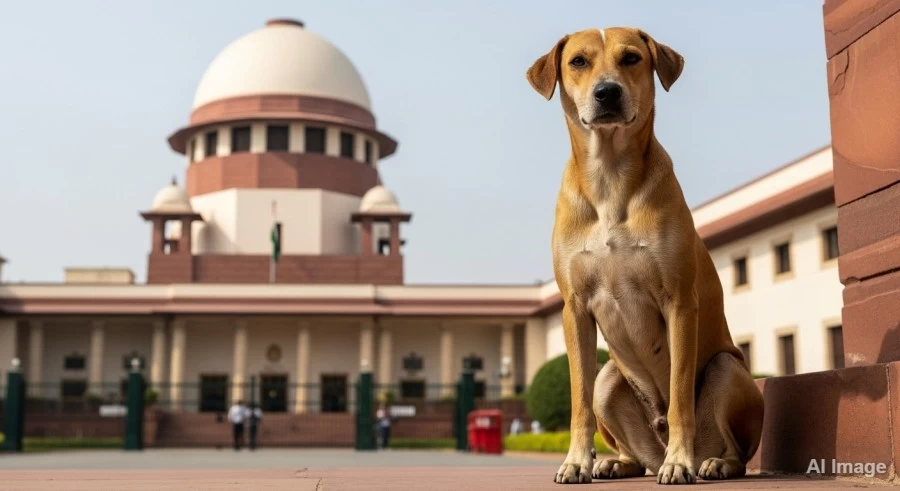
The Supreme Court on Wednesday heard a crucial case concerning stray dogs, expressing serious concerns about the ongoing public nuisance and safety risks, while the court questioned how long common people would have to endure problems caused by stray dogs. The hearing, which lasted for two and a half hours, saw various parties presenting their arguments. The bench explicitly stated that its order wasn't for roads in general, but specifically for institutional areas such as schools, hospitals, and court premises, emphasizing the need to remove dogs from these sensitive locations.
Supreme Court's Firm Stance on Institutional Areas
The apex court unequivocally questioned the necessity of stray dogs within the confines of schools, hospitals, and court campuses, while the bench raised strong objections to any resistance against removing these animals from such vulnerable environments, where children and adults are frequently present. The court highlighted the grim reality that people are being bitten, children are falling victim, and fatalities are occurring, making the presence of dogs in these areas unacceptable, while this firm stance underscores the judiciary's deep concern for public safety and welfare, particularly in places meant for learning, healing, and justice.
Debate on Solutions and Public Safety
During the proceedings, Senior Advocate Kapil Sibal, representing the interests of stray dogs, suggested that aggressive dogs could be sterilized. The court, however, responded with a touch of sarcasm, remarking that perhaps the only thing left to do was to provide 'counseling' to dogs so they wouldn't bite upon release, while sibal also asserted that he had never been bitten by a dog when visiting temples or similar places. To this, the Supreme Court retorted, 'You're lucky. People are being bitten, children are being bitten. People are dying. ' This exchange vividly illustrates the gravity of the issue and the contrasting perspectives on finding a viable solution.
Accident Risks and Implementation Failures
The court not only focused on the threat of dog bites. But also highlighted the significant risk of accidents caused by stray dogs. It pointed out that dogs running on roads can lead to serious mishaps, and it's impossible to predict the mood or behavior of a dog at any given time. Plus, the Supreme Court questioned the government on the inadequate implementation of the strict Animal Birth Control (ABC) directives issued in 2018. The court stressed that the public shouldn't suffer due to delays in enforcing these crucial regulations, underscoring the need for effective and timely execution of policies aimed at managing stray animal populations.
Startling Statistics on India's Stray Dog Population
Senior Advocate K. K. Venugopal presented comprehensive and alarming data regarding India's stray dog population. He revealed that the country is home to over 52. 5 million stray dogs. To manage this vast number, he detailed the immense infrastructure required: approximately 77,347 shelters, each. Capable of housing 200 dogs, with each dog needing 40 square feet of functional shelter space. The daily feeding cost for just 15. 4 million dogs was estimated to exceed 61 crore rupees. Venugopal also highlighted the practical challenges faced by educational institutions, noting that nearly 194,412 schools lack basic amenities like working electricity connections, proper toilets, and drinking water, making it financially unfeasible for them to allocate funds for fencing to control stray dogs.
Distinction Between Institutional and Public Spaces
Justice Mehta drew a clear distinction between institutional premises and public roads, reiterating that there is no justification for the presence of dogs within court campuses, schools, or hospitals, as these aren't public thoroughfares. Sibal argued that, according to existing rules, dogs must be released back. Into their original areas after sterilization, which would prevent institutions from becoming dog-free. He also contended that simply removing dogs wouldn't eradicate the population; instead, a scientific model, allowing dogs to age out over a decade, would be more effective, while however, the Supreme Court maintained its position, emphasizing that roads must be kept clear of dogs, not only to prevent bites but also to mitigate the risk of traffic accidents.
Next Steps in the Legal Battle
The hearing, which saw intense arguments and detailed presentations, will resume on January 8 at 10:30 AM. The Supreme Court carefully listened to all parties involved, signaling its commitment to finding a comprehensive and sustainable solution to this pressing issue, while this ongoing legal process represents a significant step towards balancing animal welfare with the paramount concern of public safety and well-being, particularly in sensitive institutional environments.
