

- USA,
- 30-Oct-2025 08:47 AM IST


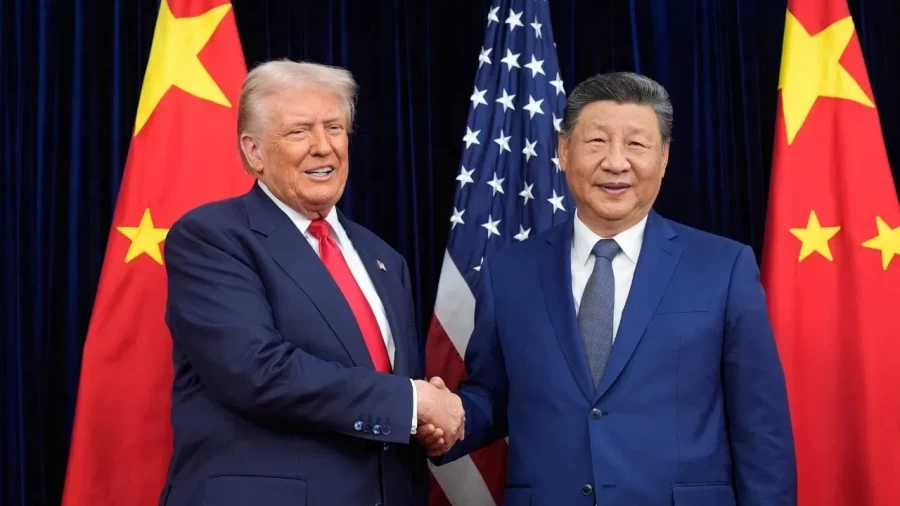
US President Donald Trump and his Chinese counterpart Xi Jinping held a crucial meeting in Busan, South Korea, on the sidelines of the Asia-Pacific Economic Cooperation (APEC) Summit. The meeting came at a time when the world's two largest economies, the United States and China, are entangled in a protracted trade war and tariff disputes. This was the first in-person encounter between the two leaders since 2019, drawing global attention. The meeting was widely seen as a significant opportunity to. Stabilize relations between the two nations and address pressing trade issues.
Trump Praises Xi's Negotiating Prowess
At the outset of the meeting, President Donald Trump lauded Chinese President Xi Jinping, calling him a 'tough negotiator. ' Trump stated, "Our meeting is going to be very successful, while he's a very tough negotiator, which isn't a good thing. We know each other well, while we've always had a very good relationship. " Trump further added that Xi is a great leader of a great country and expressed his hope for strong, long-lasting relations between the two nations. These remarks underscore a personal rapport and respect between the leaders, even amidst ongoing trade disagreements.
#WATCH | President of the United States, Donald Trump, holds a meeting with Chinese President Xi Jinping in Busan, South Korea.
— ANI (@ANI) October 30, 2025
(Source: US Network Pool via Reuters) pic.twitter.com/YG9BBDAzGt
#WATCH | While meeting Chinese President Xi Jinping in Busan, South Korea, US President Donald Trump says, "We are going to have a very successful meeting. He is a very tough negotiator, that is not good. We know each other well. We have always had a great relationship..."… pic.twitter.com/8sZ7R2d8LJ
— ANI (@ANI) October 30, 2025
Xi Jinping Emphasizes Stability in Relations
Chinese President Xi Jinping also expressed his pleasure at meeting Trump, while he remarked, "President Trump, it's a great pleasure to see you, and it's good to see you again because it's been several years. " Xi stressed that under their joint guidance, China-US relations have remained stable overall. He acknowledged that due to differing national circumstances, the two countries don't always agree, and it's normal for the world's two major economies to have differences from time to time. Jinping has publicly stated on multiple occasions that China and the US should be partners and friends, as history has taught them this lesson.
Signals of De-escalation in Trade Tensions
Both sides offered positive signals regarding the de-escalation of trade tensions before and during the meeting. US officials had indicated that Trump didn't intend to follow through on his recent threat to impose 100 percent additional tariffs on Chinese goods. Concurrently, China signaled its willingness to ease export controls on rare earth minerals and to purchase US soybeans. While en route to South Korea aboard Air Force One, Trump told reporters that he might reduce tariffs imposed on China earlier this year concerning its role in fentanyl production. These signals offer a glimmer of relief to the global trading community.
Key Issues and Strategic Omissions
Prior to the Busan summit, US and Chinese officials had met in Kuala Lumpur, after which China's top trade negotiator, Li Chenggang, announced an initial consensus had been reached, a point affirmed by US Treasury Secretary Scott Bassant. However, despite the cordial rhetoric, significant disagreements persist between Trump and Xi Jinping on various issues. Trump indicated that he had no plans to raise sensitive topics such as Taiwan's security with Xi. This suggests a strategic focus on trade-related matters for the time being, avoiding direct confrontation on other geopolitical flashpoints.
Crucial for Global Stability
This meeting between Trump and Xi Jinping could play a pivotal role in shaping the future trajectory of US-China relations. Harmonious relations between the world's two largest powers are crucial for global economic stability and peace. The summit could prove to be a significant step towards resolving complex trade ties and maintaining global stability, benefiting not only both nations but the entire world. While numerous challenges remain, this meeting has rekindled hope for continued dialogue and cooperation, while this is a critical juncture for international diplomacy and economic policy.
