
- India,
- 08-Nov-2026 03:02 PM IST



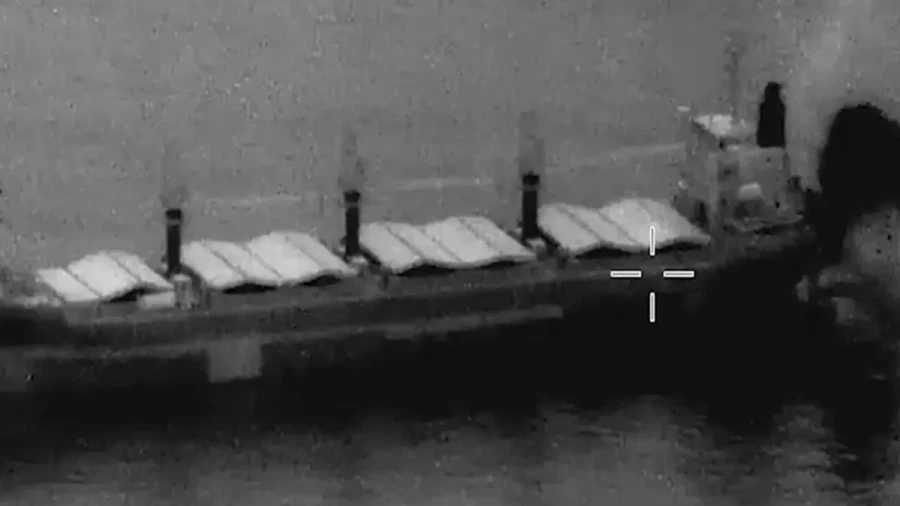
In a major and decisive military action, the United States military has launched an airstrike to completely neutralize a commercial cargo ship in the Gulf of Oman that was persistently attempting to breach an ongoing naval blockade. This high-profile development was officially made public by the United States Central Command, widely known as CENTCOM, while this intense maritime incident has once again brought the escalating tensions in the strategic waters of the Middle East and the uncompromising stance of the US military into sharp global focus. According to the official statements released by the United States military, the commercial cargo vessel attempting to break the blockade was flying the flag of St. Kitts and Nevis and was identified by authorities as the M/V Huda. This merchant ship repeatedly demonstrated blatant disregard for international maritime protocols and the strict naval blockade enforced by the US military, ultimately forcing American combat aircraft to execute this rigorous and targeted countermeasure.
The official statement issued by CENTCOM on Saturday confirmed that this destructive and calculated military action was successfully carried out by American forces on November 7. During the course of this targeted operation, a US military aircraft struck the stern—the rear section—of the St. Kitts-flagged cargo vessel M/V Huda with extreme precision. The primary objective of this calculated strike was to render the massive commercial ship completely incapable of further propulsion or movement, thereby preventing it from continuing its unauthorized voyage and piercing the naval blockade, while the strategic leadership of the US military firmly maintained that such strict enforcement measures are indispensable to uphold maritime law and deliver an unambiguous message to entities attempting to bypass established regional restrictions.
Prior to executing this aggressive and potentially lethal military strike, the US military ensured that adequate warnings were repeatedly issued to the personnel onboard, prioritizing civilian safety above all else. In its detailed operational report, the US military explicitly revealed that right before the strike was initiated, the civilian crew members onboard the vessel were issued strict instructions to immediately evacuate the specific sections of the ship that were designated as targets for the American aircraft, while this precautionary protocol was strictly implemented to ensure that no innocent civilian lives or crew members suffered any casualties or physical harm. Despite these clear, repeated, and urgent warnings issued by the American forces, the ship's operators and crew chose to completely ignore the directives and persisted with their dangerous attempts to violate the naval blockade.
Preliminary investigations and intelligence assessments released by the US military further revealed that this particular cargo ship had recently originated its journey after making a prolonged stop at an Iranian port. Following its departure from the Iranian port, the vessel aggressively attempted to navigate straight out of the designated regional waters, a move that the US military categorized as a direct and provocative challenge to its blockade enforcement operations. This direct association with an Iranian port, combined with the stubborn refusal to respect regional restrictions, compelled American military forces to resort to this harsh and uncompromising course of action. In the aftermath of this dramatic event, the US military issued a stern and unequivocal warning to all commercial ship operators, maritime shipping companies, and vessel captains operating in the region, instructing them to strictly comply with all directives issued by the US military when transiting through Iranian coastal waters and surrounding maritime lanes.
Elaborating on the broader statistics and scale of these enforcement operations, the US military command revealed that since the blockade enforcement initiatives began in July, a total of 147 commercial vessels have been intercepted mid-route and forced to alter their navigational paths. However, the scope of these operations has not been limited merely to rerouting compliant vessels; the US military has maintained an exceptionally aggressive posture against commercial ships that have explicitly refused to halt when ordered. According to official US figures, a total of five commercial ships that stubbornly refused to stop have now been completely neutralized to prevent them from engaging in similar illicit activities in the future. This extensive and unrelenting military campaign serves as concrete evidence that the United States is fully determined not to allow its strategic grip over Middle Eastern maritime routes to be undermined under any circumstances.
In addition to these commercial vessel interdictions, CENTCOM made another startling and significant disclosure by announcing that it has successfully destroyed a total of 10 commercial oil tankers belonging to Iran. According to verified intelligence assessments by the US military, all of these destroyed oil tankers served as critical and foundational components of the multi-billion-dollar maritime smuggling and economic network allegedly operated by Iran's Islamic Revolutionary Guard Corps, commonly known as IRGC. The elimination of these oil tankers has inflicted a massive, crippling blow to the clandestine financial infrastructure that was reportedly being utilized to fuel regional instability and sponsor illicit activities. This decisive American action is widely considered a cornerstone of the broader long-term strategy designed to choke off Iran's financial lifelines and systematically degrade its military projection capabilities.
To further reinforce and tighten this multifaceted military and strategic encirclement against Iran, the United States Central Command has announced another major policy initiative, while cENTCOM has officially declared the establishment of a brand-new task force specifically dedicated to disrupting and dismantling Iran's alleged overland and ground transport network. The core mandate and primary objective of this specialized task force will be to decisively halt the illicit supply of advanced weaponry, dual-use technologies, and restricted materials destined for Iran. Through this solid and comprehensive measure, the United States aims to escalate strategic and diplomatic pressure on Iran's entire military supply chain, thereby restricting its capacity to project power or expand destabilizing activities across the wider regional theater.
This intense maritime incident and the subsequent military strike also underscore the reality that the Gulf of Oman and its surrounding strategically vital chokepoints have remained major flashpoints of extreme geopolitical tension over the past several months. Earlier this year in October, another commercial vessel flying the Panama flag, identified as the MT On Peace, came under a devastating projectile attack while transiting through the highly sensitive Strait of Hormuz located near the coast of Oman. During that shocking assault, a total of 12 crew members onboard the vessel sustained severe injuries, with 11 of those injured individuals belonging exclusively to Indian nationality. Official details concerning that serious maritime incident were formally shared by India's Ministry of External Affairs, highlighting the deep international concerns surrounding the safety and security of commercial navigation routes in the Middle East, while the latest airstrike by the United States and its unrelenting crackdown on blockade-violating vessels clearly indicate that geopolitical and military frictions in this volatile region are likely to persist, leaving a profound impact on the global shipping and maritime trade industry.