

- भारत,
- 20-Apr-2026 09:57 AM IST


North Korea has sparked concerns across South Korea, Japan, and the United States by conducting cluster bomb warhead missile tests for the second consecutive day. Amidst the breakdown of the ceasefire between Iran and the US and the looming threat of intensified conflict, Pyongyang launched dangerous ballistic and cluster missiles on both Sunday and Monday. The Kim Jong Un administration claimed this marks the second time this month that ballistic missiles equipped with cluster bomb warheads have been test-launched.
Supervision by Kim Jong Un and Kim Ju Ae
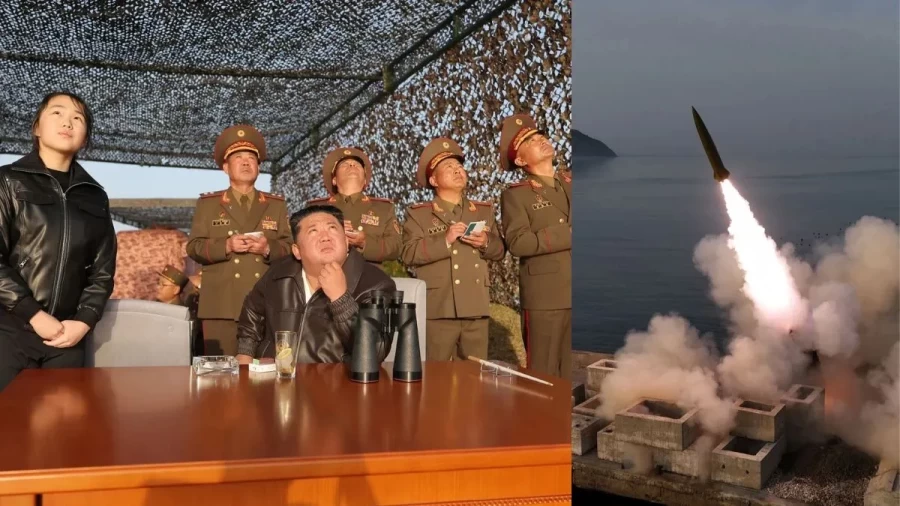
According to the Korean Central News Agency (KCNA), multiple ballistic missiles were launched from North Korea's east coast on Sunday, which were detected by South Korean, Japanese, and US authorities. This was followed by the launch of cluster bomb warhead missiles on Monday. KCNA released images showing North Korean leader Kim Jong Un and his teenage daughter, Kim Ju Ae, both dressed in black leather jackets, observing the launch. The projectiles were seen moving over the water, leaving trails of brown smoke. South Korea's intelligence agency recently assessed that Kim Ju Ae is likely being positioned as Kim's successor.
Technical Specifications of Hwasong-11 Ra Missiles
KCNA reported that Kim Jong Un monitored the launch of five upgraded surface-to-surface Hwasong-11 Ra ballistic missiles equipped with cluster bomb and fragmentation mine warheads. The missiles successfully hit an island target, while expressing satisfaction with the launch, Kim stated that these tests are crucial for military operations aimed at increasing high-density attack capabilities. 2 acres) into ashes.
Lethality and International Status of Cluster Munitions
Cluster bomb warhead missiles are designed to explode at high altitudes, scattering dozens of small bomblets over a wide area, making them extremely difficult to intercept. While more than 120 countries have signed an international treaty banning the use of cluster munitions, North Korea, Iran, Israel, and the United States aren't among the signatories. Experts suggest that the ongoing conflict involving Iran may have motivated North Korea to demonstrate its cluster munition capabilities and accelerate the development of improved cluster weaponry.
North Korea is currently intensifying efforts to acquire advanced weaponry, including multi-warhead nuclear missiles, hypersonic weapons, and submarine-launched ballistic missiles.
