
- India,
- 10-Jul-2026 08:22 AM IST



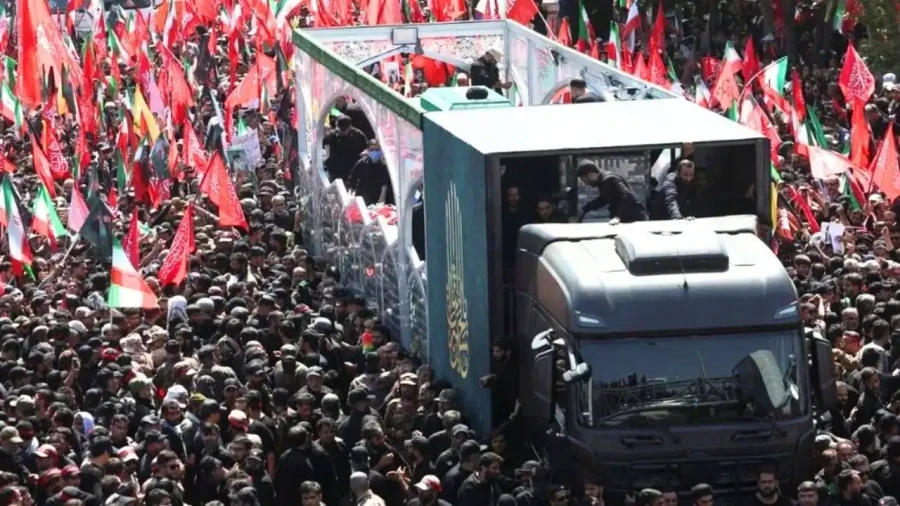
Ayatollah Ali Khamenei, the Supreme Leader who governed Iran for approximately 37 years, has been laid to rest in his hometown of Mashhad. The burial took place following months of intense conflict that was initiated by a series of airstrikes by the United States and Israel on 28 February. Khamenei's death marked a significant turning point for the nation, as he was the second ruler in the history of the country to be interred in the city of Mashhad. The funeral proceedings were marked by massive public mourning and intense anti-Western sentiment, with millions of Iranians gathering to pay their respects while chanting slogans against the United States and Israel.
Historical Context of the Burial in Mashhad
The decision to bury Ayatollah Ali Khamenei in Mashhad carries deep historical significance. He's only the second Iranian ruler to be buried in this city; the first was Nader Shah, who was interred there in 1747 after being assassinated following a reign of approximately 11 years. The funeral process began on Saturday, leading to a total shutdown of the capital, Tehran, and other major cities across Iran, while authorities ordered the closure of roads, restricted airspace, and suspended all everyday activities to accommodate the massive crowds. These citizens gathered to pay tribute to a leader who had led the country for decades and maintained a stance of fierce resistance against Western powers.
Fresh US Airstrikes and Regional Retaliation
The burial occurred amidst a sharp escalation in military activity. Early Thursday morning, the United States launched a new wave of airstrikes against Iran. In response, Tehran targeted Middle Eastern nations that are allies of the United States. This exchange of fire has severely threatened the interim agreement that was designed to end the war in the Middle East. While previous attacks, including those just a day earlier, had already put the ceasefire at risk, the strikes on Thursday were notably larger in scale. In Bahrain, which serves as the headquarters for the US Navy's 5th Fleet, sirens were heard at least three times. Simultaneously, missiles were reported to have targeted locations in Kuwait and Qatar, further expanding the scope of the conflict.
Nuclear Plant Area Targeted and Trump's Warning
The conflict reached Jordan on Thursday afternoon, where sirens blared in areas housing US troops and aircraft. An Iranian official alleged that late Thursday night, the United States conducted an airstrike targeting the vicinity of Iran's only nuclear power plant. Reports of explosions also surfaced from various other parts of the country throughout the day, while these developments followed a statement by US President Donald Trump, who noted that recent Iranian attacks on vessels in the Strait of Hormuz signaled the end of the fragile ceasefire. Trump warned that if these attacks didn't stop, the conflict could escalate further, potentially involving multiple nations and disrupting the global energy supply, which is vital for the world economy.
Casualties and Military Interceptions
The human toll of the recent strikes has been heavy. According to the Iranian Ministry of Health, at least 14 people were killed and 78 others were injured during the two days of US airstrikes. Reports suggest that the majority of the deceased were members of the armed forces. In Kuwait, the military stated that one person was injured by falling debris after the country successfully intercepted three ballistic missiles, one cruise missile, and 10 drones. Bahrain also reported intercepting incoming attacks but didn't provide specific details. Meanwhile, Jordan's government spokesperson, Mohammed al-Momani, stated that all attacks from Iran were blocked. However, Iranian state television claimed that the Revolutionary Guard had fired missiles at US bases located in Jordan.
Impact on the Strait of Hormuz and Global Trade
The US military's Central Command announced that it had struck 90 targets within Iran, releasing footage of attacks on airport runways and missile launchers. The stated goal of these strikes was to further reduce Iran's ability to threaten the freedom of navigation in the Strait of Hormuz, while before the conflict began on 28 February, one-fifth of the world's oil and natural gas trade passed through this waterway. While traffic had increased following an initial agreement last month, the recent escalation poses a new threat. Data from Lloyd's List Intelligence showed that at least 576 ships passed through the Strait in June, compared to 233 in May. In June 2025, more than 3100 ships were recorded passing through the waterway, highlighting its critical importance to global trade.