

- India,
- 03-Nov-2025 04:00 PM IST


Traveling on highways using Fastag has become a common and essential practice, Importantly reducing the time spent at toll plazas, while this digital payment system allows vehicles to pass through toll booths without stopping, saving both fuel and time. However, with this convenience, certain challenges have emerged, particularly concerning the misuse and fraudulent use of Fastags. To address these issues, the government has issued a crucial new update for Fastag users, while now, not only KYC (Know Your Customer) but also KYV (Know Your Vehicle) verification has been made mandatory. This move aims to bolster the integrity and security of the Fastag. Ecosystem, ensuring a smoother and more reliable experience for all road users. KYV, which stands for 'Know Your Vehicle,' is a new and vital verification process initiated by the government to enhance transparency and security within the Fastag system. This process is specifically designed to curb fraud and misuse associated with Fastags. Just as the KYC (Know Your Customer) process confirms an individual's identity and address, the KYV process involves a thorough examination of your vehicle's identity and the details of its true owner. Its primary objective is to ensure that each Fastag is used exclusively on the vehicle for which it's registered, thereby preventing any form of misuse or misidentification. This ensures that a single Fastag isn't utilized for multiple vehicles or on a vehicle for which it isn't authorized, maintaining the integrity of the toll collection mechanism.
Why KYV is Crucial: Curbing Fraud
With the increasing popularity of the Fastag system, the potential for its misuse has also grown. In some instances, individuals might attempt to use one Fastag for multiple vehicles or use a Fastag on an incorrect vehicle, leading to revenue loss for toll authorities and irregularities within the system. KYV verification effectively helps to curb all such types of fraud. It firmly links each Fastag to its specific vehicle, ensuring. That the toll collection system remains entirely accurate and secure. This government initiative is expected to further strengthen trust in the digital payment system and ensure a smooth and secure experience for all road users. By establishing a clear and verifiable link between the Fastag and the vehicle, the system becomes far more solid against unauthorized usage.
Consequences of Non-Compliance
Following the government's mandate for KYV verification, any Fastag user who fails to complete their vehicle's KYV will face significant consequences. The most critical outcome will be the deactivation or suspension of their Fastag. A deactivated Fastag means that the vehicle will no longer be able to automatically pay tolls at toll plazas. In such a situation, vehicle owners will be required to pay the full toll amount in cash at the toll plaza, which won't only lead to wasted time but also contribute to longer queues at toll booths. This effectively defeats the primary purpose of Fastag, which is smooth transit at toll plazas, while So, it's extremely important for all Fastag users to complete their vehicle's KYV verification in a timely manner to avoid any inconvenience and ensure uninterrupted travel.
Required Documents for KYV
To successfully complete the KYV process, you will need several important documents that verify your vehicle's identity and ownership. These documents include a digital copy of your vehicle's RC (Registration Certificate), which serves as the primary proof of vehicle registration and ownership. On top of that, you will need the VRN (Vehicle Registration Number), which is the unique identification number of your vehicle. The chassis number is also a mandatory detail, embossed on the vehicle's frame, ensuring its specific identification. Finally, you will need to provide the details of your mobile-linked Fastag, to ensure that your Fastag is correctly associated with the appropriate vehicle, while the accuracy and availability of all these documents are crucial for the smooth and unhindered completion of the KYV process.
Mobile KYV Process: A Step-by-Step Guide
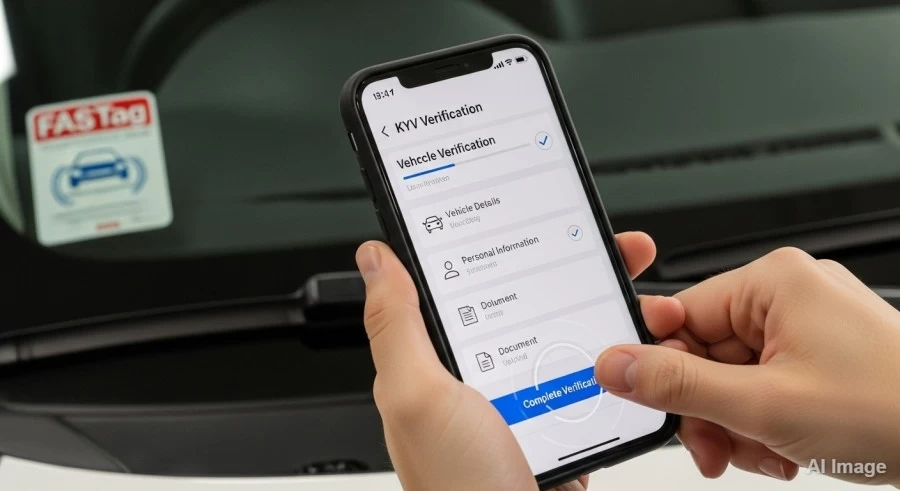
The KYV verification process has been made incredibly simple and convenient to complete via mobile. First, you need to open your respective banking app (the bank linked to your Fastag) or the official Fastag app, while within the app, you will need to search for the relevant option by typing 'KYV' or 'FasTag Verification' in the search bar. Once the option is found, you must carefully follow the on-screen instructions to initiate the process. During this process, you will be required to upload clear photos of. Your vehicle from different angles to ensure comprehensive identification of the vehicle. One specific photo must clearly show that the Fastag is correctly affixed to the vehicle's windshield. Along with this, you will also need to upload a scanned copy of your vehicle's RC (Registration Certificate). After filling in all the necessary details and uploading the photos, you will need to click on the 'Submit' or 'Send' button. This streamlined process ensures that both your vehicle and Fastag are properly verified.
Processing Time and Status Tracking
Once you've submitted all the necessary information and documents for KYV verification, the process typically takes approximately 7 days to complete. During this period, the relevant authorities will review and verify the information and documents you've provided. You will receive regular updates regarding the status of the process. This information will be sent to your registered email address or via SMS, keeping you informed about the progress of your application. On top of that, you will also be able to easily check the status of your KYV verification by logging into your banking app or the Fastag portal app. This feature helps users keep track of their application status and be prepared for any further necessary actions, ensuring transparency throughout the verification period.
Conclusion: A Step Towards Smoother and More Secure Toll Travel
The government's decision to make Fastag KYV verification mandatory is a significant initiative aimed at making the Fastag system more secure, transparent, and efficient, while this won't only help in preventing fraud and misuse of Fastags but also ensure that every vehicle has a valid and correctly registered Fastag. By completing this process, vehicle owners won't only avoid potential. Inconveniences but also contribute to strengthening the country's digital payment system. This step is expected to promote easy movement at toll plazas and provide a better experience for all road users, solidifying the benefits of digital toll collection across the nation.
