
- India,
- 25-Nov-2026 07:34 PM IST



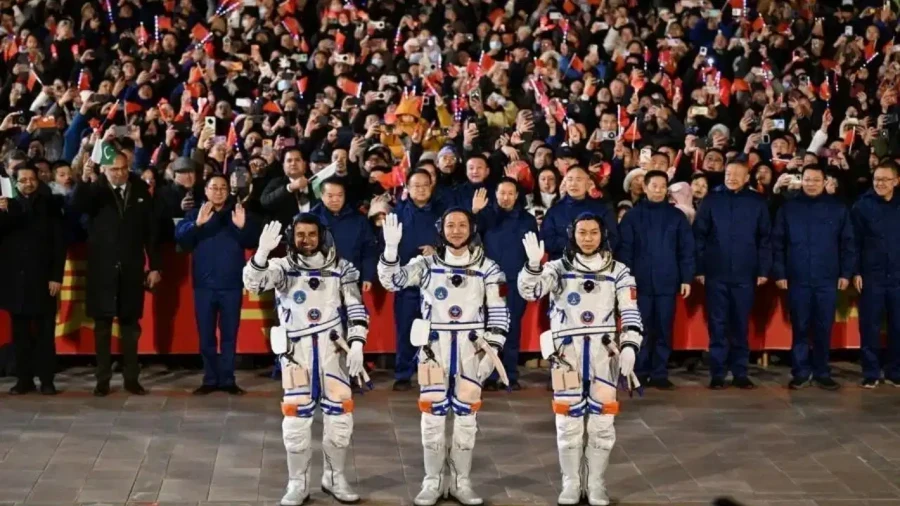
A new and historic chapter has been added to the world of space science, where China's Shenzhou-24 space mission has become a major topic of discussion. Through this mission, Pakistan's first astronaut has departed for China's Tiangong space station and successfully arrived there. According to China time on the morning of November 25, Pakistani astronaut Zeeshan Ali reached the Tiangong space station, accompanied by other members of the Chinese crew. Zeeshan is the first Pakistani citizen to have this historic achievement registered in his name, and he has now successfully reached Earth's orbit. Zeeshan will stay at the Tiangong space station for a maximum of 10 days and will return via the Shenzhou-23 spacecraft, while he reached space via the Shenzhou-24 spacecraft.
Shenzhou-24 and Pakistani Astronaut Zeeshan Ali
China's Shenzhou-24 spacecraft was launched on November 25, 2026, from the Jiuquan Launch Center. This spacecraft successfully docked with Tiangong about three and a half hours after taking flight. Muhammad Zeeshan Ali, aboard this spacecraft, has become the first Pakistani astronaut in history to reach Earth's orbit. He's participating in the mission as a payload specialist. He's the first official Pakistani citizen who has managed to reach Earth's orbit successfully. Before him, Namira Salim had traveled to space in 2023 via a suborbital flight, but her spacecraft didn't enter Earth's orbit, making Zeeshan Ali's achievement completely distinct and unique.
How Big Is China's Tiangong Space Station and How Was It Built?
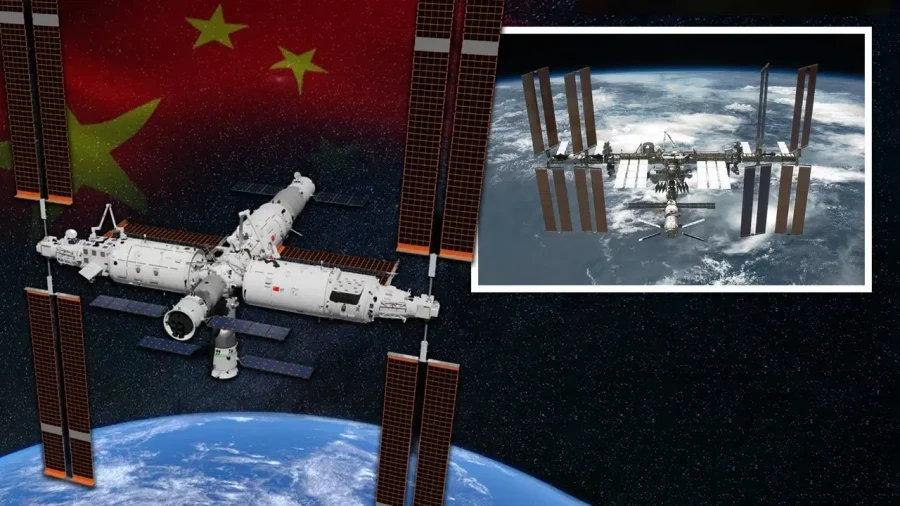
On this historic occasion, it becomes very interesting to understand just how large China's Tiangong space station is in size and how different it's from the International Space Station, known as the ISS. The biggest and primary difference between the two space stations is that the Tiangong space station has been built entirely by China alone, whereas the International Space Station has been built collectively by multiple countries around the world. Located about 400 kilometers above the Earth's surface, both space stations are continuously used for scientific experiments and long-term human missions.
The construction of the Tiangong space station began in Earth's orbit on April 29, 2021, when China launched its first core module named Tianhe. In July 2022, the Wentian laboratory was sent, and in late October 2022, the Mengtian laboratory was dispatched. Both laboratories were connected in orbit to the already present Tianhe module and attached to its two sides, while thus, by the end of 2022, the three-module core structure of the station was fully ready. It's noteworthy that China had previously sent two test laboratories named Tiangong-1 and Tiangong-2, whose names are similar to the current station, but they weren't part of this existing and modern station.
Structure and Features of Tiangong's Three Modules
China's Tiangong space station looks like the English letter T when viewed in space. Right in the middle is the Tianhe module, where all the vital systems controlling the space station and the main living quarters for the crew are located. 2 meters. Also, the Wentian module features advanced facilities for conducting scientific experiments along with an airlock, allowing astronauts to step outside for spacewalks, while this module also provides backup for some of the core systems of the central module. The third part of Tiangong, Mengtian, has comprehensive facilities to conduct experiments both inside and outside the station, and its separate cargo airlock is used to send equipment outside or bring them back inside.
Maximum Capacity of Six People and Spacecraft
According to the China Manned Space Agency, the total mass of all three core modules of Tiangong is about 66 metric tons. There is about 110 cubic meters of living space available inside. Normally, three astronauts reside at this space station at a time. However, when a new crew arrives and the old crew has not yet returned to Earth, up to six people can stay together for a short period. Shenzhou series spacecraft are used to bring and take away the crew, while Tianzhou cargo vessels deliver equipment, fuel, and other essential materials to the space station.
Construction and Design of the International Space Station (ISS)
On the other hand, speaking of the International Space Station or ISS, its construction happened in a very different way. The very first module of the ISS, named Zarya, was launched into space in November 1998. Shortly after, the American Unity module was attached to it. In November 2000, the first long-term crew arrived at the ISS, and humans have continuously lived on the station ever since. The main construction work of this massive space station continued until 2011, although new parts have continued to be added even after that. Major global institutions such as the United States, Russia, Japan, Canada, and the European Space Agency have had active participation in its construction and smooth operation. Its large parts were transported to orbit through separate space flights and then connected together with the help of astronauts and robotic tools.
The International Space Station houses state-of-the-art laboratories like America's Destiny, Europe's Columbus, and Japan's Kibo. On top of that, Canada's robotic arm named Canadarm2 helps handle heavy equipment outside the station and safely attach some cargo vehicles to the station. Large solar panels installed on the ISS provide continuous power supply. Inside, there are special sleeping quarters for astronauts, exercise facilities to keep the body fit, and a special windowed section called the Cupola, from where astronauts can sit and view our Earth and the outer parts of the station.
Key Differences in Size, Orbit, Mass, and Crew
If compared in terms of mass and size, the International Space Station is much larger than the core structure of China's Tiangong space station, while the mass figure of the ISS, which is about 420 metric tons, is excluding visiting spacecraft. Its massive 109-meter span includes the entire external structure with large solar panels. The habitable space inside the ISS is about 388 cubic meters, which is nearly three and a half times larger than the approximately 110 cubic meters of habitable space in China's Tiangong. Regarding the crew, typically seven astronauts live simultaneously on the International Space Station, while this normal number is three on China's Tiangong space station. However, there is no major or notable difference in the altitude of both.
The International Space Station is situated at an average altitude of about 400 kilometers and takes approximately 90 minutes to complete one orbit of the Earth. On the other hand, China's Tiangong space station is specifically designed to operate within an altitude range of 340 to 450 kilometers. Both of these space stations are established in low Earth orbit, where the space station and everyone inside it constantly fall together towards the Earth while orbiting it. Due to this wonderful scientific condition, astronauts always experience weightlessness or microgravity in space.
What Kind of Scientific Research Takes Place on Both Space Stations?
In the field of space science, both of these stations are utilized for extremely crucial scientific research. On the International Space Station, intensive studies are primarily conducted on how long-term living in space affects the bones, muscles, and other internal systems of the human body. Also, experiments on plant growth and various new space technologies are continuously carried out on the ISS. On the other side, in the modern laboratories of China's Tiangong space station, research can be performed meticulously on life sciences, materials science, and the behavior of fluids in microgravity conditions. The biggest advantage of both space stations is that scientists can easily run such complex experiments continuously for days or months, which would be extremely difficult to conduct in the exact same way inside a laboratory on Earth.