

- India,
- 14-Feb-2026 02:10 PM IST


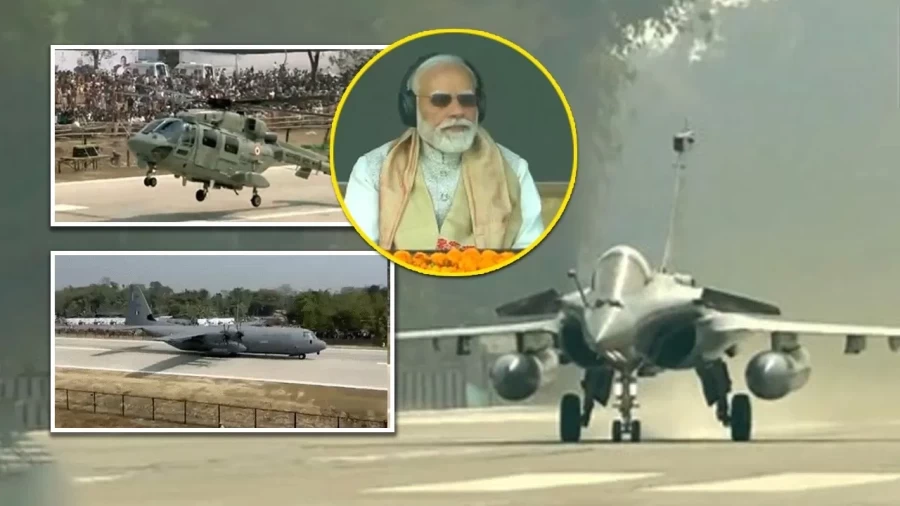
Prime Minister Narendra Modi on Saturday inaugurated India's first Emergency Landing Facility (ELF) on the Moran Bypass in the Dibrugarh district of Assam. In a historic display of infrastructure integration, the Prime Minister arrived at the site aboard an Indian Air Force (IAF) C-130J Super Hercules transport aircraft, which landed directly on National Highway-127 (NH-127). Upon his arrival at the Chabua airfield earlier, he was received by Assam Governor Lakshman Prasad Acharya and Chief Minister Himanta Biswa Sarma. The inauguration marks a pivotal moment in India's efforts to strengthen its strategic capabilities in the Northeast region.
The visit to Assam also saw the Prime Minister launching and laying the foundation stones for multiple development projects valued at over ₹5,500 crore. The event at Moran featured a comprehensive air show by the IAF, showcasing the operational readiness of the country's aerial defense. For approximately 40 minutes, the Prime Minister witnessed a series of maneuvers involving fighter jets, transport aircraft, and helicopters, highlighting the easy coordination between civil infrastructure and military requirements.
Historic Landing of C-130J Super Hercules
The highlight of the event was the landing of the C-130J Super Hercules on the designated highway stretch. Prime Minister Modi boarded the aircraft from the Chabua Airfield to reach the Moran ELF. This was the first time a Prime Minister has landed on a national highway in a military transport aircraft in this region. Following the landing, the IAF conducted a series of drills. A Rafale and a Sukhoi-30 fighter jet performed touch-and-go maneuvers on the airstrip, while a Dornier aircraft successfully took off from the same facility. The display emphasized the facility's capability to handle diverse aircraft types under various operational conditions.
Technical Specifications of the Moran ELF
4 km long stretch of NH-127. Designed to meet stringent military standards, the airstrip is capable of supporting the weight and landing requirements of heavy transport planes and high-speed fighter jets. The project is a result of a collaborative effort between the Ministry of Road Transport and Highways (MoRTH) and the Indian Air Force. While the stretch will remain open for regular vehicular traffic under normal circumstances, it can be converted into a fully functional runway within a short timeframe during emergencies.
Strategic Significance for National Defense
According to defense officials, the establishment of ELFs across the country is a strategic move to prepare for potential two-front security challenges. These facilities provide the IAF with alternative operating bases in case primary airfields are compromised during a conflict. The Moran ELF is particularly significant due to its proximity to the international borders in the Northeast, while it enhances the military's ability to mobilize troops and equipment rapidly. The integration of such facilities into the national highway network ensures that the country's logistics and defense capabilities remain resilient.
Dual-Use Utility for Civil and Military Aviation
Beyond its military applications, the ELF serves a critical role in civil aviation safety. It provides a secure landing option for commercial or private aircraft experiencing technical failures or fuel emergencies. The government's vision involves creating a network of such landing strips across India to bolster both national security and aviation safety. The Moran project serves as a blueprint for future infrastructure developments where highways are designed to serve dual purposes, maximizing the utility of public investments in infrastructure.
Regional Development and Infrastructure Growth
The inauguration of the ELF was accompanied by the unveiling of development projects worth ₹5,500 crore aimed at transforming Assam's landscape. These projects cover sectors such as healthcare, energy, and road connectivity. The Prime Minister emphasized that the development of the Northeast is central to the nation's progress. The synergy between the Ministry of Road Transport and the IAF in completing this project reflects a modern approach to nation-building, where infrastructure is designed to be both economically productive and strategically vital.
