
- India,
- 09-Jun-2026 08:21 AM IST



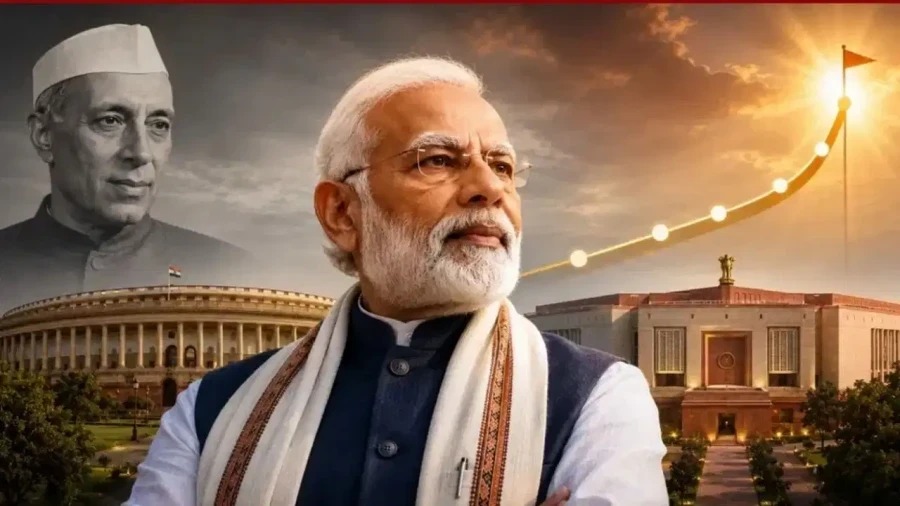
Pandit Jawaharlal Nehru established the dominance of the Congress party by winning three consecutive elections. Now, Narendra Modi has also achieved a hat-trick of victories, serving as the Prime Minister for the third time. PM Modi has provided a full majority at the national level to the BJP, a party that was previously struggling. He has extensively expanded the party, kept it in constant election mode, and made it the largest political party in the world. This reflects his extraordinary electoral achievements. As an elected Prime Minister, the discussion regarding Narendra Modi surpassing Pandit Nehru's electoral milestones is natural. Under Nehru's leadership, the Congress maintained its dominance from the center to the states by winning three consecutive elections. Interestingly, Narendra Modi is also the Prime Minister for the third time through a hat-trick of wins. Pandit Nehru was in power as the head of the interim government even before independence, at a time when the opposition's presence was merely symbolic.
The Contrast Between Nehru and Modi's Rise
On the other hand, in 2014, Modi was leading the BJP at the national level for the first time, a party that had never secured a full majority at the center before. In the 2004 elections, the party even lost its coalition government. Its performance in the 2009 elections was even more disappointing. Modi is credited with reviving the BJP during a difficult period and ensuring its widespread expansion. Pandit Nehru was one of the heroes of the independence struggle and came from a very wealthy family background. Under the protection of Mahatma Gandhi, Nehru's public and political life began as a front-line leader of the country. Just before independence, in the 1946 Central Assembly elections during the British era, Nehru was appointed Vice President of the Viceroy's Executive Council, a position equivalent to the Prime Minister. After independence on August 15, 1947, the provisional Lok Sabha accepted Nehru as the Prime Minister.
The Evolution of the Electoral Landscape
In the first general elections of 1951-52, Pandit Nehru entered the field while already holding the office of Prime Minister. In this election, the opposition mainly consisted of the Communists and parties whose leaders were part of the freedom movement but had become disillusioned with Nehru or the Congress after independence, while in terms of resources and organization, these parties were very weak compared to the Congress. The Bharatiya Jana Sangh was in its infancy. Nehru had his own aura along with the legacy of the Congress, which was the platform for every freedom lover. The expectations of the people, weary of long slavery, were high for their own government. Nehru continued this winning streak until the third election in 1962, maintaining the voters' hopes. However, by the time Narendra Modi entered central politics in 2014, 50 years after Nehru's death on May 27, 1964, the picture had completely changed. The dominance of the Congress began to break in 1967, and it was ousted from power in 1977. Although it returned in 1980 and won again in 1984, the era of coalition governments began in 1989. During the 1990s, four Lok Sabha elections were held in 1991, 1996, 1998, and 1999, leading to five changes in government.
Modi's Resilience and Strategic Breakthroughs
During this decade, BJP leader Atal Bihari Vajpayee took the oath as Prime Minister three times. He ran the government for 16 days the first time and 573 days the second time. His third government in 1999 proved to be a stable coalition. In 2004, he went to the polls early with the India Shining slogan, but voters rejected it. The BJP shrank from 182 seats in 1999 to 138 seats. In 2009, it fell further to 116 seats. In both these elections, UPA governments were formed under the leadership of the Congress, with Dr. Manmohan Singh as Prime Minister. By this time, Atal Ji had become almost inactive due to health reasons, and Advani Ji's aura had also diminished. The BJP was in a state of despair after two consecutive Lok Sabha losses and a decrease of 66 seats and 5 percent votes compared to 1999. However, a decision by the party in 2013 suddenly filled it with enthusiasm. Narendra Modi, who had been the Chief Minister of Gujarat since 2001, had made his national identity by then. Coming from a modest background and an economically weak family, Modi's life was full of struggle.
Breaking Myths and Expanding Horizons
Modi entered the BJP as an ordinary worker after being associated with the RSS as a Bal Swayamsevak. With his hard work and skill, he played a vital role in establishing the BJP's roots in Gujarat. He also left his mark on the party's central organization. As Chief Minister, the opposition constantly attacked him regarding his role in the 2002 Gujarat riots. He had to fight long battles from the political front to the Supreme Court, but he emerged clean on every front. Every attack made him stronger, while his ability to overcome every challenge created a large class of supporters and admirers from within the country to the diaspora living in distant lands. With Modi's entry into central politics, all equations suddenly changed. It's believed that the path to power at the center goes through Uttar Pradesh, which sends the maximum 80 members to the Lok Sabha. Saying "Mother Ganga has called me," Modi made Varanasi his parliamentary constituency and then created history in the 2014 Lok Sabha elections. The BJP rose from 116 seats in 2009 to 282 seats. 80 increased to 31 percent in this election.
The Era of Dominance and Global Recognition
For the first time in the 63-year long journey of the Bharatiya Jana Sangh and then the BJP, the party succeeded in forming a full majority government at the center. Modi didn't just bring victory to the BJP in this election; he also broke the 25-year record of no party achieving a majority at the center. Modi also broke the myth that it's mandatory to gain the support of Muslim voters for a majority at the center. Compared to Nehru's era, all definitions of electoral politics and conditions for success have changed in recent decades. Along with the race for wealth and resources, the information revolution has made challenges more severe, while in 2014, the BJP had governments in five provinces: Gujarat, Rajasthan, Madhya Pradesh, Goa, and Chhattisgarh. It was part of governments as a partner in Punjab and Andhra Pradesh. About 25 to 28 percent of the population was under these governments. But with Modi's rise, the BJP entered a new era, while the party, which relied on its traditional urban base and upper-caste supporters, expanded extensively among the backward classes, Dalits, and remote rural areas. Crowds chanting "Modi-Modi" joined the BJP. In the 2019 Lok Sabha elections, Modi's magic worked again. 3 percent.