
- India,
- 20-Jul-2026 02:44 PM IST



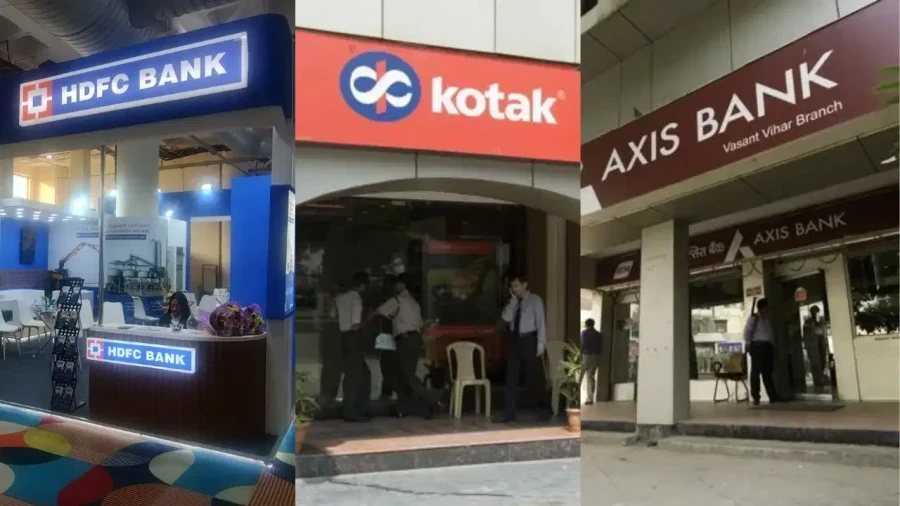
The Indian stock market witnessed a significant downturn in the private banking sector on Monday as investors engaged in a massive sell-off of shares belonging to industry leaders. HDFC Bank, Axis Bank, and Kotak Mahindra Bank were at the center of this financial storm, collectively losing more than 1 lakh crore in market capitalization. While the headline credit growth figures appeared promising, they were overshadowed by deeper structural concerns regarding profitability and the quality of growth. Investors, who were previously optimistic about credit expansion, shifted their focus toward the underlying margins and the sustainability of low-cost deposit franchises, leading to a sharp decline in stock prices.
The Scale of the Market Capitalization Erosion
The magnitude of the sell-off was reflected in the staggering loss of market value across the three major private lenders. Axis Bank emerged as one of the hardest-hit entities, with its share price tumbling by 6%. This sharp decline resulted in a reduction of approximately 25000 crore in the bank's total market capitalization. 56%, leading to a massive loss of nearly 65000 crore in market value. 51%, which translated into a loss of about 14000 crore. Collectively, these three banking giants saw over 1 lakh crore vanish from their market valuation in a single trading session.
ICICI Bank: The Notable Exception
Interestingly, the sell-off wasn't uniform across the entire banking sector. ICICI Bank stood out as a notable exception, with its shares actually gaining approximately 1% during the same period. This divergence suggests that investors weren't selling banking stocks indiscriminately, while instead, their decisions were driven by a careful evaluation of individual bank performance, specifically focusing on the quality of credit expansion and the ability to maintain healthy profit margins. The positive movement in ICICI Bank's stock indicates that the market is rewarding banks that demonstrate better management of their growth-to-profitability ratio.
Core Reasons Behind the Investor Anxiety
Several factors contributed to the sudden lack of confidence in these banking majors. One of the primary concerns is the pressure on Net Interest Margin (NIM), while nIM is the critical difference between the interest income a bank earns from loans and the interest it pays to its depositors and other fund providers. Despite rapid loan growth, the margins have come under significant stress. This is largely due to the changing composition of bank deposits. There has been a noticeable decline in Current Account and Savings Account (CASA) deposits, which are typically low-cost sources of funds for banks, while as these low-cost deposits weaken, banks are forced to rely more heavily on high-cost term deposits and external borrowings, which increases their overall cost of funds and squeezes their margins.
Corporate vs. Retail Lending Dynamics
Market analysts have pointed out a shift in the lending landscape that's impacting bank returns. While corporate lending is experiencing a strong surge, retail credit growth has not kept pace. Corporate loans, while high in volume, generally offer lower returns compared to retail loans. The current trend shows that corporate credit is being driven by increased demand for working capital and a shift where companies are moving away from bond market funding toward bank borrowings. Also, there has been a slight uptick in capital expenditure related to general business operations. However, the sustainability of retail growth and the timeline for margin recovery remain major points of concern for bank investors.
Expert Insights and Future Outlook
A review by Equirus Securities highlighted that most large private banks, with the exception of ICICI Bank, recorded a sequential decline in margins in the 'mid-teen' basis-point range. This decline was primarily attributed to the rapid increase in corporate loans and a narrowing of the spread, which is the difference between lending and borrowing rates, while brokerage firms are closely monitoring how long the current retail growth can be sustained and when the margins will begin to show signs of improvement. Also, leadership uncertainties in some of these institutions have added another layer of caution for investors, making them more sensitive to any signs of weakness in the quarterly performance data.